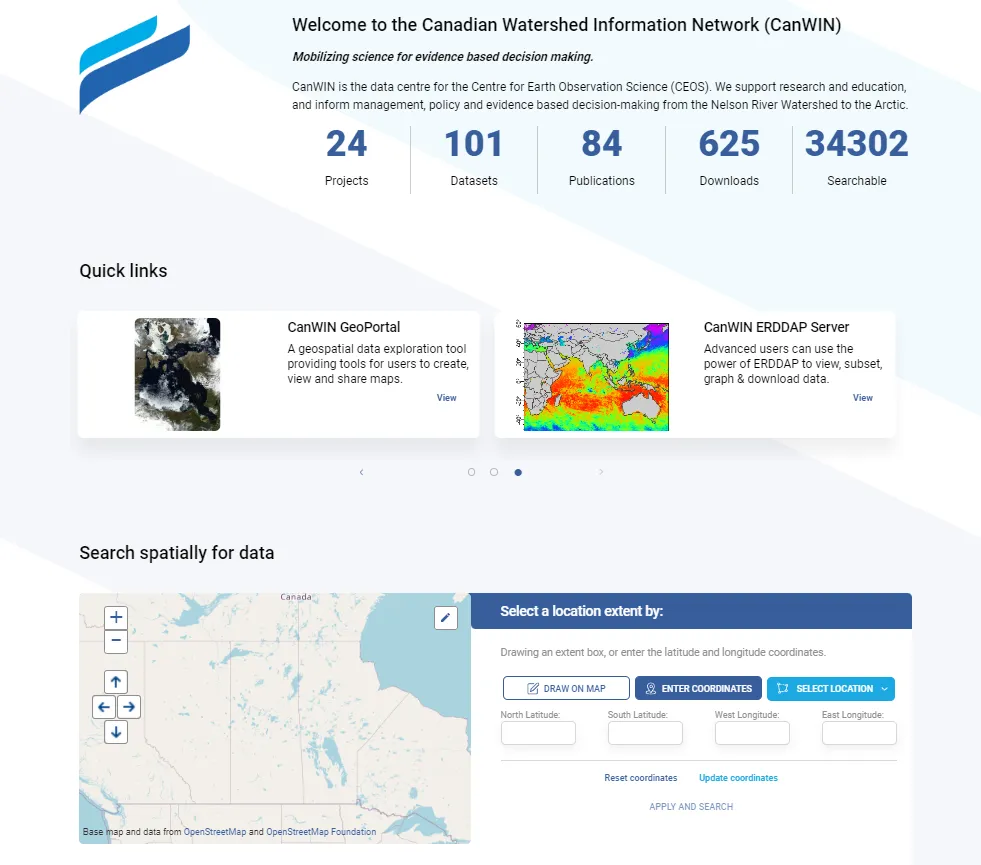
The Canadian Watershed Information Network (CanWIN) is a spatial research data infrastructure (SRDI) system hosted at the University of Manitoba and managed by the Centre for Earth Observation Science (CEOS). Created in response to growing environmental and water security concerns, CanWIN offers a platform for data management and exploration.
Link Digital addressed limitations in the original platform by streamlining data and implementing a comprehensive overhaul. Their solution leverages a combination of CKAN and Drupal. CKAN, utilizing Python, ensures user-friendly data discovery and minimizes redundant metadata. Drupal, a content management system, brings additional functionalities. The development process involved Link Digital's environment, followed by deployment to a staging area for testing before release.
CanWIN is part of the Canadian Consortium for Arctic Data Interoperability (CCADI) which fosters an Arctic Research Data Infrastructure (ARDI). This collaboration allows researchers to search data across partner repositories from a single location and facilitates analysis of multidisciplinary datasets.
Read the full case study: https://linkdigital.com.au/project/canadian-watershed-information-netwo…
About the project
Objectives
The original CanWIN database was developed by the federal government department Environment and Climate Change Canada (ECCC) to share freshwater research in the Lake Winnipeg Basin. The original database was created as a relational database using Visual Studio 2008, which ultimately was not able to capture and share the complexity of the multi-disciplinary data produced. After much consultation with users and data providers, we realised the CanWIN ecosystem required a non-structured database that was flexible, modular, had an easy-to-use user interface, was open-source and had good community development support.
In 2020, CanWIN had the opportunity to redevelop and redesign its current CKAN implementation to a) implement a distributed ecosystem consisting of multiple software platforms with CKAN as the central hub and b) redesign CKAN’s UI in line with the UM’s visual identity.
Challenges
The biggest challenge for CanWin was around showing the complex relationships between the data and the programs, sub-projects, facilities, instruments etc., the data is related to. In addition, data is collected, processed and packaged into datasets, publications or collections which contain a lot of metadata that is very useful to the data consumers and required for reproducibility. A key challenge and the initial focus of the redesign was on linking all these records in a way that allowed users to find all related information when searching and using the data, thereby minimising metadata duplication, and allowing users to view and download metadata in a human-readable format as well as make the metadata machine-readable so it is accessible to data aggregators like Google Dataset search. Another challenge was related to ensuring all these records are easily discoverable by users in a user-intuitive and easy way.
After engaging Link Digital, the collaboration between CanWIN and Link’s team began to address such challenges.
Solution
Link Digital completely overhauled the data portal and added a Drupal CMS component alongside CKAN. The development work was undertaken on Link Digital’s development environment, and then the overhauled portal was deployed to a staging environment for user acceptance testing before releasing it to production.
FAIR (findable, accessible, interoperable and reusable): The relationships between different types of datasets and their integration into the enhanced search bar and spatial display make the data findable, and providing the data in an open-access portal makes them accessible. Furthermore, creating detailed templates mapped to internationally recognised standards (e.g. schema.org and ISO-19115) and providing multiple export formats (human and machine-readable) makes the data accessible and interoperable. Finally, the creation of “data packages”, which provides users with a zipped package containing the data, the metadata in human and machine-readable formats and the data dictionary, along with any codebooks and cookbooks created, maximises the reusability of the data.
With the CKAN data portal now extended with a Drupal CMS, data custodians can feature and promote data and tell stories about the data. The CMS also connects users seamlessly to tools that visualise the datasets published on the portal.
Why Drupal was chosen
Link Digital completely overhauled the data portal and added a Drupal CMS component alongside CKAN. The development work was undertaken on Link Digital’s development environment, and then the overhauled portal was deployed to a staging environment for user acceptance testing before releasing it to production.