Sector(s)
Health First is a not-for-profit, integrated health system that has served Florida's Brevard County since 1995. It runs hospitals and outpatient services and operates its own insurer, Health First Health Plans.
That gives one website two audiences with very different jobs: patients looking for care, and members managing their coverage.
Winner, Healthcare category, International Splash Awards 2026, DrupalCon Rotterdam
Where we started
Vardot began with a discovery program on the live site: Hotjar feedback surveys, Semrush, Google Search Console, Google Analytics, task analysis, and a heuristic review against Nielsen's 10 usability heuristics.
Hotjar respondents reported:
- 2.9 out of 5 average ease-of-use rating
- 41% rated the site very difficult to use
- 91% did not find what they were looking for
- 86% rated search very difficult
- 70% found it very difficult to locate a doctor
- 91% found it difficult to find or pay for their insurance plan
- 1.4 out of 5 for reaching Login to Account and Pay My Bill
- 1.5 out of 5 for scheduling a lab appointment
The SEO audit found 690 pages without an H1, 130 missing meta descriptions, 48 duplicate meta descriptions, 18 duplicate title tag issues, and 29 images without alt text.
The challenge
One site was doing two jobs for two audiences. Patients looking for a doctor, a location, or a bill-pay link met navigation organized around hospital marketing. Health Plans members and prospects trying to enroll, find a covered provider, or download plan documents had to dig through healthcare content.
The header changed from page to page. Search ranked news articles above service pages. Every visitor had to work out which side of Health First they needed before getting anywhere.
Health First wanted a rebuild that served both audiences under one brand, live before the Medicare open enrollment window in October.
About the project
Goals
- Shorten the time to complete primary tasks: find a provider, find a plan, pay a bill, log in
- Give Health Care and Health Plans each a coherent experience under one brand
- Make the right page rank for the right search intent
- Move to Drupal 11, WCAG 2.1 AA, schema.org markup, and mobile-first design
- Give the marketing team a content model that scales
- Launch before Medicare open enrollment
What we did
- Discovery first We ran workshops with Health First's marketing, communications, and digital teams, and benchmarked navigation against peer healthcare and insurance providers. We audited the full site against usability heuristics, mapped tasks and flows for six priority journeys, and ran a full SEO audit. The six journeys: find a service, find a location, find a provider, access the member portal, shop a plan, and enroll as a broker. Every requirement in the build PRD traces back to a measured finding from this phase.
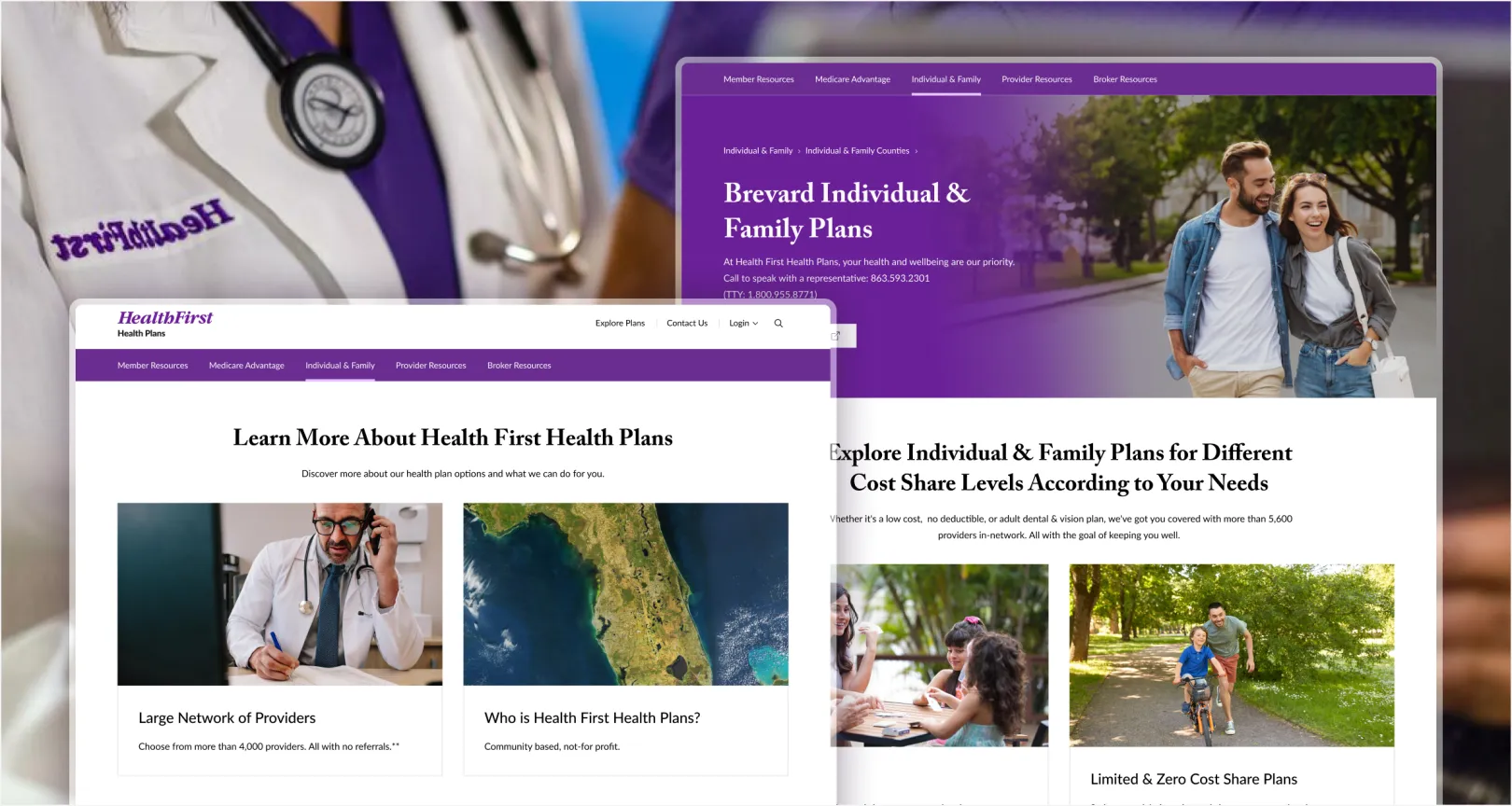
- Three structures tested We prototyped three site architectures: one unified menu, one site with a separate menu per audience, and two separate sites. Each was compared on CMS, user access, design, SEO authority, cost, scalability, and domains. Health First chose the middle option: one Drupal codebase and one domain, with a splash entry page at hf.org that routes visitors to Health Care or Health Plans. Each side has its own menu, content, and theming on a shared content model and editorial governance, and SEO authority stays on a single domain.
- Audience-led navigation We rewrote the sitemap. Navigation is grouped by audience (Member Resources, Provider Resources, Broker Resources) and by intent (Care & Services, Patient Resources, Your Wellness), with labels in plain language. Breadcrumbs are consistent across both experiences, and a menu position rule applied site-wide shows visitors where they are.
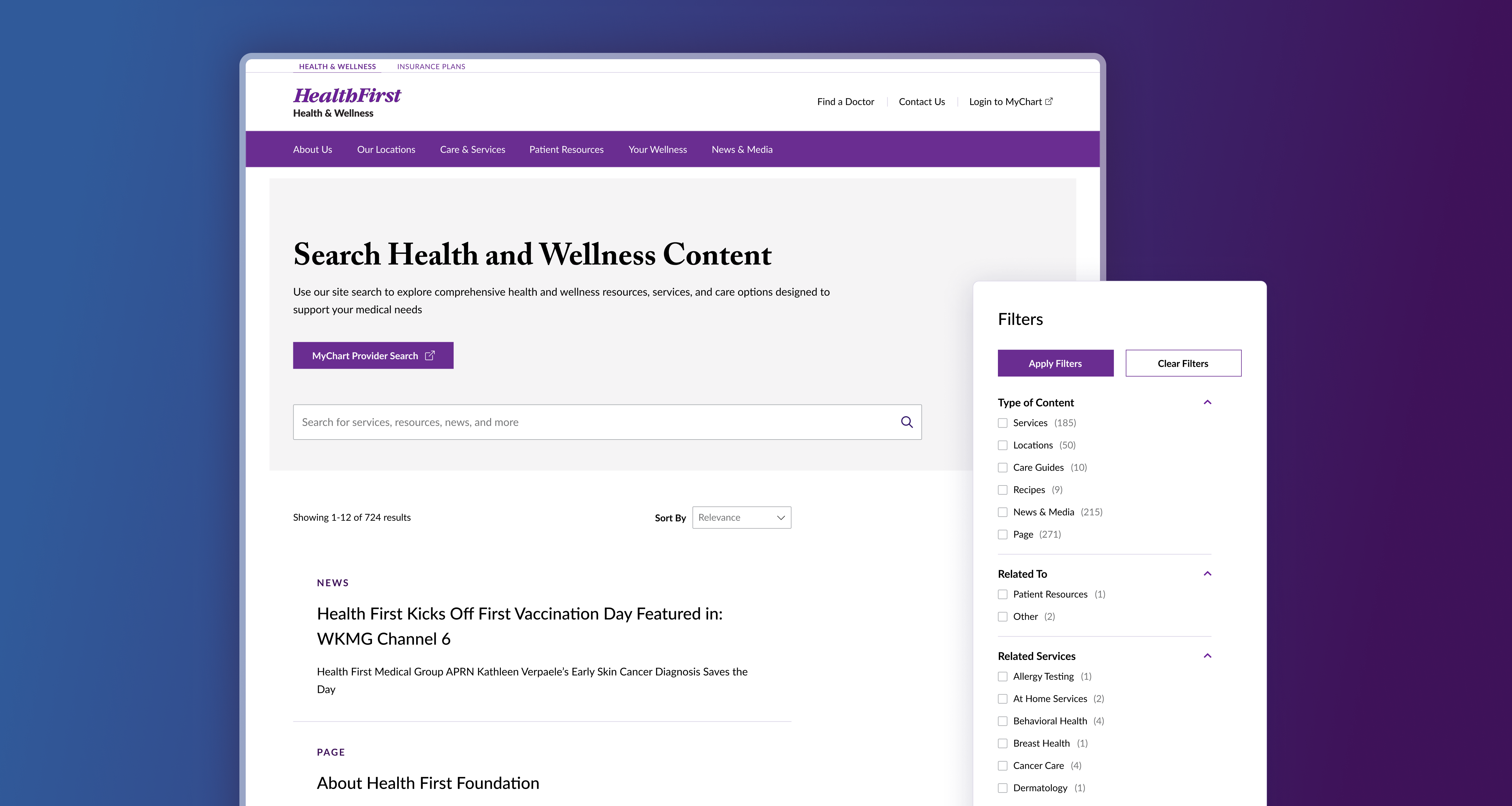
- Unified search The previous search ranked news above service pages, left Health Plans content out of its filters, and returned nothing for terms like "Login." The new site-wide search adds predictive suggestions, popular terms, visible filter chips, dedicated modes for locations, services, news, and documents, result cards tagged by content type, and better relevance ranking. It works the same way on both sides of the site.
- Documents and forms library Members used to hunt through tabbed accordions for plan documents, brochures, and forms. We built a filterable library as a Drupal view that pulls eligible documents from several content types. Filters cover plan type, document type, year, language, and benefit, with file type and last-updated date on each item, previews, and direct downloads.
- Cleaner content model We retired duplicate and deprecated content types (basic pages, landing pages, events, services) and added a dedicated Health Plan content type, which the old site lacked despite Health Plans being half the business. URL patterns are now standard. Each content type maps to a schema.org type (Article, Event, MedicalOrganization, Person, HealthPlan) so search engines can show rich results. Taxonomies were consolidated to five vocabularies: Article Type, Medical Category, Event Type, Facility Type, and Document Category.
- SEO fundamentals We fixed every issue from the audit: missing H1s, missing and duplicate meta descriptions, duplicate titles, and missing alt text. Title and meta description patterns are templated per content type, and structured data is generated automatically, so the same gaps cannot reopen. Local SEO, mobile performance, and page speed were part of the launch checklist.
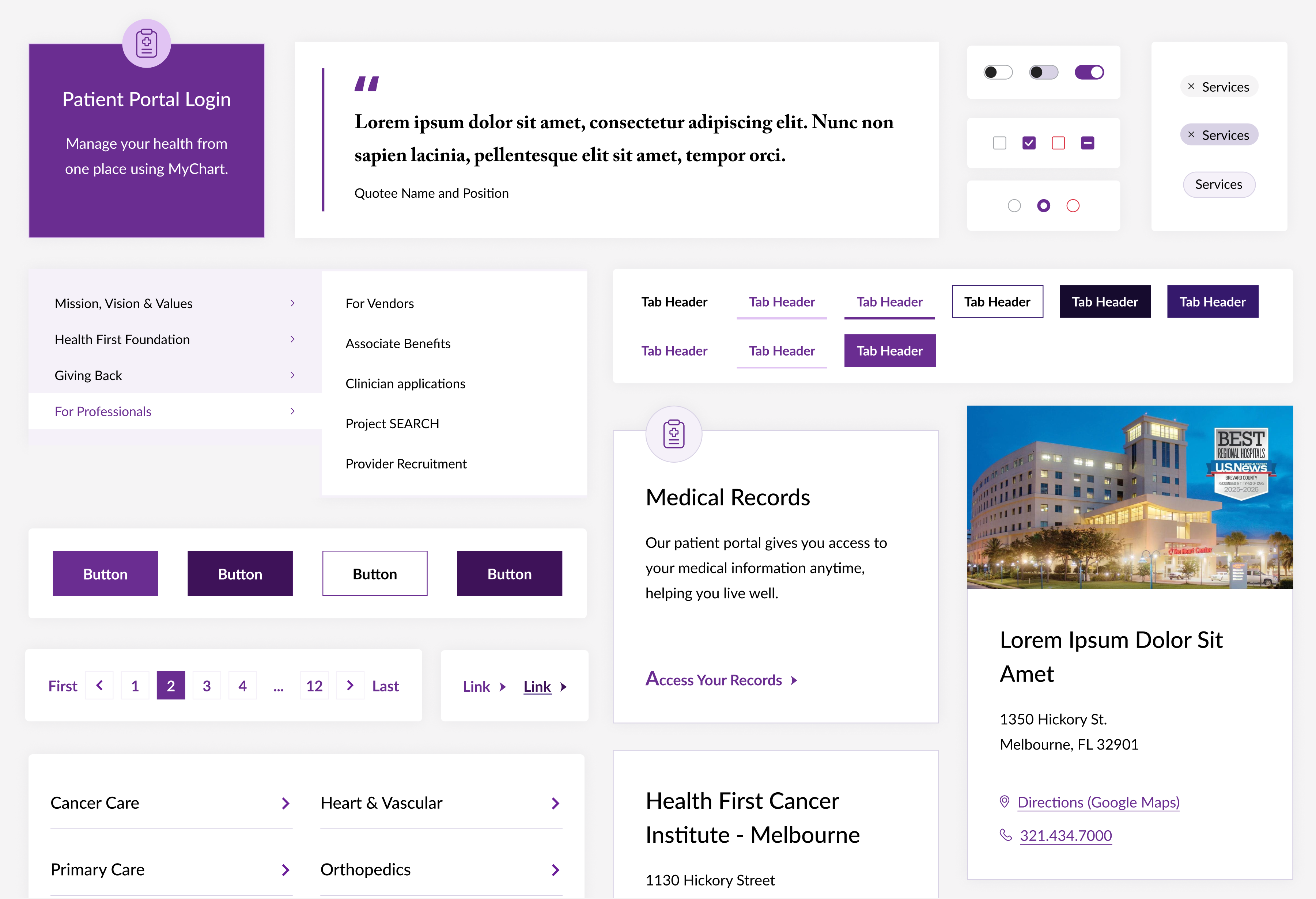
- Drupal 11 theme The new theme uses Drupal's Single Directory Components, with each component's template, styles, JavaScript, and configuration in one folder. The site moved to Drupal 11 at the same time. The design system includes a full block library, four layout principles (consistent heading hierarchy, simplified flow, contextual design patterns, mobile-first proportions), and redesigned media headers, payment paths, and care and plan landing pages.
- Accessibility built in The platform is built to WCAG 2.1 Level AA. Heading hierarchy, focus states, color contrast, alt text, keyboard navigation, and ARIA usage are defined in each component's specification.
- Content migration Eligible content moved automatically through the Migrate API. Vardot's team republished 50 priority items by hand where structure or sensitivity called for it, then trained Health First's editors, who uploaded the remaining content themselves.
Results
The new hf.org won the Healthcare category at the International Splash Awards 2026, presented at DrupalCon Rotterdam in September 2026. An independent jury judged entries on business cases, technology, concept and strategy, design and user experience, quality of execution, innovation, and community value.
What changed on the platform:
- One splash entry leading to two purpose-built experiences, on one codebase and one domain
- Health Plans products are first-class content, with their own content type and HealthPlan schema
- Site-wide search returns service pages ahead of news, with audience-aware filters
- A searchable Documents and Forms Library replaces tab-and-accordion hunting
- All audit issues closed (690 missing H1s, 130 missing and 48 duplicate meta descriptions, 18 duplicate titles, 29 missing alt text), with templates that keep them closed
- Built to WCAG 2.1 AA across the new theme
- A Drupal 11 codebase with SDC components, ready for continued iteration
The site launched ahead of Medicare open enrollment. Post-launch user metrics will be reported against the discovery baseline: ease-of-use rating, find rate, search ease, provider and plan task ease, primary-task ratings, and organic visibility for Health Plans pages.
Why Drupal was chosen
Health First needed one platform that could serve two distinct audiences under one brand, handle open enrollment traffic, give in-house editors real publishing control, and meet the accessibility and structured data expectations of a U.S. health system. Drupal covers all of this on a single codebase.
As open source, it also lets Health First keep evolving the platform without vendor licensing standing in the way.
Vardot brought experience as a Drupal Certified Partner at Diamond level and Varbase, its enterprise Drupal distribution, which shortened the path to a stable, secure baseline. Its discovery method tied design and engineering decisions to measured user behavior.
Technical Specifications
Drupal version:
Key modules/theme/distribution used: