The Department of Fisheries and Oceans Canada (DFO) is responsible for safeguarding Canadian waters and managing fisheries and oceans resources. Reporting lost fishing gear goes a long way to ensuring safe and clean waterways in Canada. The Lost Gear Reporting System supports commercial harvesters who are required to report lost gear to DFO, which helps the Department coordinate retrieval operations, return gear to owners, and collect data to prevent future losses.
Following the success of the initial web-based Lost Gear application, DFO recognized the need to provide a mobile-first solution that harvesters could use offshore, even without internet access. To address this, DFO partnered with DrupalBliss to design and develop a Progressive Web App (PWA)—a mobile-friendly, offline-capable reporting tool that integrates seamlessly with Drupal.
About the project
Progressive Web Application for Offline Access to Government Systems
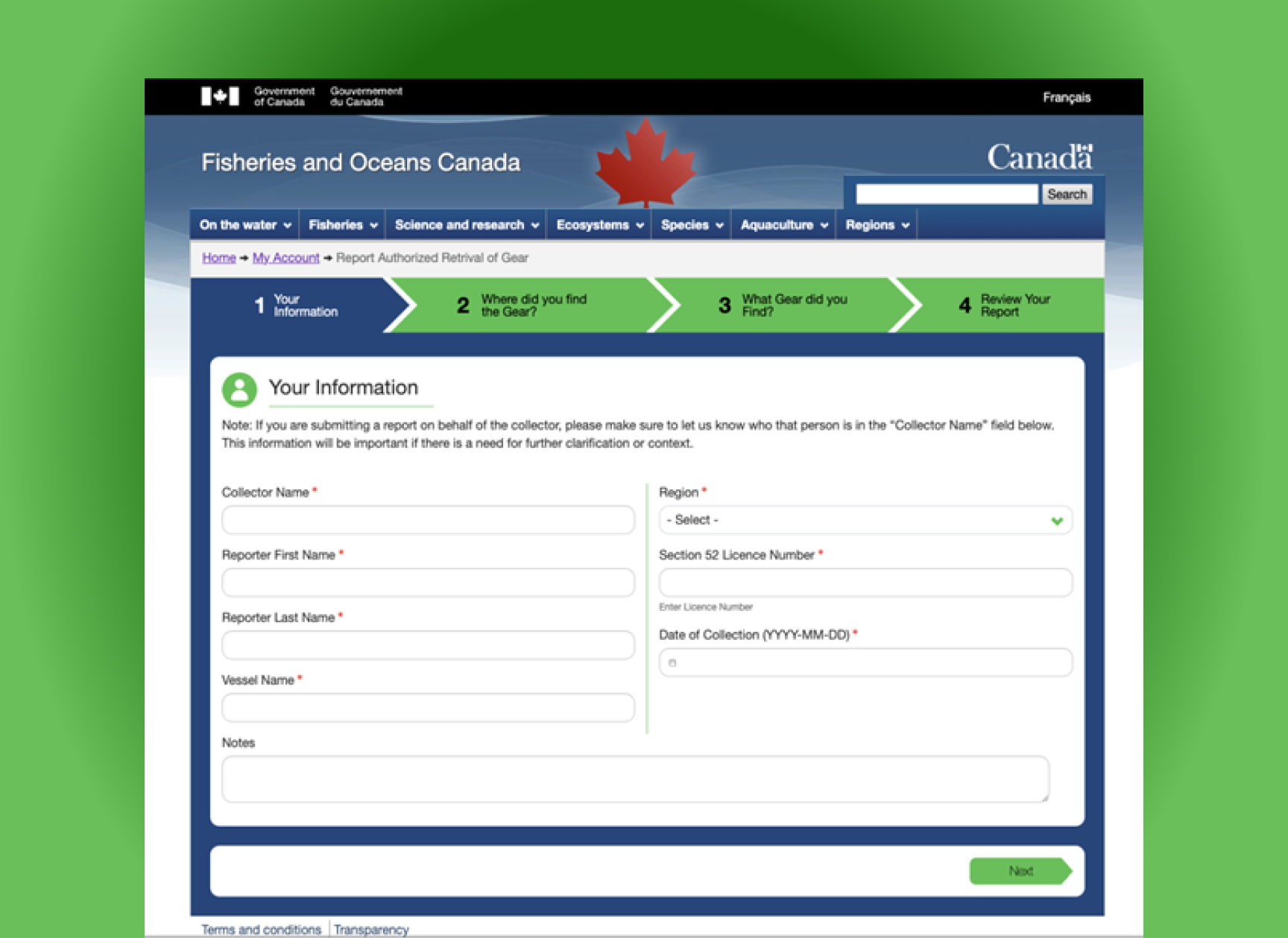
The project’s goal was to deliver a mobile-app for commercial harvesters and retrievers working offshore, where there is no internet access. A key objective was to ensure the application functioned seamlessly offline, allowing users to capture data and geolocation information without requiring connectivity. In addition,, the solution needed to comply fully with Government of Canada standards for accessibility, usability, and security.
To support both user needs and organizational requirements, the platform was designed to integrate seamlessly with existing Drupal Webform configurations and DFO internal systems via APIs. This ensured consistency across digital tools while reducing duplication of effort. The solution also emphasized scalability and reliability, with deployment planned in the Microsoft Azure cloud environment and supported by CI/CD pipelines to streamline ongoing updates and maintenance.
From a technical standpoint, the system was built on Drupal 11 with the Web Experience Toolkit (WxT) distribution, ensuring compliance with federal web standards. The mobile experience was delivered through a progressive web application (PWA) developed in Vue.js, leveraging an offline-first architecture. Native device features such as geolocation and offline storage were incorporated to enhance field usability, while APIs connected the platform to critical internal DFO systems, including CCM and LDAP, for secure authentication and data management.
Results
Operational Efficiency and Deep Integration with Internal Systems
The launch of the Lost Gear Reporting PWA marked a significant digital milestone for DFO. The solution received strong praise from commercial harvesters and gear retrievers, who finally had a reliable, intuitive way to report gear loss—even while offshore and disconnected from the internet.
By leveraging Drupal and modern PWA architecture, DrupalBliss delivered a tool that enhances operational efficiency, increases reporting accuracy, and supports DFO’s broader environmental and policy goals.
Why Drupal was chosen
Innovating Offline Capabilities for Remote Locations in Canada
Drupal 11 was selected thanks to its robust content modeling, API integrations, and modular architecture. The Government of Canada’s WxT distribution of Drupal ensured that accessibility, usability, and security standards were met from the ground up.
Drupal Bliss was engaged for its expertise in building high-performance, accessible, government-compliant digital solutions—and for its ability to deliver advanced integrations, including mobile PWA frameworks and Azure cloud deployment.
Technical Specifications
Drupal version:
Key modules/theme/distribution used: