Sector(s)
Team Members
Project Team
Organisations
Reading Room
NHS London
NHS Choices
Delib
Project Team
Adam Bushell
Barry McKaine
Cameron Wortlehock
Ching Man Leung
Dan Ashdown
Dilan Shah
Jamie Griffiths
Jessica Li Wan Po
Karen Haydon
Luke Haas
Mark Spires
Paul Goodman
Visit the site
Visit the siteOrganizations Involved
Community contributions
During development comments were made against bug reports for various community modules. Additionally we submitted code changes to the ‘model’ project (creating entities within the CMS).
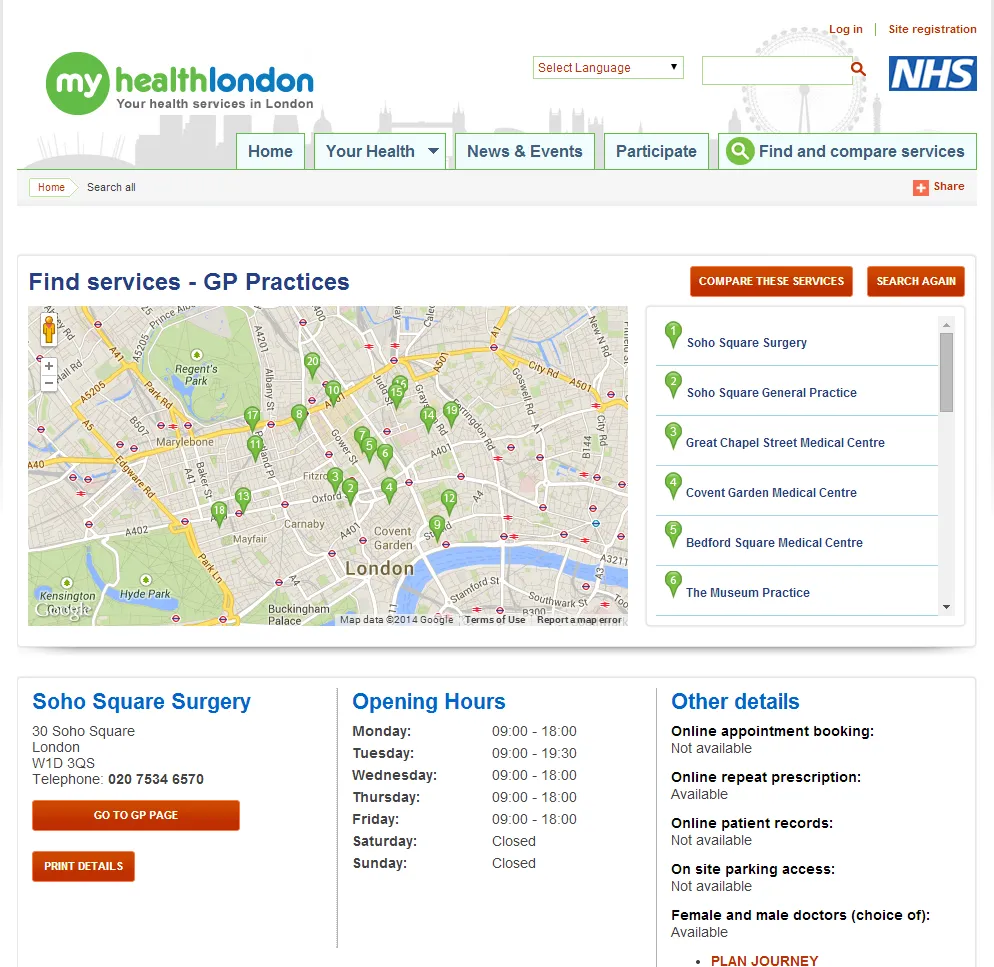
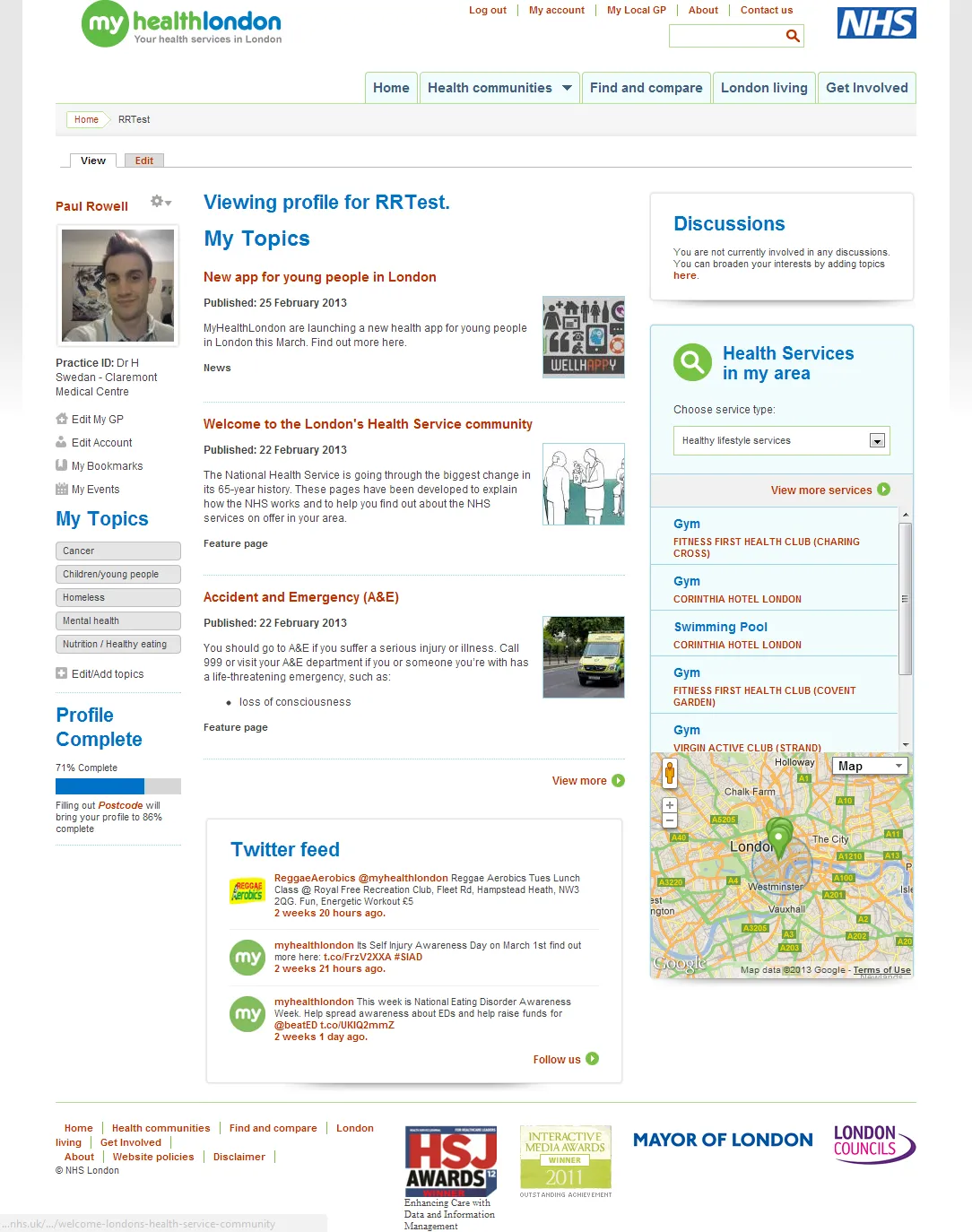
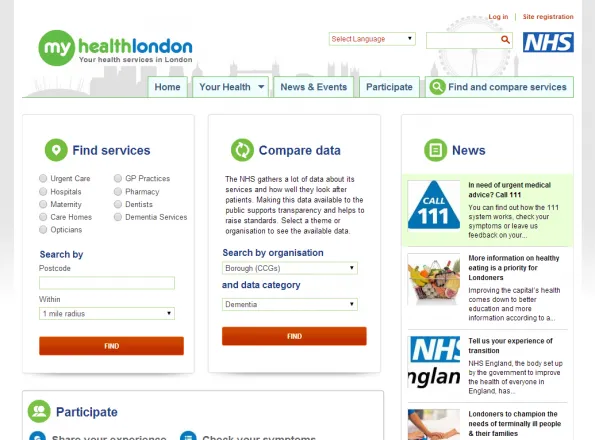
The project was designed to give Londoners a more transparent view of general practitioner physicians (GPs) and their data. Each of the 1500+ GP practices in London have a site within myhealth London, allowing them to display details about their practice, staff, and services as well as local news and events.
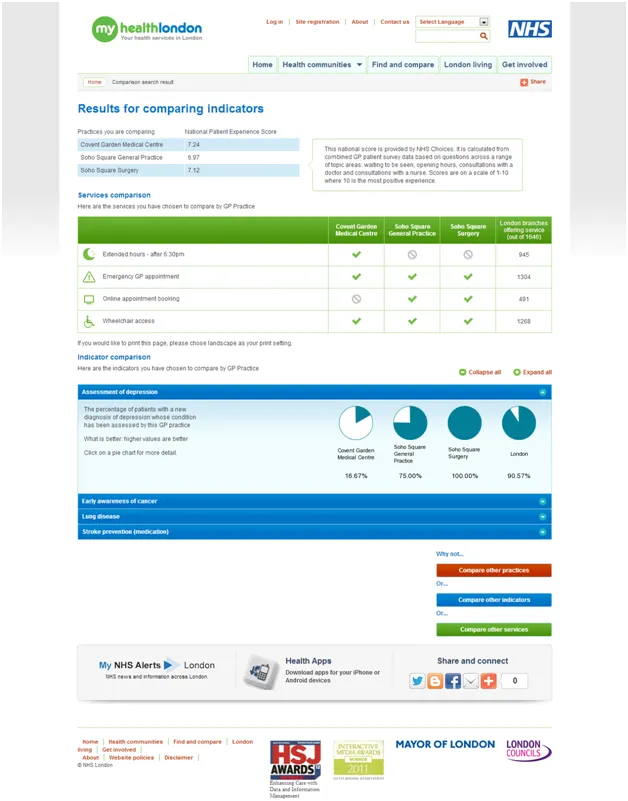
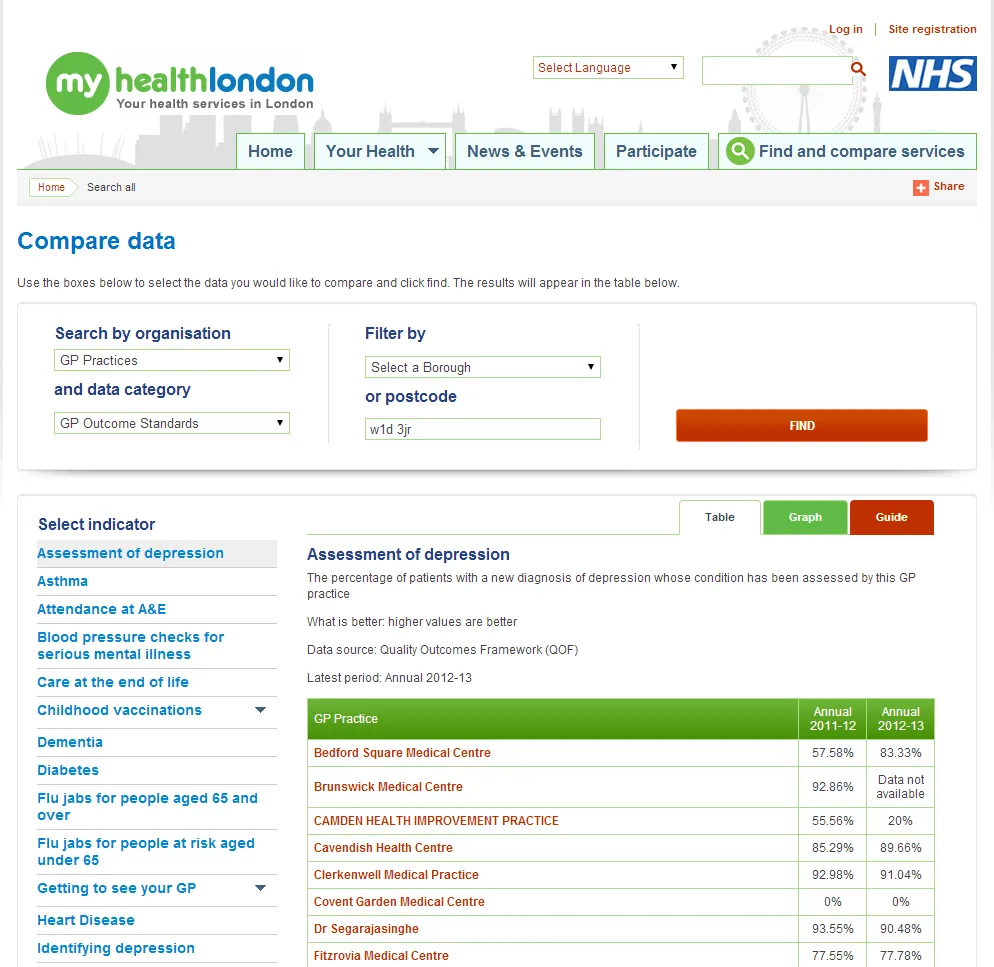
Each GP has Outcome Standards, indicators that show how well they’re doing in different areas of health (from how well they cope with asthma to stroke prevention). Users can search for their GP and compare them against others, viewing results as generated pie chart images.
About the project
The goals
The main goal was to make data more transparent to Londoners. Enabling users to browse how well a GP performs in certain areas and compare multiple GPs in order to ensure they are making the best decision for their health.
To achieve this we would provide each of the 1500+ GP Practices in London a central hub where they can display their practice details, including opening hours, staff details, services offered, local news and events, patient participation forums, surveys and other information they wanted to upload. Alongside this each GP has 26 indicators, each represented as pie charts, showing how well they performed in the latest period, and this would be the initial data users of the site could compare to gain a quick visual overview of GPs in their area.
The challenge
The first phase of this project had a build timeline of ten weeks. This would include the 1500+ GP ‘sub-sites’, data migration and the building of a comparison tool for 26 performance indicators. The success of this was due to an agile project run in sprints, tightly managed to enable us to meet the deadline when the site was launched by Mayor of London Boris Johnson on national television.
Data
A massive part of this site is data. The initial release meant we had to import data from GP Practices all across London. Additionally, we had to structure a user permissions system to allow GPs to manage their own data going forward.
The other immense piece of work involved GPOS (General Practice Outcome Standards) data; we had to create a way to display data in a visually-appealing and user friendly way. For this we decided to use the PHP charting library pChart. Using this we would retrieve data from a database to generate pie charts, outputting a GP score on an indicator. A detailed view was required to show the GP score over the last four data periods (quarterly or annually) as well as the GPs score against other GPs in the same borough. Working with different formats (percentage, ratio, and score out of x) as well as periods (quarterly or annually) provided an additional level of complexity to the process.
Working alongside NHS Choices we were the first to implement a two-way patient opinion feed. By embedding patient-submitted comments into each of the 1500+ GP pages we allow users to see what others have said about a particular GP and enable them to offer their own opinion.
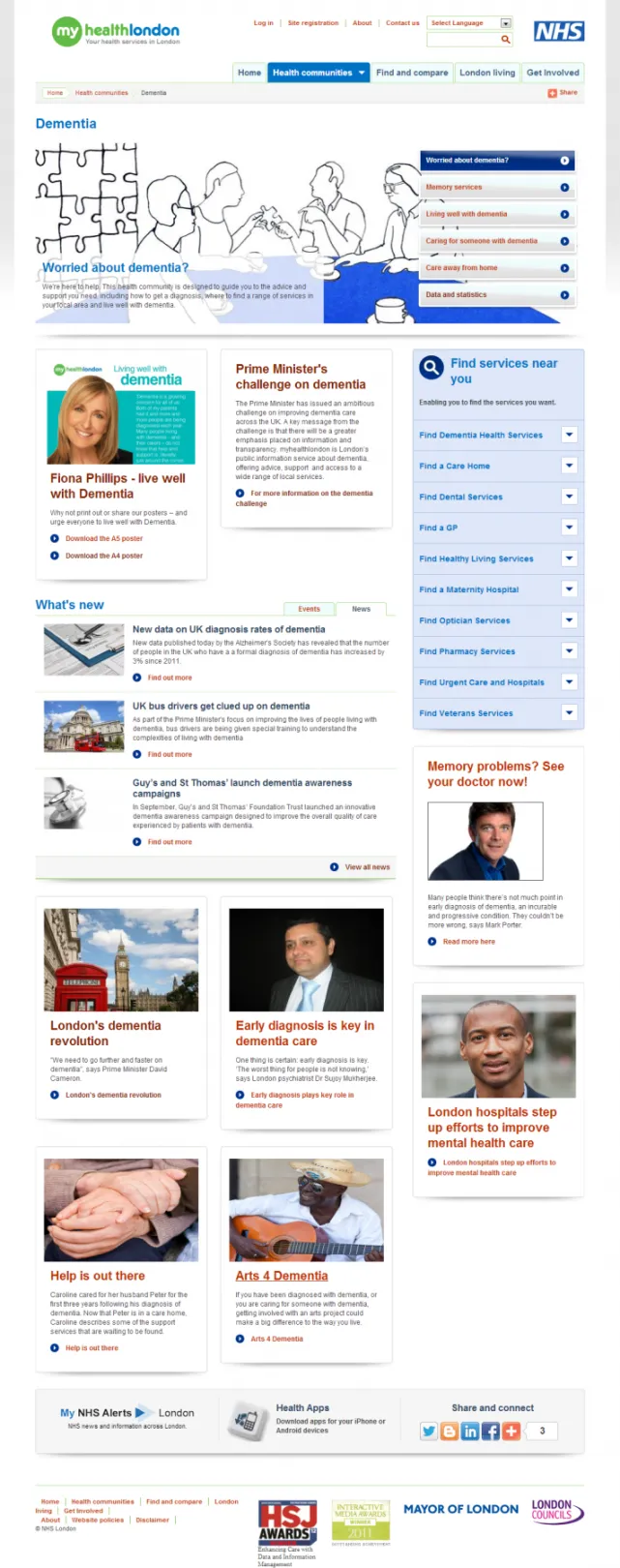
Continual data development has seen us introduce additional health channels such as a facility to find care homes across London. Website visitors can compare the services offered and if necessary report a concern to CQC (Care Quality Commission). The addition of the dementia channel allows Londoners to find dementia health services within a postcode radius or a selected borough.
Giving GPs power
After the initial data migration GP Practices were able to manage their ‘site’ going forward, being able to update their details, add and edit staff and services, create news, events and information pages and send newsletters to those that choose to receive them. Patient engagement was also key to the success of the site. We made good use of Drupal’s webform module to create patient satisfaction surveys as well as allowing GPs to post questions and welcome comments. GPs can now get closer than ever to their patients.
Drupal’s comprehensive user and permission system, alongside the previously mentioned features, meant GPs instantly had the tools they needed to create an online presence.
The Results
Being launched by Mayor of London Boris Johnson in December 2011 on national television meant the site had a high volume of traffic and has continued to increase as more functionality is added - and improved - giving Londoners the power to control their health. Winning awards such at the Interactive Media Awards, and HSJ awards (Enhancing Care with Data and Information Management) has proven the site to be a success not only with the public but with its peers as well.
Ongoing since launch
Since the initial launch of the site it has grown massively, allowing users to additionally compare GP services offered, such as Wheelchair access, weekend opening hours, and the like, as well as enabling them to search for local health services, such as gyms, swimming pools, tennis courts etc. The addition of ‘health communities’ such as Veterans, Cancer, Care Homes and Dementia has meant it’s never been easier for Londoners to find and compare various services and data across the capital. Drupal’s power has meant each of these can be built using the same templates and functionality but also enabled each community to have their own theme within the site.
Further development has allowed greater growth and integration. Working alongside other providers more democracy tools will be brought online, with single sign-on allowing users of myhealth London to feed back to specific issues personalized to them and their health interests.
User profiles have now been personalised, allowing users to view content specific to their interests (such as diabetes, dementia, stroke etc), subscribe to new and updated content and view services in their immediate area thanks to a combined view of the 'super maps'
The future
The future of myhealth London includes a microsite and mobile app for young people. Drupal’s flexibility and scalability has enabled the vast amounts of development required and has ensured the project was a success and continues to be so.
Why Drupal was chosen
The site was to be used as a platform for each of the 1500+ GP practices in London and so required an easily scalable and user friendly solution that also had to be delivered in a ten week timeline. Flexibility was also essential as further large pieces of functionality were planned after the initial launch in December 2011. Drupal’s large number of vastly customizable features and ability to grow without compromising the rest of the site made it a clear choice of CMS.
Technical Specifications
Drupal version:
Key modules/theme/distribution used:
Apache Solr search integration was a key component as we wanted users to be able to filter search results to high relevancy. So far we have included content about various health communities; such as GP, cancer, dementia, veteran and care homes.
WYSIWYG and IMCE were essential to allow the CMS to be as user friendly as possible, allowing GPs to maintain their own content with ease.
Other listed modules allowed us to build powerful customizations for carrying out the vast and complex functionality required by this very comprehensive GP portal