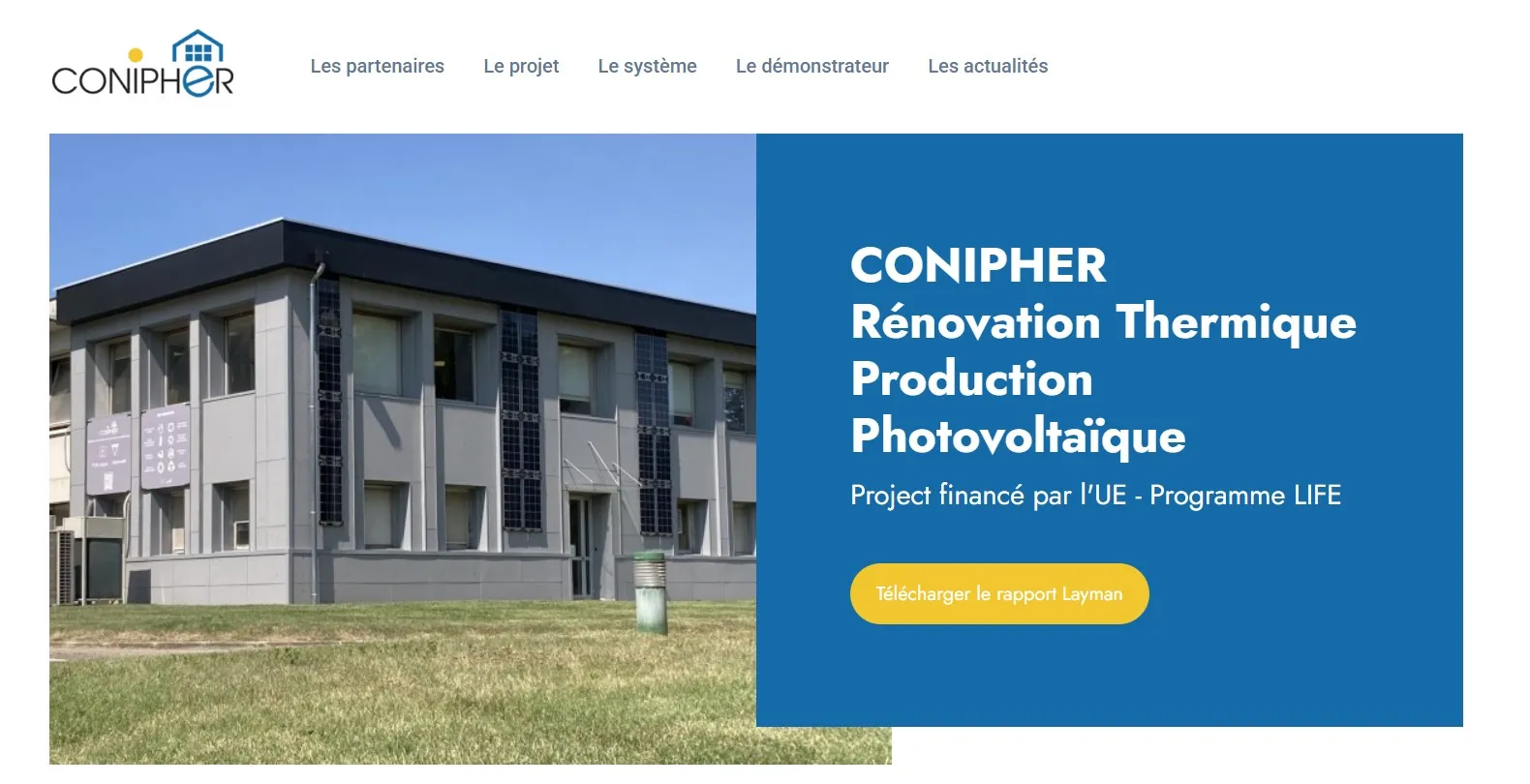
As a project supported by the European LIFE Programme, LIFE CONIPHER requires a dedicated website to communicate its activities, share technical information, and meet European dissemination obligations.
About the project
Goals
- Give the LIFE CONIPHER project the public website required by its European co-funding, and meet the programme's dissemination and visibility obligations
- Explain a technical demonstration project - its rationale, the system it develops and the demonstrator it builds - to a mixed audience of industry professionals, public bodies and the general public
- Document the progress of the demonstrator in real time, from retrofitting to final commissioning
- Give visibility to the consortium partners and provide a single point of contact for enquiries
Requirements
- A bilingual French/English site, both versions maintained in parallel
- A clear editorial structure: the project, the system, the demonstrator, the partners, the news
- A news diary able to carry short, frequent, photo-driven updates from the construction site
- A project visual identity distinct from the other sites of the platform, but obtainable without custom development
- A contact form with bilingual confirmation messages and GDPR consent
- Legal pages, privacy and cookie policy aligned with European requirements
- The shortest possible time to publication, and a minimal running cost over the project's lifetime
Outcome
- A bilingual project website opened on the shared platform with zero custom code, entirely configured through the back office
- A project identity - colour scheme, typography, logo - applied through the factory's no-code fonts and colours tool
- An illustrated news diary tracking the demonstrator step by step: retrofitting, assembly, lifting, cladding, photovoltaic installation, notice boards, site visits and final commissioning
- Dedicated pages for the project, the system, the demonstrator and the consortium partners, all translated
- A bilingual contact form with automatic acknowledgement to the sender
- A site whose hosting, monitoring, security updates and GDPR consent layer are inherited from the shared platform, at a marginal cost for the project budget
Why Drupal was chosen
Its website is hosted on the Drupal site factory operated by the group, and Drupal was chosen for what that model makes possible:
- A new project website can be opened on the existing platform in a few days, with no development and no additional infrastructure
- Branding is handled through configuration - fonts, colours and logo - so a project identity can be applied without writing a single line of CSS
- Native multilingual support, required by the European dissemination obligations attached to LIFE funding
- A component library that lets a small project team publish progress reports, technical explanations and partner information on its own
- Long-term security and maintenance inherited from the shared platform, which matters for a site that must remain online and unchanged well after the project ends
- No licence cost and no vendor lock-in, a decisive argument for a publicly co-funded project
Drupal turns a communication obligation into a low-cost, fully autonomous website.
Technical Specifications
Drupal version:
Key modules/theme/distribution used:
Content Translation, Configuration Translation, Translatable Menu Link URI and Toolbar Language Switcher answer the bilingual obligation attached to LIFE funding. Every page, news item and menu exists in French and in English, menu link targets included. Configuration Translation is the decisive one here: it lets the project team localise the interface strings, the form labels and the confirmation e-mails itself, so the English version is never dependent on a development request. Toolbar Language Switcher makes moving between the two back-office languages immediate for contributors who work alternately in both.
Paragraphs, Metatag hreflang and Simple XML Sitemap cover publishing and visibility. Paragraphs provides the component library used to lay out the explanatory pages - the project, the system, the demonstrator, the partners - and, above all, the photo-driven news diary that tracks the demonstrator step by step, from retrofitting to lifting, cladding, photovoltaic installation and final commissioning. No specific component had to be developed for the project. Metatag hreflang and Simple XML Sitemap ensure both language versions are correctly indexed, which matters for a publicly co-funded project whose results must remain findable long after the programme ends.
Webform, Webform Spam Words and reCAPTCHA v3 provide the single public point of contact the programme requires. Webform carries the enquiry form and its bilingual acknowledgement to the sender, with the GDPR consent step declared as part of the form itself. Since a project site of this kind is lightly monitored and has no permanent editorial team, Webform Spam Words and reCAPTCHA v3 filter automated submissions upstream, so the mailbox that receives them stays usable throughout the project's lifetime without day-to-day moderation.