Sector(s)
Team Members
Visit the site
Visit the siteOrganizations Involved
Community contributions
As a Drupal Certified Partner Platinum and a supporting partner and organizational member of the Drupal Association, Factorial has been contributing to the global Drupal community since its founding in 2015. By sponsoring and organizing events (Splash Awards, DrupalCamp, Drupal User Group Hamburg), sponsoring development time for our Drupal developers, and submitting sessions for conferences, we actively invest in the further development of the framework and the community. As a member of Drupal e.V., the German Drupal Association, we are also committed to promote Drupal in the DACH region.
The Stiftung Unabhängige Patientenberatung Deutschland (UPD Foundation) was established in 2024 as a non-profit organisation on a statutory basis. Its mandate (§ 65b SGB V): to provide all people in Germany with free, quality-assured, and independent advice on health and health law matters – enabling them to navigate the healthcare system and make informed, self-determined decisions about their health.
The interdisciplinary counselling team brings together specialists from law, social law, medicine, dentistry, pharmacy, psychology, nursing, and social work. Advice covers a range of topics, including health insurance, patients' rights, suspected treatment errors, medical and dental care, pharmaceuticals, and psychosocial support services – including help understanding medical findings and preparing for doctor's appointments. The counselling conversations also yield valuable insights into challenges within the healthcare system, which UPD Foundation uses to identify problem areas and drive impulses toward stronger patient orientation.
The service is in high demand: in 2024, Stiftung UPD recorded around 24,000 counselling contacts; by 2025, that figure had risen to around 48,000 – with approximately 900 people seeking advice each week and numbers continuing to grow. As the network of counselling centres expands, in-person consultations are also increasing: in 2025, more than 500 people visited a counselling centre in person.
Starting Point
Since the organisation's founding, the counselling team has worked with a range of isolated systems: dedicated telephony software, an external video counselling solution, Confluence as a knowledge base, Microsoft 365, and a separate HR system. None of these systems communicated with the others. For counsellors, this means: constant switching between different software systems in the middle of an active counselling session – time and focus lost where it matters most.
The Solution: One Central Cockpit Instead of Many Switches
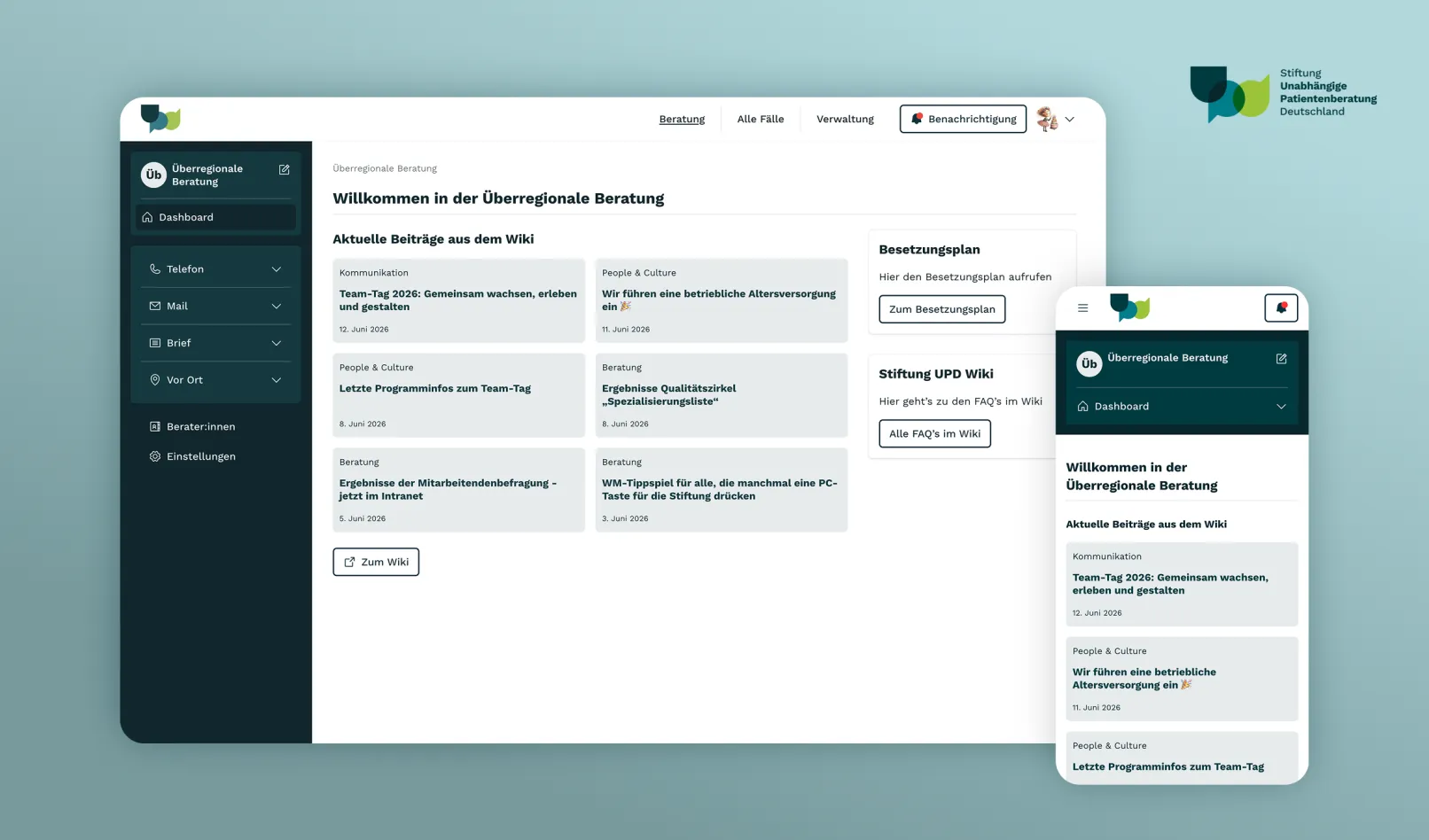
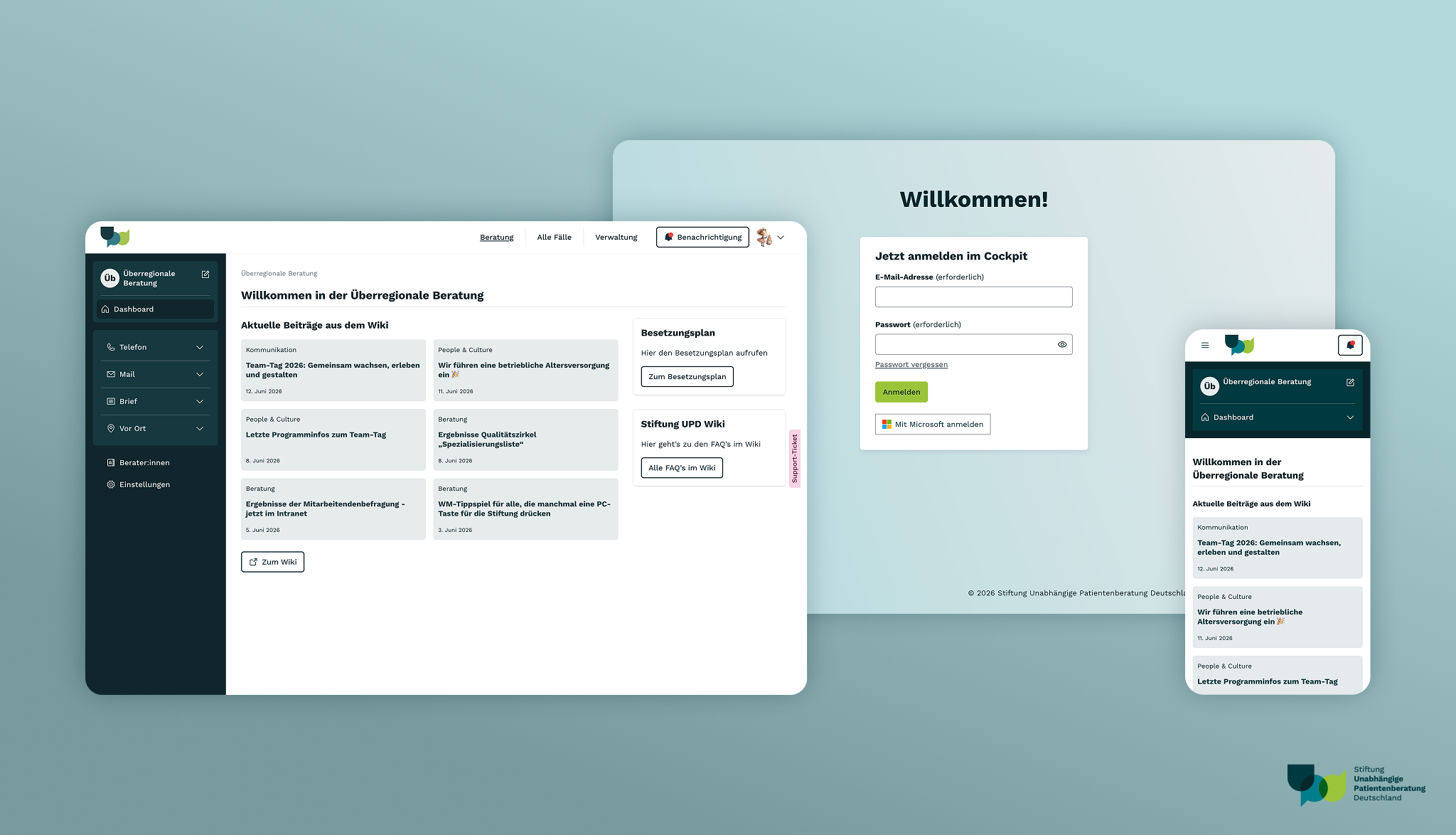
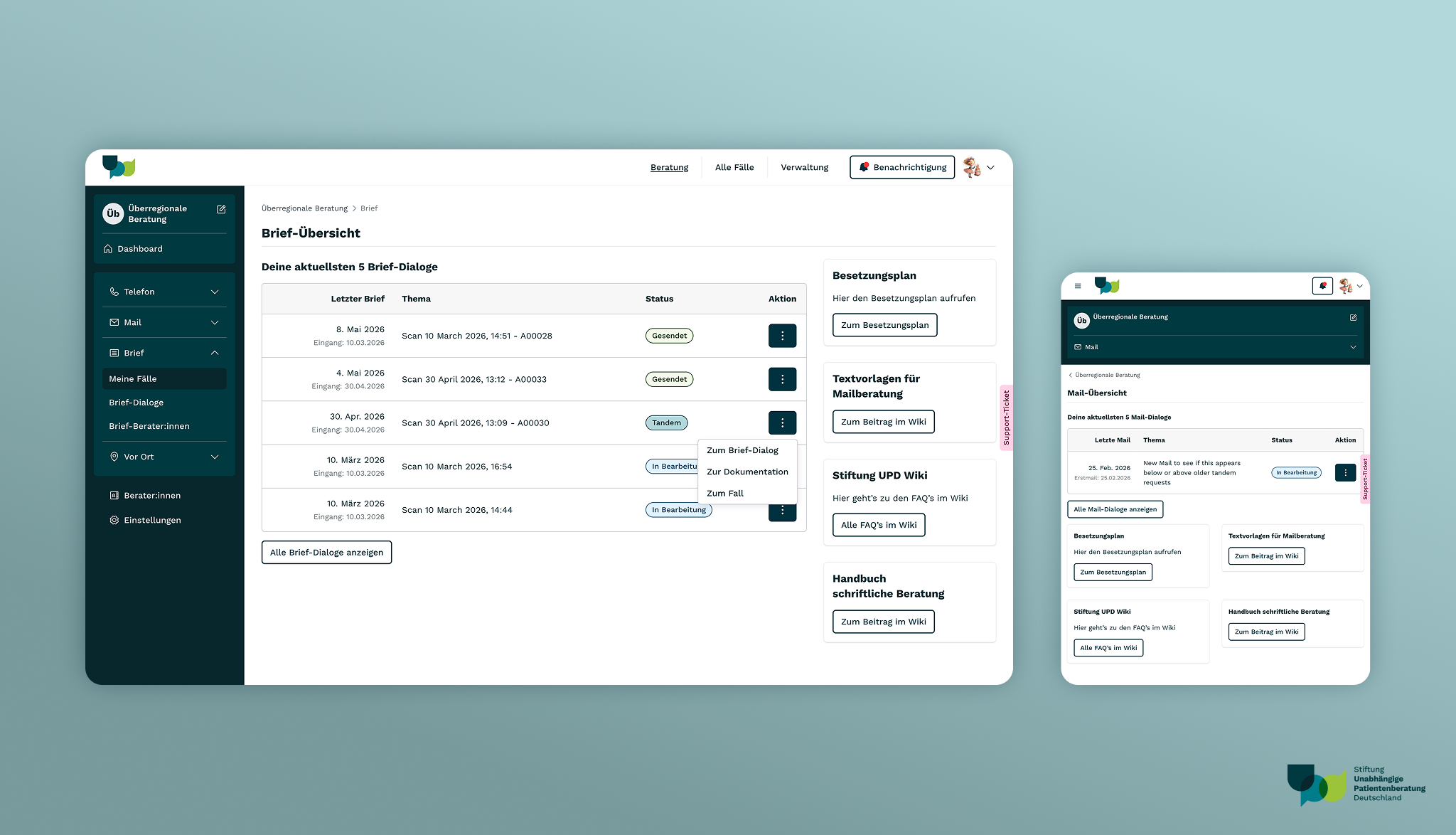
The Advisory Cockpit is being developed with the goal of consolidating all systems relevant to counselling work into a single, unified interface. Counsellors should need to open only one application in the morning to manage their entire working day. A first base version of the platform already enables privacy-compliant written digital counselling as well as digitalised postal counselling. In addition, master and contact data for people seeking advice can be maintained and counselling sessions documented.
Technical Architecture
The foundation is JOCI OS, Factorial's platform solution for counselling organisations – originally developed for TelefonSeelsorge Deutschland, where it underpins the digital ecosystem of more than 7,500 volunteer staff. For UPD Foundation, JOCI OS was substantially redeveloped and tailored to the specific requirements of a public-law organisation in healthcare counselling. The technical stack: Drupal as a stable, open-source backend, Vue.js as a modern frontend, a headless architecture with an API-first approach. This enables seamless integration of external systems – from Confluence for knowledge management to CTI telephony software and video counselling solutions.
Privacy and Accessibility as Core Requirements
The Advisory Cockpit stores and processes highly sensitive personal health data. The system was built according to the principle of Privacy by Design – with end-to-end encryption, a granular rights and roles concept, and full transparency in data processing. Accessibility in line with BITV is not an optional add-on; it is part of the core.
Project Start and Approach
The project launched in October 2025 with an intensive requirements and conception phase. In close collaboration with UPD Foundation's product management, processes were analysed, user needs captured, and a modular architecture defined that can grow with the organisation. The system has been in production since early 2026. The roadmap ahead is clear: implementation of online appointment scheduling, integration of telephony software, digitalisation of feedback and complaints processes, and chat and video counselling.
About the project
Goal
The goal is to build a digital infrastructure that keeps pace with UPD Foundation's growth and organisational development: from a single counselling channel to omni-channel counselling, from isolated individual systems to a coherent ecosystem for patient advice. A central software solution for decentralised, interdisciplinary patient counselling across nationwide counselling locations.
Challenges
Fragmented Systems in a Sensitive Context
Connecting different isolated systems into a coherent platform is technically complex. In a context where personal health data is being processed and any data protection misconfiguration could have serious consequences, that complexity was particularly high. The integration had to work seamlessly – while simultaneously meeting the high data protection standards required when handling sensitive health data.
Growth as a Requirement, Not an Option
UPD Foundation is still in the process of building out its nationwide network of counselling centres and is targeting a significant increase of counselling contacts. The system therefore could not be built for the status quo, but for an organisation that will grow fundamentally: more counsellors, more channels, more counselling locations across the entire country. A modular architecture that scales was a baseline requirement.
A New Platform, a Running Operation
UPD Foundation counsels people daily, often in acute health situations. Operations could not be interrupted. The system had to be introduced in a way that allowed counsellors to work confidently from day one – without learning curves that come at the expense of those seeking help.
Privacy by Design in Practice
Retrofitting privacy into a system is difficult. Embedding it as a design principle from the outset requires a fundamentally different development approach. End-to-end encryption, a granular rights and roles concept, full transparency in data processing – these are not checkboxes, but architectural decisions that must be made early.
Results
Since its launch in March 2026, the following measurable results can be stated:
— 99.9% system availability and robust infrastructure setup in BSI C5-certified hosting
— Live in production since early 2026, with a clear roadmap for further integration stages
— BITV certification of the platform's access point for people seeking advice
This project has been submitted to the Splash Awards International 2026.
Why Drupal was chosen
Drupal was chosen for its combination of an open source essence with powerful capabilities: Managing complex data structures, supporting granular, role-based permissions for thousands of users, and seamlessly integrating a wide range of third-party applications into a unified, efficient platform.
Technical Specifications
Drupal version:
- Simple OAuth (OAuth2) & OpenID Connect: Handling the OAuth 2.0 login process for both applications (onlineberatung, cockpit)
- OpenID Connect / OAuth client and OpenID Connect Microsoft Azure Active Directory client: Handling the Microsoft Azure SSO before integrating into our application OAuth process.
- Private Message: Processing the consulting message threads
- Group: Collections of content data and working users, grant access control permissions on those collections
- Storage Entities: Managing data that should be stored in the database, but only displayed/associated. for example: consulting cases (flows, master data), consulting documentation form structure
- JSON Field: As the input structure of document forms is dynamic, we need a flexible data storage system.
- Message: Logging and displaying participant Events/Actions
- Search API (Solr): Provide fast, scalable, and highly relevant search capabilities while reducing the load and complexity of traditional database queries for search-intensive operations.
- TCPDF: Use the UPD mailing template to create a reply letter for consultancy services in PDF format