Sector(s)
The group runs its sites on a Drupal site factory designed by Parker+Parker: a shared base, a block library and sites derived from a template site. It wanted its web team to handle routine changes without going through the agency every time. Parker+Parker organized several training sessions a year: block creation, simple to medium features, new site deployment, minor and major version upgrades. When a change requires its expertise, the agency builds it, then trains the team so it can work on its own the next time.
About the project
Results
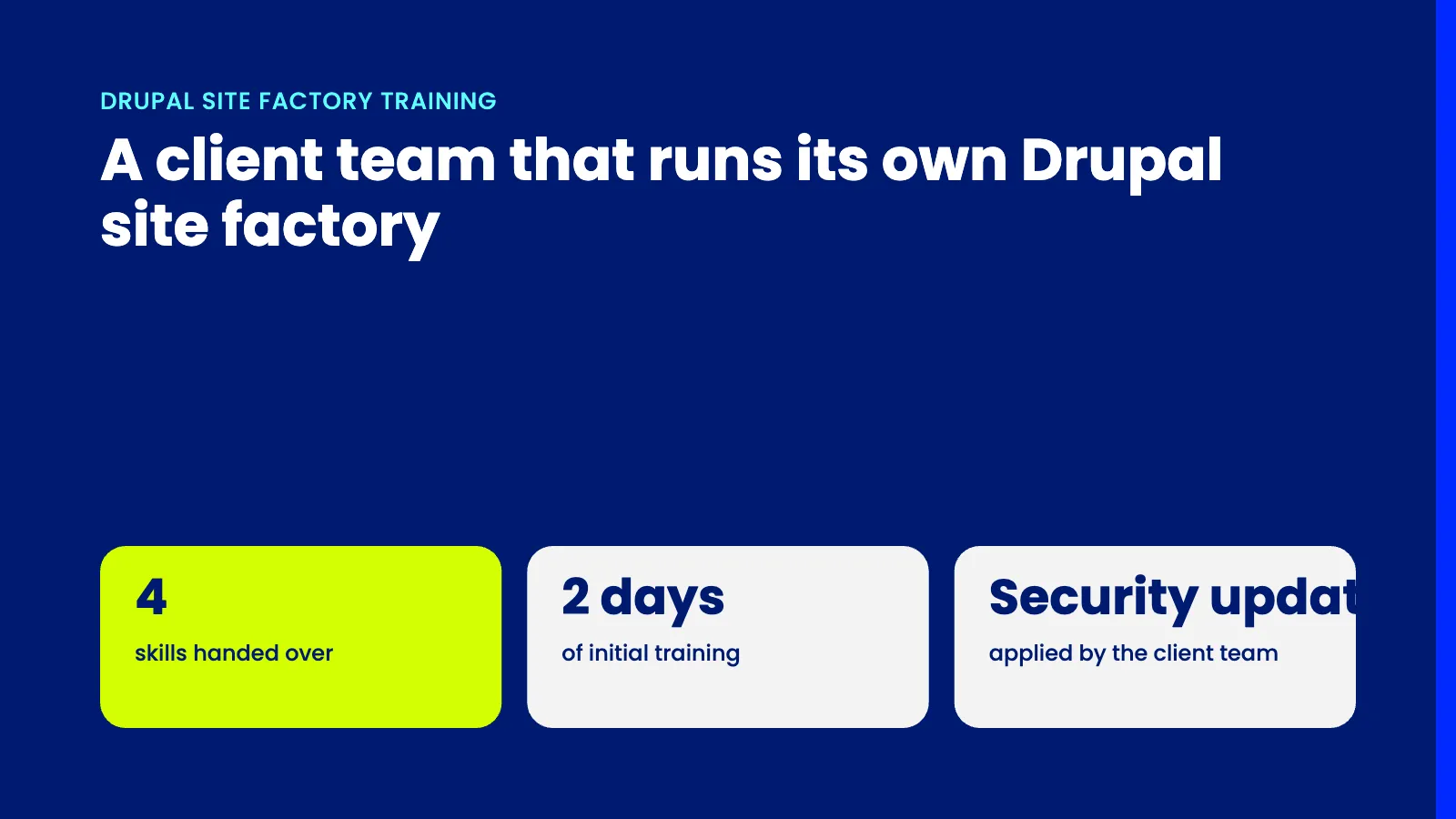
- Four skills handed over to the client team: block creation, simple to medium features, new site deployment, minor and major version upgrades.
- Two days of initial training, right after delivery of the first site derived from the template.
- The client team now applies Drupal security updates on its own.
Goal
Give the group's web team control of routine work on the site factory, while keeping a shared codebase that is easy to maintain.
Challenge
A shared platform only stays healthy if every new block and every new site follows the same architecture. The team had to learn Drupal theming and templates, beyond content editing. Version upgrades had to become a routine task for the client, aligned with Drupal's schedule.
Solution
- Site adaptation. Two days of training at Parker+Parker's offices, right after delivery of the first site derived from the template, so the team could adapt the theme of the following sites itself.
- Templates and blocks. A half-day on Drupal's templating engine: variables, loops, template hierarchy and overrides, debugging, then creating a content type in a workshop.
- Documentation. Technical documentation of the factory serves as a reference between sessions.
- Version upgrades. A dedicated training session prepares the team for minor and major version upgrades.
- Training with every new feature. For a complex change, Parker+Parker builds it, then trains the team on what was delivered.
What editors do without developers
Editors build their pages from the block library. The web team creates new blocks, deploys new sites from the template site and applies security updates.
Why Drupal was chosen
The group needed a single platform for several sites that its own team could learn and run. Thanks to multisite, a Drupal core feature, a single codebase and a shared block library serve every site, each with its own theme and content. Pages are assembled from reusable blocks: editors work without developers. Drupal's templating engine is documented, and in-house developers can learn it in workshops. Drupal's release cycle is predictable and the path from one major version to the next is documented: training the client team to handle version upgrades became realistic.
Technical Specifications
Drupal version:
Key modules/theme/distribution used:
Paragraphs powers the shared block library, to which the client team adds its own blocks. All sites share one codebase through Drupal core's multisite feature: a new site is deployed from the template site.