Sector(s)
Team Members
Project Team
Yeah, well, as mentioned above, only one team member, me. I would not consider this a normal project, as typically at least some of the roles for a project this size should be ideally done by various persons with more specialized roles. However, I find it interesting and worth a case study, that given clear requirements, strategy and a helpful client, such an amount of work can be executed by a single developer/designer thanks to Drupal as a basis.
This case study is an example of how Drupal can be the perfect CMS for a small company on a tight budget, as this project was realized by a single Drupal developer.
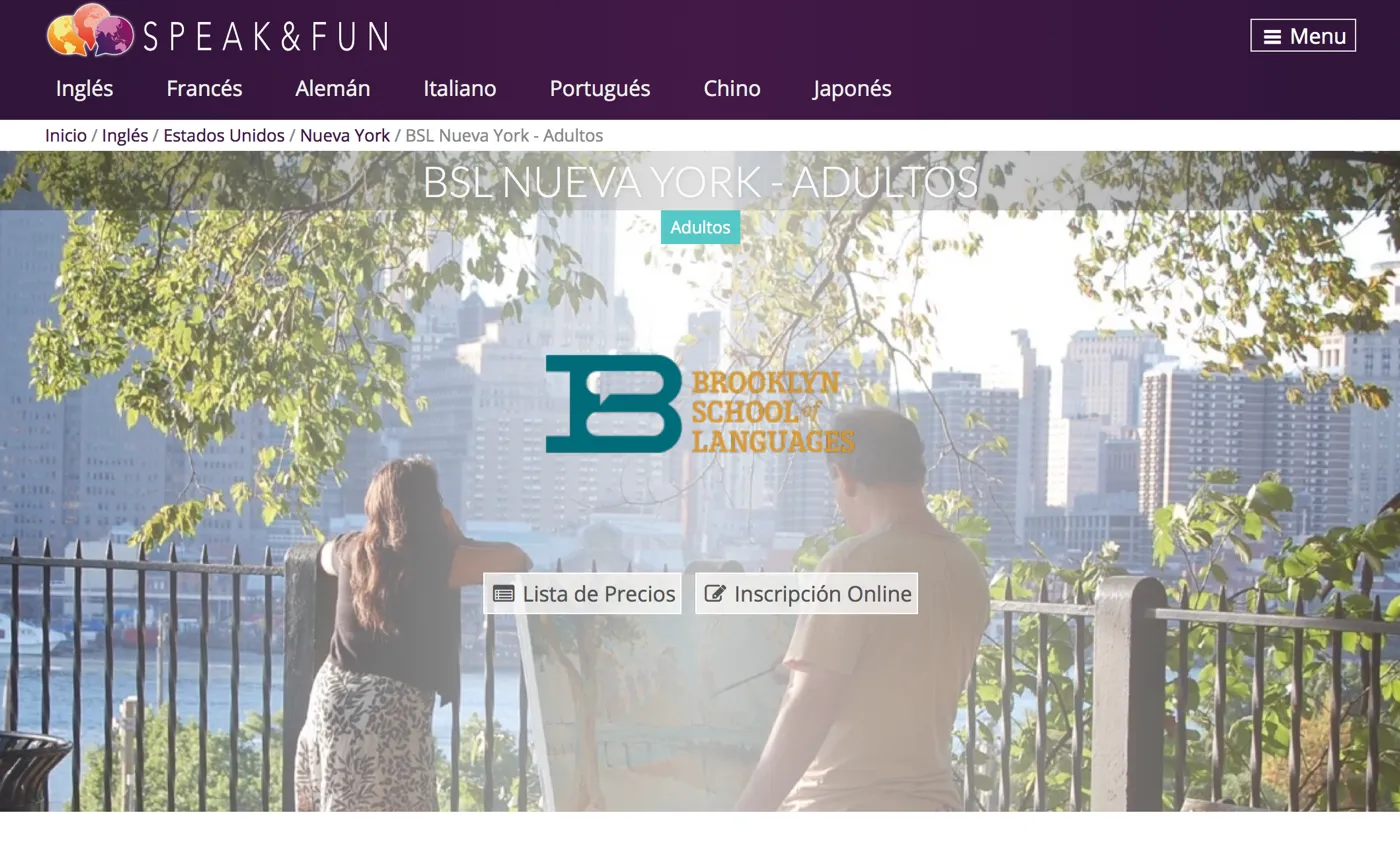
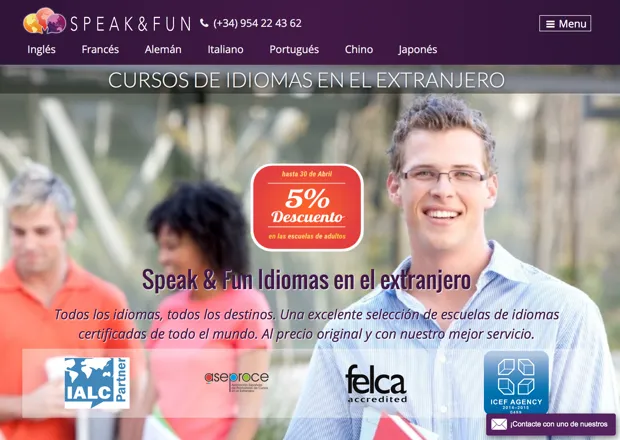
Speak & Fun is a language course agency based in Seville, Spain. They offer language courses all over the world to their Spanish clients.
Speak & Fun approached me in 2014 to provide them an overall concept to migrate their outdated website based on a legacy CMS to a new, modern version that could accommodate all their needs. I, as a lone freelancer, was responsible for the complete project with minimal help from the employees, who would need to continue their day to day work.
We managed to successfully launch the new website after a couple of months of web design, development and content migration with very positive results for the agency as well as their customers.
About the project
The main goal for Speak & Fun was to stay competitive in an industry where SEO is key and the top positions on Google are heavily fought for. That requires a highly flexible website with:
- easily extendable content, that can be managed by non-technical employees
- a well defined structure of content types and taxonomy terms that can grow with the company´s need to add new destinations and course types to their business
- a responsive web design that is able to present a great amount of content on small devices to be able to cater to the high amount of mobile visitors
- an interface to the legacy backend-systems, that are responsible for price calculations and customer inscriptions
- a clear strategy of how content will be administered and updated by the various internal and external roles of content creators
- automatically added metadata for new content like metadata tags in the header and microdata for specific content types
Why Drupal was chosen
Drupal was chosen, as it was one of the few CMS with the necessary flexibility and extendability for the project. As it was made clear from the beginning that there would be no budget for a second developer/designer, the development heavily depended on Drupal's infrastructure and community to get as much as possible of the project done with pre-existing modules and techniques. In addition I had to define a clear strategy of how to solve the outstanding problems with custom code in form of new modules for integration of the backend-systems.
The ability to mix taxonomy listings, content types and lists into a seamless system and have them administered by clearly defined roles is one of Drupal great strengths, without which the development would have taken much longer.
Technical Specifications
Key modules/theme/distribution used:
The website was built based on a standard Drupal 7 installation.
Omega 4 was chosen as the basis for the custom sub-theme. It provided an excellent basis for quickly creating the custom theme using the CSS-preprocessor Sass and a flexible grid system (Susy). In addition, Compass and Bourbon helper functions were used for a better CSS outcome.
The combination of the modules Display Suite, Context, Views and EVA allowed for easy customization of the content type layouts. Display suite was also very helpful at providing a simplified HTML structure compared to what a standard Drupal installation would have produced.
For SEO and a smooth transition from the old website, I found the modules Metatag and Redirect invaluable.
The navigation used on the website is mainly based on Superfish with a side menu based on custom code. Breadcrumbs are managed with the help of the module Easy Breadcrumb.