Sector(s)
Team Members
Project Team
- Luiss Guido Carli: project vision, governance and content ownership
- SparkFabrik: analysis, design, development, delivery, design system, AI search, cloud native infrastructure, SEO and GEO implementation
- Altura Labs: strategic consulting, project governance, information architecture, SEO migration
- Pezzilli & Company: editorial contribution and go-live support
The platform was built by an interdisciplinary team: Drupal engineers, designers, UX and UI specialists, cloud native and platform engineers, and security and analytics specialists.
Team members without a drupal.org profile: Davide Salvadori, Silvia Marinelli, Rocco Franchini, Daniele Monti, Stefano Sibilia.
Visit the site
Visit the siteOrganizations Involved
Community contributions
The team behind the platform maintains more than 25 modules on drupal.org, many dedicated to AI, and holds over 1,000 contribution credits. The modules developed for this project go back to the community. SparkFabrik is a Drupal Certified Partner Gold, co-organizes DrupalCamp Italy and speaks at DrupalCon and Drupal Dev Days.
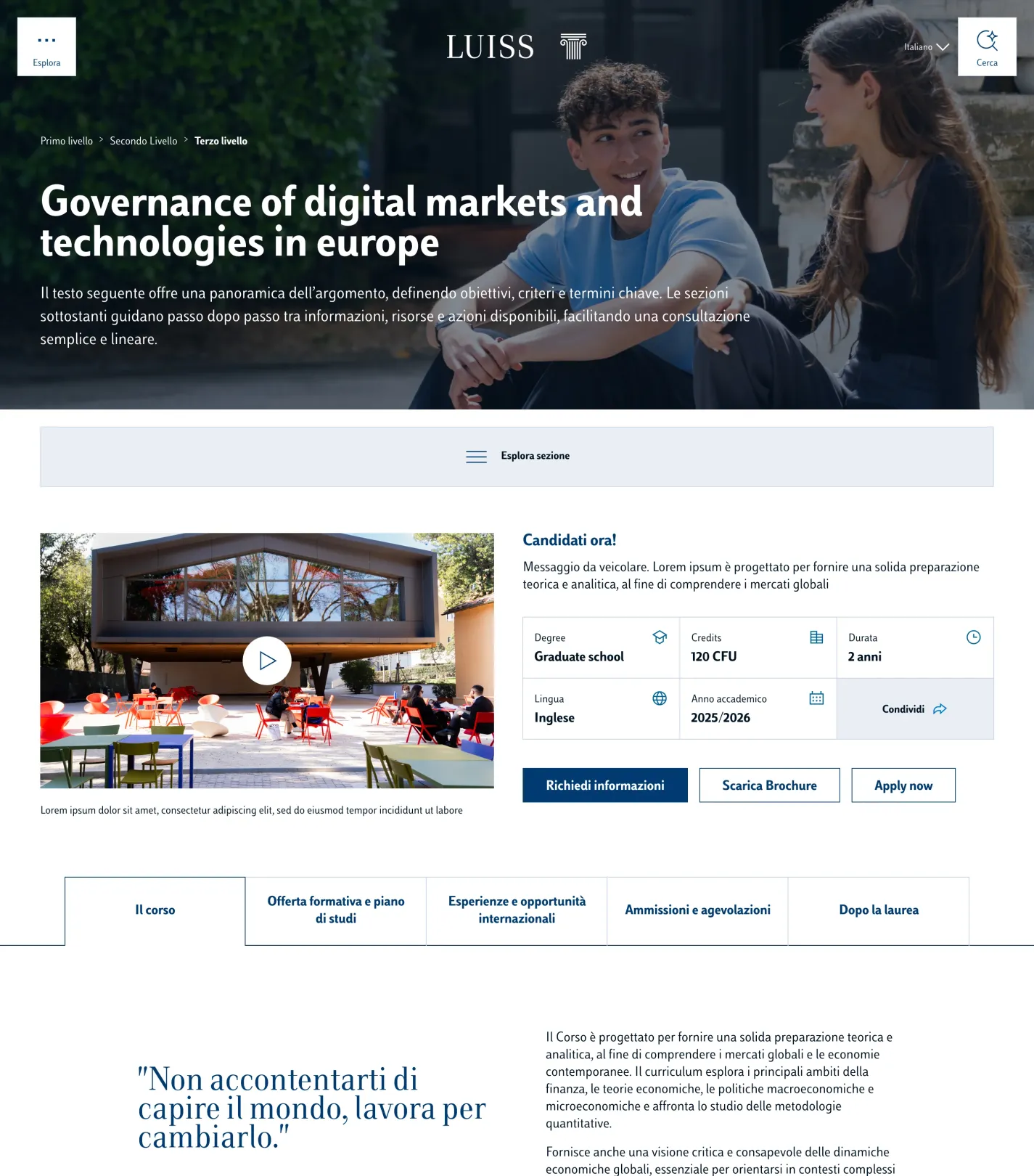
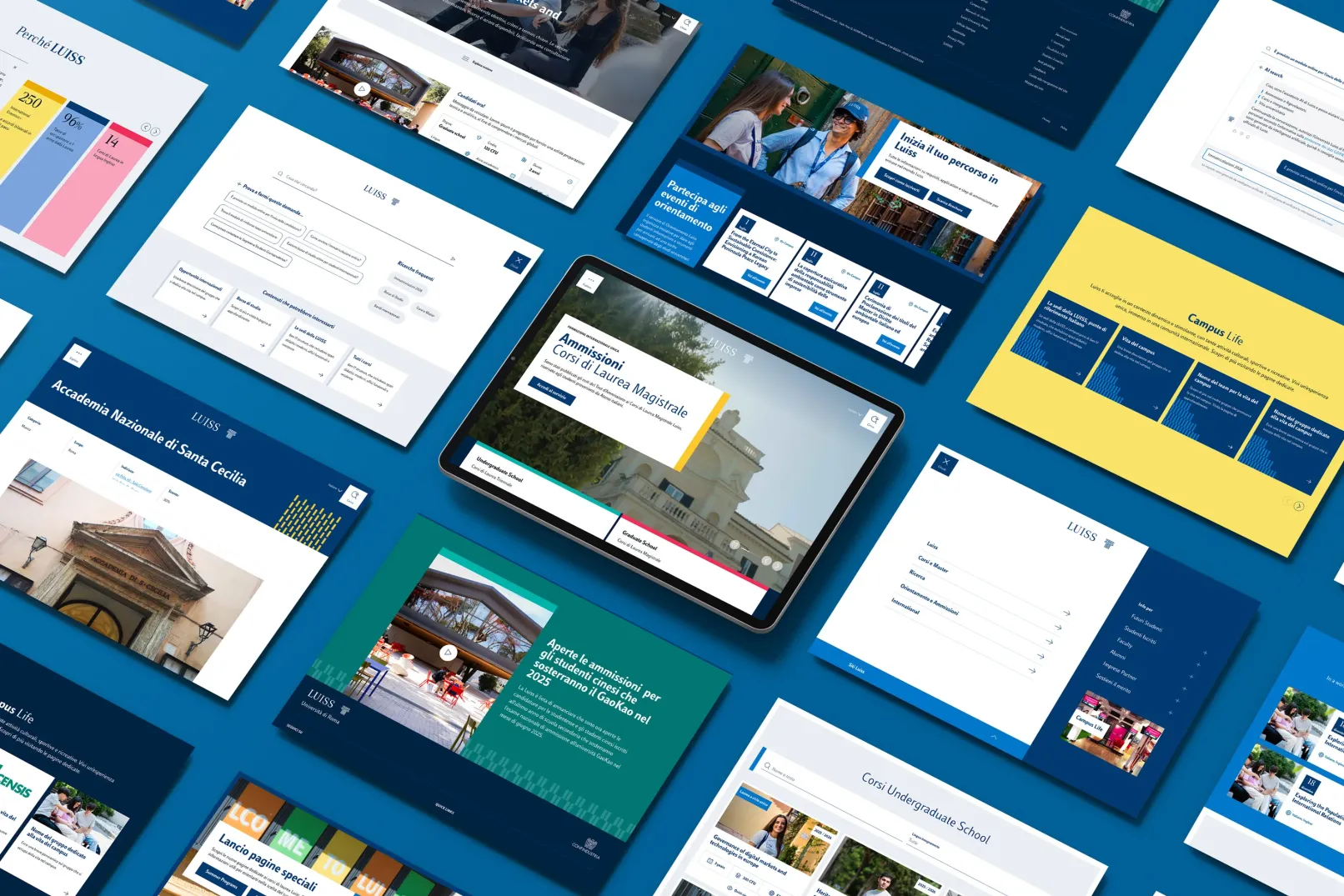
Luiss Guido Carli is a private university in Rome, with schools in Economics, Law, Political Science and Management and a large international student body. Its digital presence had grown to roughly 65,000 pages across the corporate site and dozens of department, school and project sites.
That platform mirrored the complexity of the institution instead of resolving it: content duplicated across sites, publishing dependent on central IT, and one undifferentiated structure for prospective students, students, faculty, families and partners alike.
A 15 month programme rebuilt it as a single platform, with Drupal running the whole content lifecycle.
About the project
Goals
- Rebuild the digital experience around how prospective students search and study today.
- Rationalize an information architecture that had grown to about 65,000 pages.
- Let every office publish, and launch a new site, without a central bottleneck.
- Make official content findable by search engines and by AI assistants, and accessible by design.
A university is measured, in part, by the quality of its digital experience. With this project we choose to combine technology and design as part of our identity, not as an add-on service.
Massimo Angelini, Chief External Affairs, Corporate Communication and Partnership Officer, Luiss Guido Carli
Challenge
A university site serves very different audiences at once, each with little patience for friction. The work started with people: more than 120 interviews (by Altura Labs) and over 20 offices involved across 15 months. Out of that came a content architecture redesigned from scratch, which took the site from roughly 65,000 pages to about 25,000.
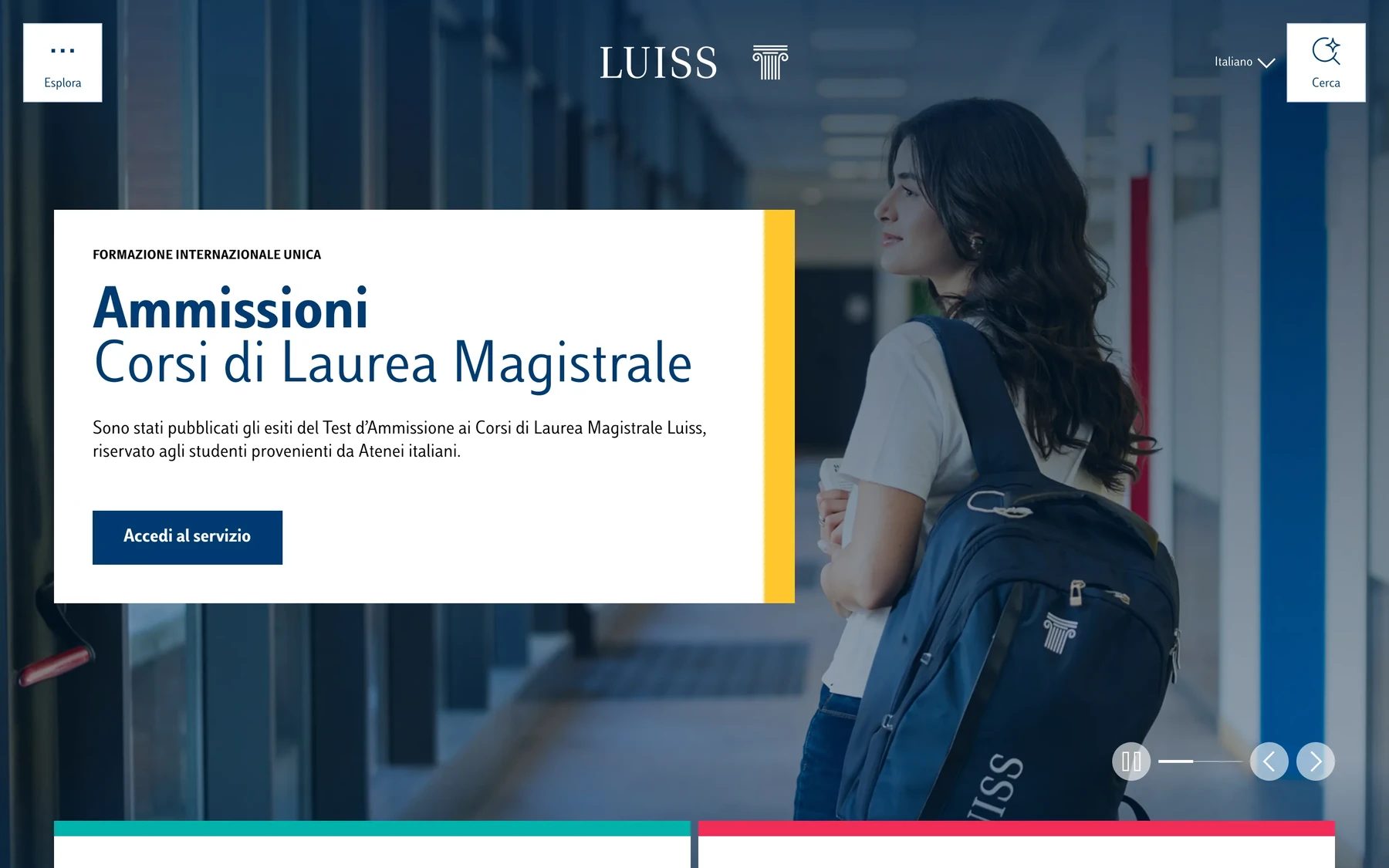
Solution
- A multibrand design system wired into the site's code. Foundations and components live in one source of truth, shared by the corporate site and every satellite site, fed by a pipeline from design tokens to front-end components.
- Drupal as the single engine for content modeling, editorial workflows, translation, media and integrations.
- Conversational search anchored to official content. A retrieval augmented agent answers in natural language, cites the pages it drew from, and says when it does not know instead of guessing. Semantic indexing covers site content and the document archive.
- AI assisted multilingual publishing with a human in the loop: translation is accelerated, approval stays with the publishing team.
- Self-service site provisioning from a master template that already carries the design system and the security baseline, with security updates propagating from one point.
- Accessibility as a design principle: keyboard-first interaction, checked contrast, screen reader support, resizable text.
- A cloud native runtime on Kubernetes, sized for admission-window traffic peaks, with content structured so the institution stays findable by search engines and AI models.

Outcome
- About 25,000 pages, down from 65,000, and 70% less time to publish content.
- Up to 10x performance on the cloud native infrastructure, at 99.9% uptime.
- One design system for the corporate site and an ecosystem of hundreds of satellite sites.
- New sites launched by the university itself, in minutes rather than weeks.
Adopting an innovative platform built on open technologies gives us full autonomy and flexibility: a strategic choice that lets us shape our digital services and evolve them in line with the University's real needs.
Francesco Amendola, Chief Digital Transformation Officer, Luiss Guido Carli
A short video walkthrough of the platform, in Italian:
The full case study, with more detail on the design system and the AI search: Luiss Guido Carli on sparkfabrik.com.
Why Drupal was chosen
The university needed full control over its own technology, to run and evolve its digital services without depending on a single vendor. Open source and open standards were a deliberate choice, framed by the university as digital sovereignty. Drupal met the specific needs of the project:
- Structured content by design, so one content model serves web pages, the internal search engine, a conversational agent and external AI models.
- Mature multilingual workflows, with per-team translation, review and approval before publication.
- Granular permissions for dozens of offices publishing in parallel, without losing central governance.
- A strong API layer and AI module ecosystem, which made retrieval augmented search possible on the content the site already publishes.
- Multisite governance from one codebase, with no licensing cost per site or per editor, which matters when satellite sites number in the hundreds.
What matters is not a website, but the platform: design system, application and infrastructure, designed and managed as a single system. We built it on open source and open standards because an institution like Luiss must be able to run its own technology, not depend on a provider.
Paolo Mainardi, CTO and co-founder, SparkFabrik
Technical Specifications
Drupal version:
Key modules/theme/distribution used:
The AI stack was assembled from modules the team maintains or contributes to in public, so the university depends on components maintained in the open rather than on a closed integration. The search modules index the university's own content and documents, which is what lets the agent answer from official sources and cite them. Asynchronous processing keeps indexing and AI calls off the request path, so page delivery stays fast under load.