Sector(s)
Project Team
The project team: Code Enigma, developer, designer and PM, Client and daily scrums.
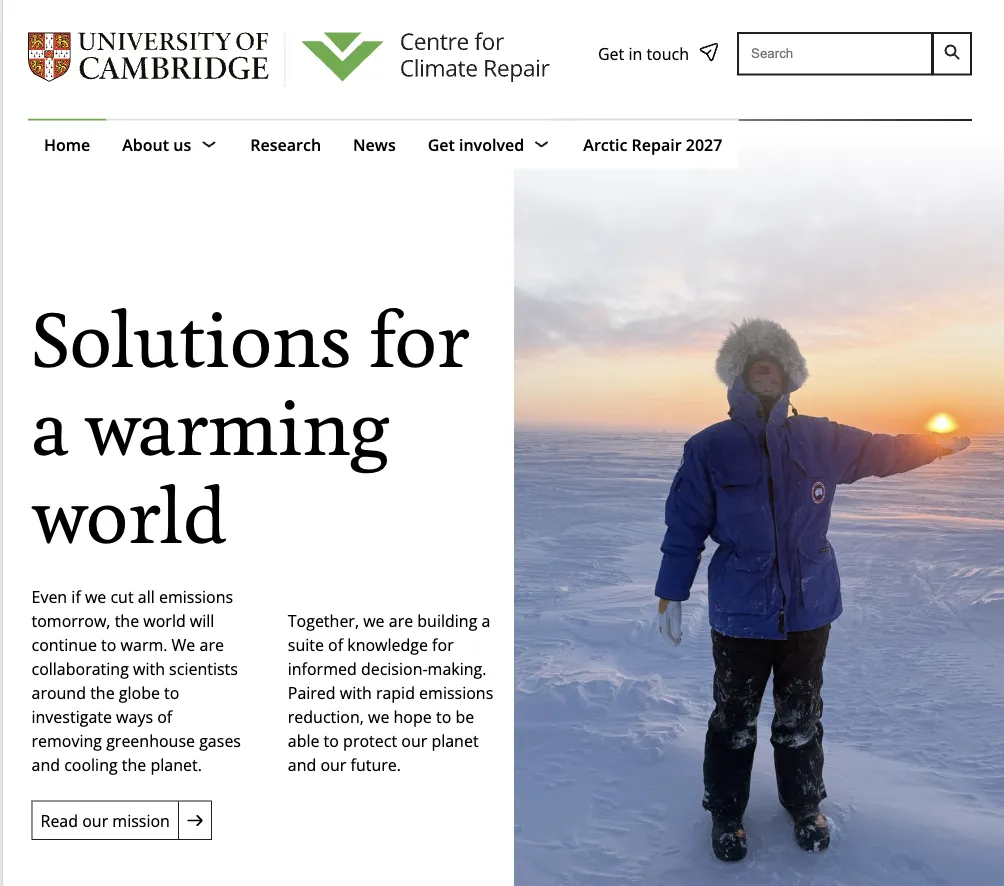
The Centre for Climate Repair is based out of the University of Cambridge and has a threefold mission:
- Reduce CO2 emissions
- Remove CO2 from the atmosphere
- Refreeze damaged parts of the Arctic environment
The Centre's website (www.climaterepair.cam.ac.uk) was hosted on Drupal 10 (running 10.3.1) and linked to the University of Cambridge, but had previously been managed externally. The client sought Drupal specialists able to overhaul the website design from its existing basic form, manage the technical aspects (security, Drupal updates, hosting), and make it more functionally suitable for the future as the work of the Centre expands. Code Enigma was contacted as a final proposer, partly because of the work done on the portfolio website for St John's College.
About the project
Aim/goals: The Centre wanted a one-stop-shop site people go to first — clear, measurable, and autonomous. Key needs: understand traffic, let visitors find what they need without asking staff, and let the Centre manage conferences, logos and research projects itself. Accessibility and responsible cookie use were essential, and since most content is added manually by the Climate Repair team, a better editorial experience was central to that autonomy.
Audit of the existing site: The Drupal 10.3.1 site had 9 content types (Basic page, Event, News, People, PhD Studentship, Projects, Publications, Vacancies, Weekly Roundups), 327 content items, 4 taxonomies, 5 media types, 8 paragraph types, 5 roles and 4 users. Listing pages were Views blocks assembled into paragraph layouts.
Key observations:
- No search, contact form, analytics or metrics.
- Entity queue made adding content to lists a multi-step chore.
- Many pages used hand-styled HTML to work around theme bugs and limitations.
- The editorial process was too complex and abstract — only two users actively managed content.
- Mailchimp lists existed but weren't integrated with the site.
- Events were frequent but hard to add.
- Hosting was overpriced (two web servers, one in use) and accessible only via FTP or a web interface — no source control, so deployments caused significant disruption.
Challenges: The site needed a modern refresh and better content architecture. Content was hidden behind multiple clicks and surfaced at the wrong moment. Editors couldn't trust that drafts matched the published result and lacked components for the layouts they wanted — so pages filled up with hand-styled embedded HTML that was hard to update and off-brand.
Method/approach: A new design came first, allowing fast iteration on what to improve and where existing content fell short; structural content changes ran alongside it for coherence.
Content types were assessed for fitness for purpose: unused legacy types (the "Projects" type, the old "associates" page) were removed or streamlined, with redirects protecting SEO. Content was enhanced with additional fields — academic and job titles on People, extra event fields, free-text News authors, menu descriptions.
New flexible components were added — Resources paragraph, events slider block, people select block, breadcrumbs — and layouts consolidated into a small set of reusable ones, steering editors away from hand-styled HTML toward structured content. Entity queue was replaced with component-driven nested paragraphs, so ordering happens on the same page.
Best-practice configuration was added: stronger SEO profile, automated accessibility checking, responsive image styles, Search API (database) search, Google Analytics with EU cookie compliance (Klaro), and automated redirects.
The site also moved to a Code Enigma–managed server, significantly reducing hosting cost and enabling automated deployments.
Design requirements: Figma designs for key templates — Homepage, Research, Event, Content page, News directory, News article/long reads, Team directory, Team biography — plus components, variables, navigation, header, footer, sticky sub-nav and core layout variations.
Outcomes: The site was upgraded rather than rebuilt, avoiding unnecessary technical debt and cost while keeping integrations largely intact. It delivered meaningful UX improvements, stronger SEO, automated accessibility checking, responsive images, robust search and analytics — a gold-standard editorial experience on a modern, supportable Drupal 11 platform, with ongoing support so the Centre stays autonomous and can measure success as its work expands.
Why Drupal was chosen
The platform was already built on Drupal and the client specifically sought Drupal specialists who could overhaul the design, manage the technical aspects (security, updates, hosting) and make the platform more functionally suitable for the future. Building the new site in Drupal 11 provided a modern, supportable CMS with the flexibility and extensibility the Centre needs. While the upgrade path (rather than a ground-up rebuild) preserved existing content, integrations and SEO value and kept editors' familiar workflows. Drupal's component/paragraphs model also directly addressed the editorial frustrations and layout constraints in the existing site.
Technical Specifications
Drupal version:
Key modules/theme/distribution used:
- Paragraphs + layout_paragraphs: give editors flexible, component-based page building and consistent layouts, moving the team away from hand-styled HTML and solving the "draft doesn't match published" problem.
- Search API + database search: the site had no search at all; a robust search solution improves findability ("people need to find what they're looking for without asking the organisation").
- Google Analytics + Klaro cookie control: the Centre had no traffic metrics and wanted to start measuring website success, with EU-compliant cookie consent.
- Gin admin theme: provides a modern, faster admin experience with front-end styling consistency in the backend (fonts/styles appear as on the front end) and fixes issues with occasional layout/blockquote handling.
- Redirect module & automated redirects: preserve SEO value when legacy content types/pages are removed.
- Smart date: used on event pages to support the richer event fields required.
- SMTP: support email relay for more reliable email sending.
- Redis modules: to allow for increased performance and caching.
- Responsive image styles, automated accessibility checking, visual regression testing (Cypress): ensure a strong mobile experience, accessibility (WCAG 2.1 AA), and quality assurance in CI.