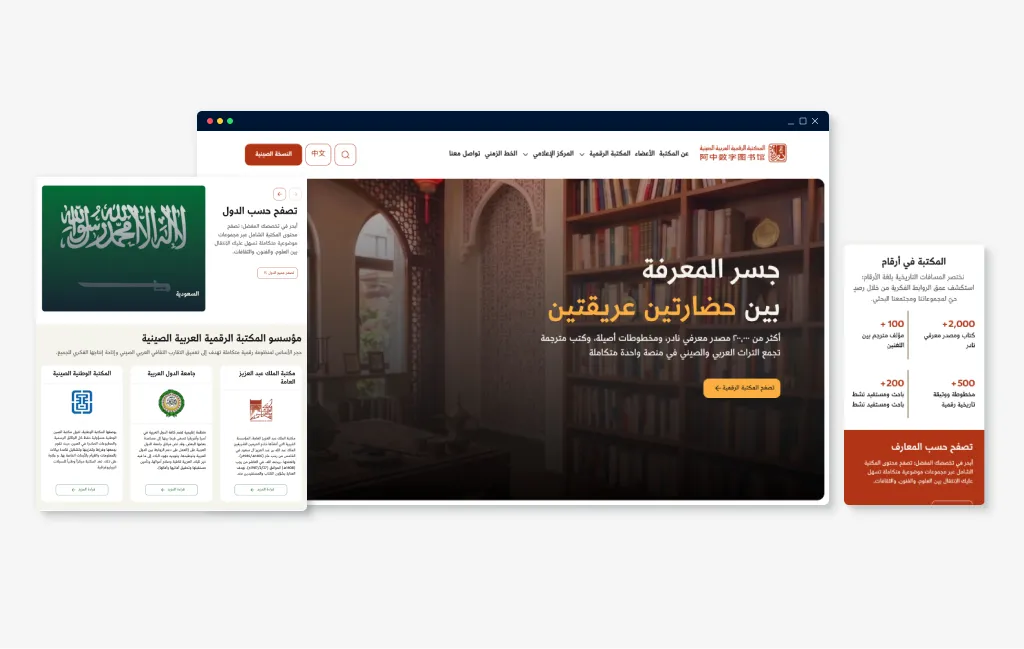
Sprintive developed a multilingual Drupal platform designed to serve both public users and editors across participating Arab libraries.
The project required more than a public-facing digital library. It needed an editorial environment that could simplify content management for different institutions while maintaining consistent content structures, bilingual compatibility, and a unified visual experience.
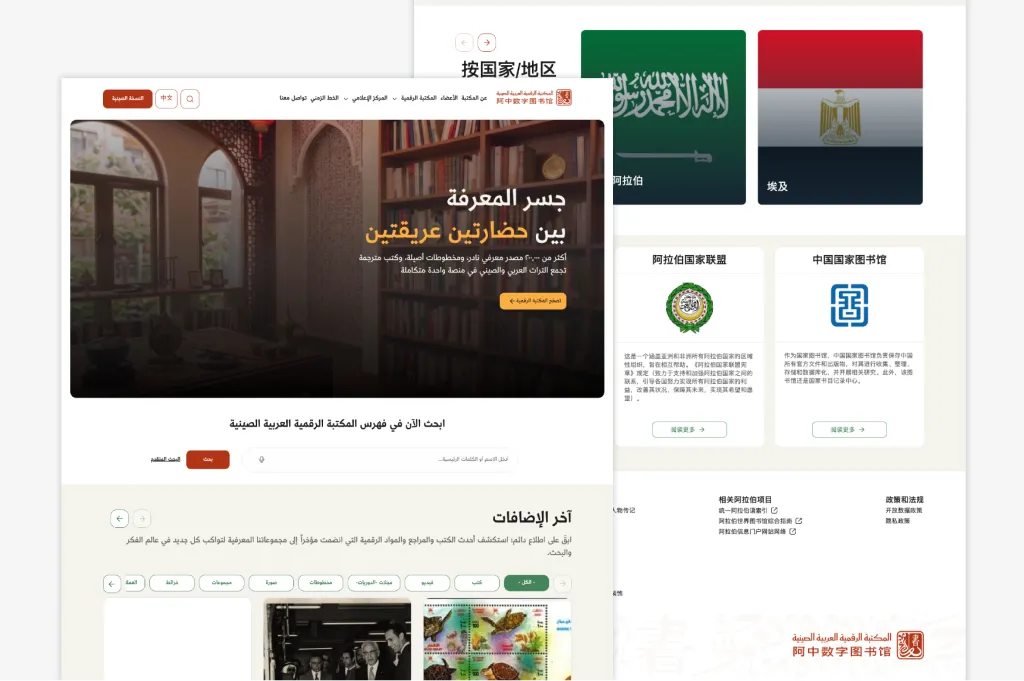
The result is a tailored digital platform that combines structured content management, multilingual publishing, and a distinctive visual identity.
About the project
Project Details
A Customized Editorial Backend
One of the key project requirements was making the platform accessible to editors across participating Arab libraries. Instead of requiring editors to work directly with the complexity of the underlying digital preservation infrastructure, Sprintive developed a customized editorial experience within Drupal.
Editors can manage their content and digital resources through a streamlined interface while the underlying architecture handles asset storage, metadata, indexing, processing, and preservation.
This separation allows librarians to focus on content and collections, while the platform manages the technical operations behind them.
Arabic–Chinese Content Architecture
The platform was designed to ensure that Arabic and Chinese content can coexist and remain connected throughout the website. Content structures support corresponding language versions while maintaining consistent navigation, organization, and presentation across both experiences.
This was particularly important for a platform serving two distinct linguistic ecosystems and facilitating cross-cultural access to digital resources.
Digital Asset Management & Preservation Architecture
The technical foundation combines several open-source technologies, each responsible for a specific part of the digital library workflow.
- Drupal
Drupal serves as the primary frontend and administration interface, providing:- Content management
- Editorial workflows
- User and permissions management
- Public-facing presentation
- Structured content
- Fedora Commons
Fedora Commons provides the long-term digital preservation and linked-data storage layer.
It manages digital objects and their associated metadata as part of the platform's preservation architecture, providing a foundation for sustainable management of the library's digital collections. - Apache Solr
Apache Solr powers the platform's advanced search capabilities.
It provides enterprise-level indexing and querying while supporting customizable search facets, allowing users to refine and explore the digital library based on available metadata and content characteristics.
Digital Processing & Metadata Extraction
The platform incorporates specialized services for processing and enriching digital assets.
- Hypercube – Tesseract OCR
Hypercube integrates Tesseract OCR capabilities to extract text from digitized materials.
This enables scanned and image-based resources to become more searchable and accessible within the digital library. - CrayFits
CrayFits extracts technical and administrative metadata directly from the binary headers of digital files.
This information supports preservation workflows and provides additional metadata that can be used for digital preservation auditing and asset management.
Microservices Architecture
Several specialized microservices support the processing and delivery of digital assets across the platform.
- ActiveMQ: provides message-oriented communication between platform components, supporting asynchronous processing and coordination between services.
- Memcached: provides caching capabilities to improve application performance and reduce unnecessary processing for frequently accessed data.
- Houdini—ImageMagick: Houdini, powered by ImageMagick, handles image generation and processing required by the digital library.
This supports the creation of image derivatives and optimized versions of digital assets for different use cases. - Homarus: handles audio and video transcoding, allowing multimedia resources to be processed into formats suitable for delivery and playback across the platform.
- Cantaloupe – IIIF Image Server: provides an image server based on the International Image Interoperability Framework (IIIF).
It enables dynamic delivery and manipulation of high-resolution images and visual assets, supporting use cases such as maps and other detailed digital materials.
This provides users with a more efficient way to interact with high-resolution resources without requiring the entire original file to be delivered at once.
Advanced Search & Discovery
The combination of Drupal, structured metadata, and Apache Solr creates an advanced discovery layer for the digital library. Users can search and refine resources based on available metadata and content characteristics, while the underlying indexing architecture supports large and diverse collections.
The use of OCR also extends discoverability to digitized materials that would otherwise contain only image-based information.
Why Drupal was chosen
Drupal was selected for its flexibility in handling structured, multilingual, and content-rich platforms.
Its content modeling and multilingual capabilities provided the foundation for managing Arabic and Chinese content while maintaining relationships between corresponding language versions.
Drupal also allowed Sprintive to customize the editorial experience and create a tailored front end without compromising the flexibility of the underlying CMS.
Technical Specifications
Drupal version: