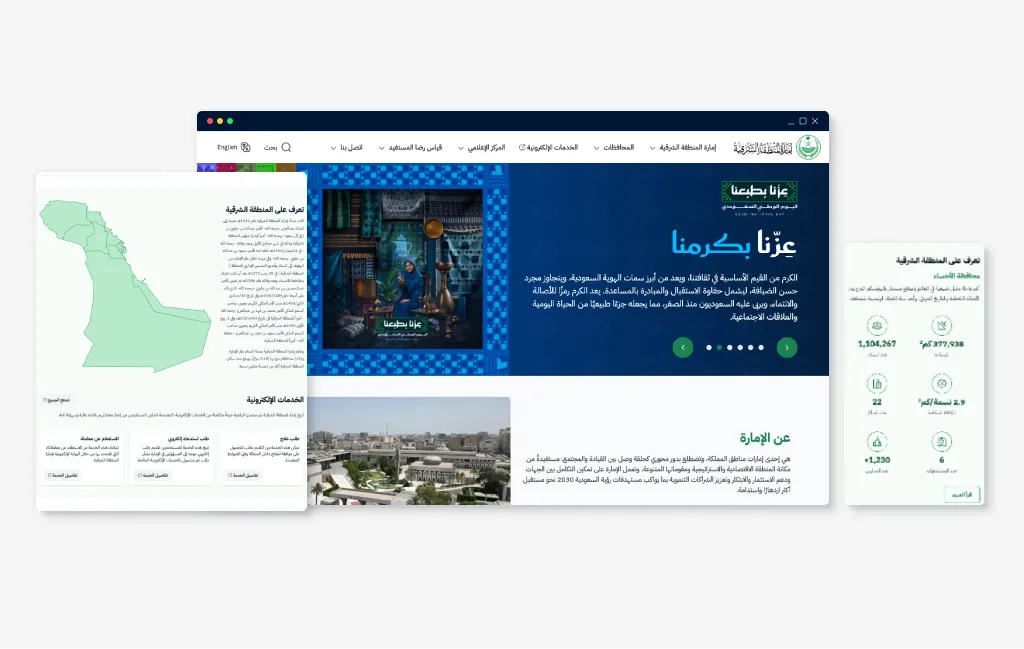
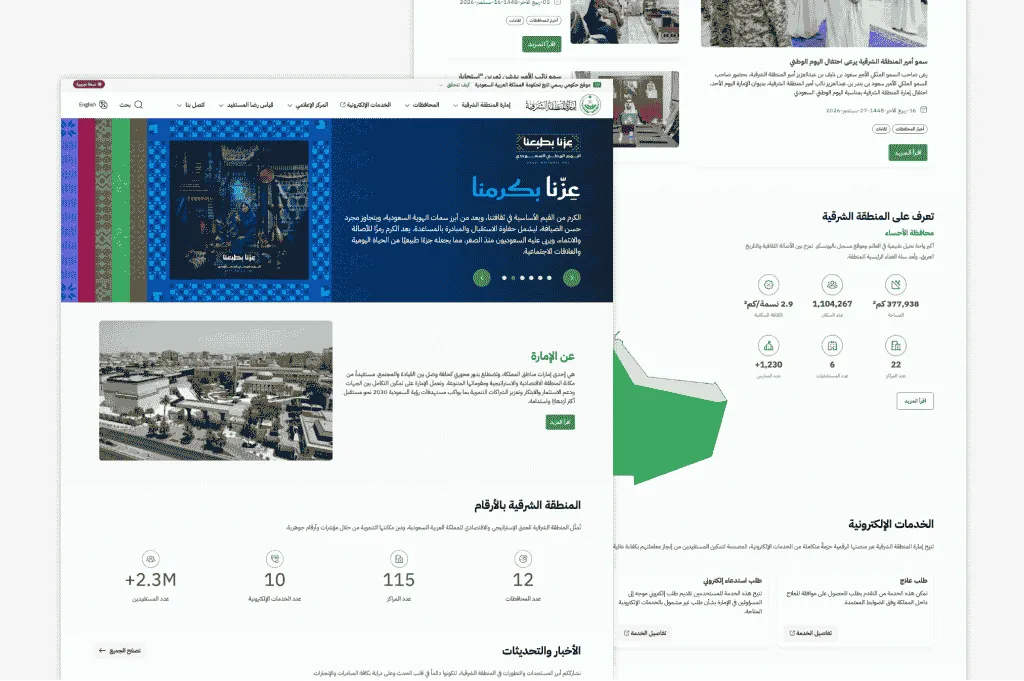
Sprintive designed and developed the new Sharqiah website as a Drupal-based government digital platform, combining a standardized government design foundation with a flexible architecture capable of supporting the Emirate’s extensive content and future digital requirements.
The project covered the complete digital delivery lifecycle, including:
- UX and UI implementation
- Drupal development
- Content migration and structuring
- Arabic and English content
- Translation and localization
- SEO implementation
- Accessibility and government compliance
- Performance optimization
- Structured content architecture
- Interactive data visualization
- Integration of strategic and sustainability frameworks
A key requirement was to deliver the platform within a highly compressed timeframe. Using Sprintive’s specially-developed tools, the website was designed, developed, populated, translated, optimized, and prepared for launch in 10 days!.
About the project
Project Details
Accelerating Government Website Development with SAUD
One of the key accelerators behind the project was SAUD, Sprintive's internal tool for developing Saudi government websites.
SAUD incorporates reusable government-focused templates, components, and interface patterns designed around the requirements of Saudi digital government platforms.
The platform is designed to work with the Platforms Code design system, Saudi Arabia's unified national design system developed by the Digital Government Authority (DGA) to standardize digital interfaces across government websites, portals, and applications.
Rather than rebuilding common government interface patterns from scratch for every project, SAUD provides a reusable foundation that can be configured and customized according to the individual entity's requirements.
For Sharqiah, this approach enabled the team to:
- Rapidly assemble standardized government interface components
- Maintain consistency with national digital design requirements
- Customize layouts and components for Sharqiah's content
- Reduce repetitive development work
- Establish a consistent design language across the platform
- Accelerate implementation without sacrificing flexibility
Three-Tier Architecture with TRIO
The website was also built using TRIO, Sprintive's architecture framework for implementing a three-tier digital platform architecture.
TRIO separates the platform into distinct layers, helping establish clearer boundaries between the presentation layer, application/business logic, and data layer.
This architecture supports:
- Separation of concerns
- Improved maintainability
- Scalability
- Reusability
- Better security boundaries
- Easier future integrations
- Independent evolution of platform components
The architecture aligns with the direction toward structured, scalable digital platforms within Saudi Arabia's government digital ecosystem.
By combining Drupal with TRIO, the project was able to maintain the flexibility of a CMS while establishing a structured technical foundation for future digital services and integrations.
Connecting Government News to Strategic Objectives
A distinctive feature of the Sharqiah platform is the way government news is connected to the Emirate's strategic goals.
Instead of treating news as isolated chronological content, the content architecture allows news items to be associated with relevant strategic objectives.
This creates a relationship between:
News → Strategic Goal → Government Direction
This structure provides users with additional context around government activities while creating a more meaningful relationship between day-to-day government communications and long-term strategic priorities.
From a content-management perspective, the approach also creates a structured data relationship that can be reused across the website, enabling strategic content to be surfaced dynamically in relevant sections.
Mapping Sharqiah's Development to the UN Sustainable Development Goals
The platform extends this structured approach by connecting relevant government news and initiatives to the United Nations Sustainable Development Goals (SDGs).
This creates an additional layer of contextual metadata around government activities, allowing content to demonstrate how initiatives and developments relate to broader sustainability objectives.
The resulting content model can connect:
News / Initiative → Strategic Objective → SDG
This provides a clearer representation of the relationship between the Emirate's activities, its strategic priorities, sustainability objectives, and the broader development framework.
It also supports the communication of the Kingdom's progress toward the objectives of Saudi Vision 2030.
An Interactive Map of the Eastern Province
One of the platform's key interactive experiences is the presentation of the Eastern Province's governorates through an interactive geographic map.
Rather than presenting the governorates as a conventional list, the website provides a visual representation of the region that allows users to interact directly with the map.
When a governorate is selected, users can access relevant information including:
- Governorate profile
- Demographic information
- Population statistics
- Key geographical information
- Development-related data
- Other relevant statistics and indicators
The experience transforms structured regional data into an intuitive visual interface.
From a technical perspective, the map is connected to structured Drupal content, allowing governorate information and statistics to be maintained through the CMS rather than hard-coded into the interface.
This creates a scalable foundation where information can be updated as regional data changes.
Structured Content Architecture
The platform was designed around structured content rather than treating pages as isolated documents.
Content entities and relationships allow information to be reused across different parts of the website.
For example, a strategic objective can be associated with multiple news items, while a governorate can maintain its own structured profile and statistical information.
This approach provides several benefits:
- Reduced content duplication
- Consistent information across the platform
- Easier content maintenance
- Better internal linking
- More powerful filtering and discovery
- Greater flexibility for future digital experiences
- Improved SEO through structured relationships
Drupal's content modeling capabilities were central to implementing this architecture.
Multilingual Content and Localization
The platform supports both Arabic and English, with content structures designed to maintain alignment between the two language versions.
The project included the translation and localization of the website's content as part of the accelerated delivery process.
The bilingual architecture ensures that language is treated as part of the content model rather than as a separate version of the website, helping maintain consistency across navigation, metadata, structured content, and key information.
SEO and Digital Content Optimization
SEO was incorporated into the development process rather than treated as a post-launch activity.
The implementation included structured optimization across:
- Page titles
- Meta descriptions
- Heading structures
- URLs
- Internal linking
- Image alternative text
- Arabic and English page relationships
- Search-engine-friendly content structures
- Structured content relationships
Drupal's content architecture also provides a foundation for maintaining SEO requirements as new content is published.
Digital Government Compliance
The website was developed with Saudi Arabia's digital government requirements in mind, including the Digital Government Authority's frameworks and standards for improving the efficiency and quality of government websites and digital content.
Compliance considerations were incorporated across the design, content, technical implementation, and user experience.
This included attention to:
- Government design-system alignment
- Digital accessibility
- Content quality
- Information architecture
- Bilingual content
- SEO
- Performance
- Usability
- Consistency of digital interfaces
The approach allowed compliance requirements to become part of the development workflow rather than a final-stage checklist.
Delivered in 10 Days
The combination of Drupal, SAUD, TRIO, reusable components, structured content architecture, and Sprintive's integrated delivery process enabled the complete website to be delivered in 10 days.
The delivery scope covered more than development. Within the same accelerated timeline, the team handled:
Design → Development → Content → Translation → SEO → Compliance → Optimization → Launch Preparation
This demonstrated how reusable digital-government infrastructure can significantly reduce delivery time while maintaining the technical and content requirements expected from a modern government platform.
Why Drupal was chosen
Drupal was selected as the core CMS because of its ability to combine structured content management, flexible content modeling, multilingual capabilities, security, scalability, and highly customizable front-end experiences within a single platform.
For a government website with a large and diverse content ecosystem, Drupal provides the architectural flexibility required to model different types of government information while maintaining consistent governance over content and presentation.
The platform also enabled Sprintive to build reusable content structures and components that could support:
- Government news and announcements
- Governorate profiles
- Statistics and datasets
- Strategic objectives
- Initiatives and programs
- Government services
- Institutional information
- Multimedia content
- Arabic and English content
- SEO metadata and structured page information
Drupal's modular architecture also provided a strong foundation for integrating Sprintive's SAUD and TRIO capabilities, allowing the project to move from conventional website development toward a reusable digital-government delivery model.
Technical Specifications
Drupal version: