Sector(s)
The group sells services online to business customers. Depending on the country, teams want to take payment online or receive a quote request. Parker+Parker built e-commerce in three stages inside the group's Drupal site factory. First, the e-shop one country already had was rebuilt inside the factory. A full e-shop, with checkout and customer account, followed. The e-commerce features were then brought together in a shared module, enabled on several country sites. A configurator calculates the price based on the service location and the product.
About the project
Results
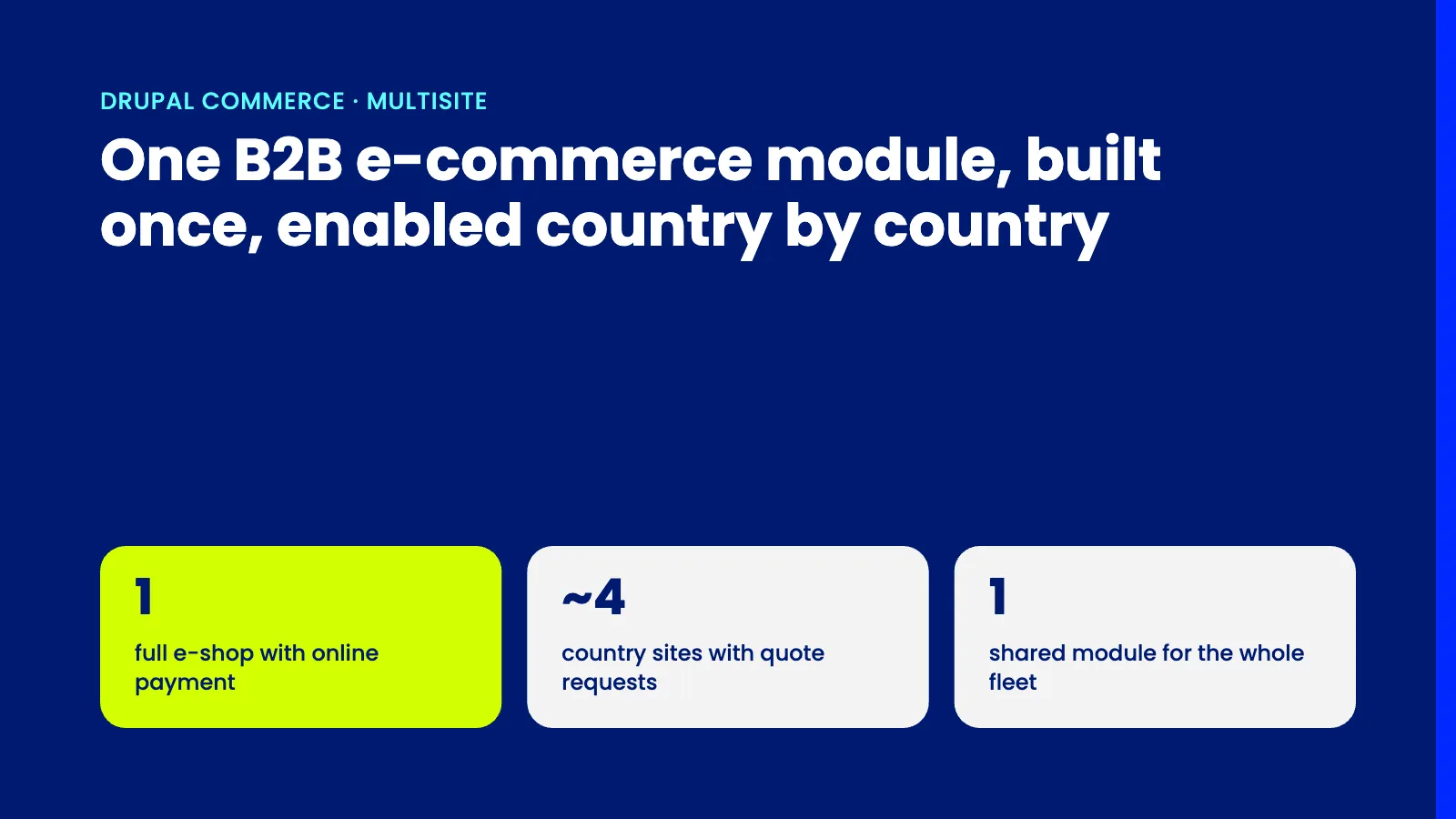
- A shared e-commerce module enabled on about four country sites, with a quote request instead of direct payment.
- A full e-shop, with checkout and customer account, on the same codebase.
- A configurator that calculates the price from four criteria related to the service location and the selected product.
- Fixes and version upgrades are done once for the module, not once per country.
Goal
Let each country sell online according to the practices of its market, without building and maintaining one e-shop per country.
Challenge
The price of a service depends on the service location: a fixed-price catalog does not work. One country already had an e-shop built outside the factory. Other countries wanted product pages and a cart, but with a quote request handled by their sales team rather than online payment.
Solution
- Rebuild of an existing e-shop. The configurator, product pages, cart and service booking were rebuilt inside the factory.
- Full e-shop on Drupal Commerce. Catalog, product pages, checkout and customer account. It is the only site in the factory with direct payment and a customer account.
- Price configurator. A product data matrix feeds the calculation, based on the characteristics of the service location and the selected product.
- Shared module. The e-commerce features were brought together in one module: product pages, cart, then a quote request sent to the country team.
- Deployment through configuration. The module is enabled and configured site by site. A new country reuses it with no new development.
What editors do without developers
Country teams manage their product pages with the shared block library and receive quote requests directly. Enabling e-commerce on another site is a matter of configuration.
Why Drupal was chosen
The group's sites already ran on a Drupal site factory. Selling on another platform would have added a second tool to host, secure and update. Drupal Commerce runs in the same codebase, with the same content model and the same back office. It handles products, cart, checkout and customer account. The journey can also stop before payment and turn the cart into a quote request. This flexibility mattered: the same module had to support online payment in one country and quote requests in others. Thanks to multisite, a Drupal core feature, the module is built once, then enabled through configuration on the sites that need it.
Technical Specifications
Drupal version:
Key modules/theme/distribution used:
Drupal Commerce handles the catalog, cart, checkout and customer account, or stops at the quote request depending on the site. Paragraphs powers the block library used for product pages. All sites share one codebase through Drupal core's multisite feature, so the e-commerce module is built once for the whole fleet.