Sector(s)
Code Enigma Ltd rebuilt and consolidated the entire digital estate of a national numeracy charity onto a single, supportable cloud environment, then retired the legacy stack it replaced. Recurring cloud spend fell by roughly sixty percent, with the stabilised run rate settling at approximately forty percent of the original monthly cost. That is the same platform, the same traffic and the same public products, delivered for a little over a third of the money. The charity's flagship public learning product stayed live throughout.
The estate had grown into five interdependent applications: one main organisational site, one high traffic public learning product, one resource library, one assessment service, and one separate application handling question delivery. They ran in a legacy cloud region with duplicated database instances, duplicated shared storage and overlapping content delivery configurations. Two of those applications also needed to exchange live data with each other, and that integration broke as soon as the sites were moved in isolation. We rebuilt every application on current supported releases, rebuilt the deployment pipelines, reconnected the application programming interfaces and asset flows, and ran a single coordinated cutover of every public domain across three separate domain providers. The legacy environment was then deleted behind a final restorable backup.
About the project
Goals
- Cut recurring cloud spend quickly and materially.
- Consolidate every application onto one supportable environment.
- Retire the legacy region completely.
- Protect the flagship public product, with no loss of user data, content or history.
Requirements
- Full data migration across four production databases plus shared file storage and public assets.
- Restore the integration between applications that had worked on the legacy stack, including content pulled from the resource library and question state exchanged with the separate application.
- Genuine parity between development, staging and production, with environment specific configuration handled in configuration rather than hard coded production addresses.
- Automated certificate provisioning across every public domain and subdomain.
- A single coordinated domain cutover across three separate providers, executed inside a content freeze.
- Preserve accessibility behaviour and content security policy behaviour, including resolving a framing restriction that blocked the assessment service from being embedded.
Outcomes
The estate went live in a single cutover window, following an early morning domain switch with a content freeze in place. Every application now runs from one region, on one deployment path, with automated builds and automatic certificates. The legacy environment was deleted behind a final restorable backup. Two residual issues were separated into their own tracked workstreams rather than being allowed to block the launch: a caching and publishing latency investigation, and a reporting data refresh reliability issue. The reporting pipeline was re-established for the charity's own analysts, including access controls and a corrected scheduled synchronisation.
Delivery effort landed at roughly a fifth more than the original estimate. That overspend is worth being honest about, and the causes were almost entirely outside our control: third party domain access restrictions with mandatory two factor codes made the planned switch window unworkable, and the integration fault between the two applications took longer to isolate than expected because the data flow is not one directional. We took the decision to delay rather than rush a cutover, which was the right call for a charity whose main public product is used by learners every day.
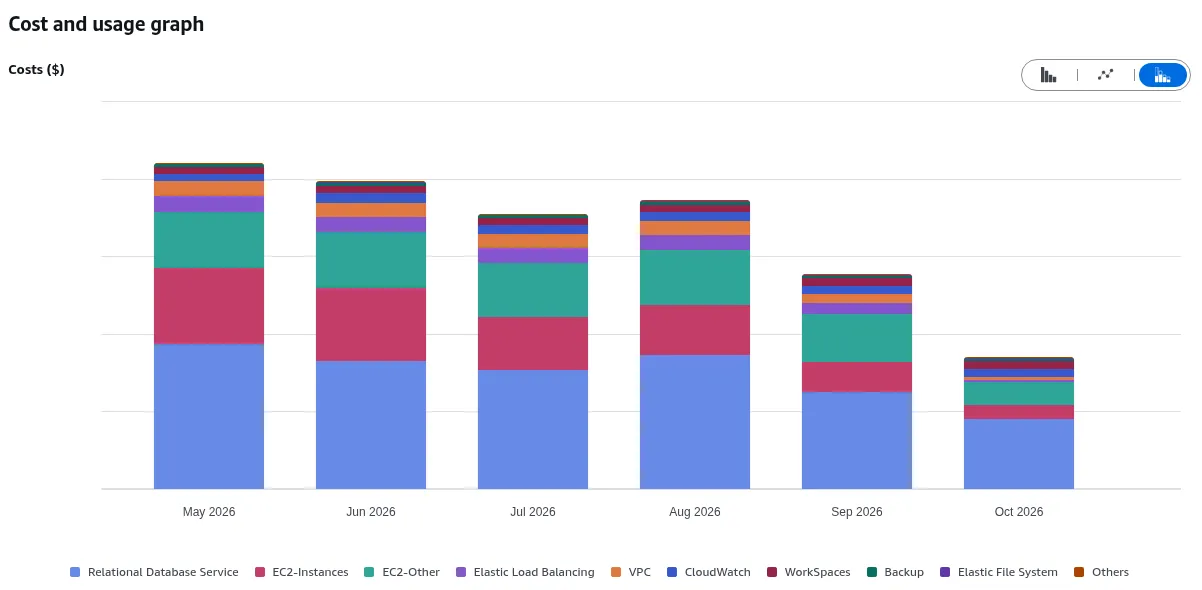
Spend by month, expressed as a percentage of the starting baseline:
- Month one, 100 percent (baseline)
- Month two, 94 percent
- Month three, 84 percent
- Month four, 88 percent (migration month, old and new running in parallel)
- Month five, 66 percent (legacy retired mid month)
- Month six, 40 percent (stabilised)
The shape of that curve matters more than the headline. The saving did not appear the moment we launched, because for a period the charity was paying for both environments at once. The real break comes the month after decommissioning, which is why retiring the old stack promptly, rather than leaving it running as a comfort blanket, was the single most valuable decision in the project.
The saving came from five changes rather than one lever:
- Database consolidation. The managed relational database service was consistently the largest single line item at the outset. Retiring the duplicated legacy instances removed the majority of it, and right sizing what remained removed more.
- Compute and attached storage. Orphaned volumes, stale snapshots and duplicated compute across two environments were eliminated entirely.
- Desktop as a service and legacy add ons. Removed from the baseline completely.
- Storage and networking efficiency. Shared file storage, load balancing and network charges all fell as five overlapping environments collapsed into one, with the content delivery network absorbing far more of the traffic.
- An avoidable software licence. The estate was paying an annual per user licence for a two factor authentication module. An equivalent, free, unlimited user module was identified and recommended in its place. Against the total cloud bill this is a small figure, but for a lean site it is the clearest illustration of the principle: audit every recurring licence before you optimise anything else.
Why Drupal was chosen
Drupal was retained here rather than introduced, and that was the deliberate and correct decision. The editorial load is carried by a very small communications team who need to publish, revise and restructure pages without developer involvement, and they need granular editorial permissions and revision history to do it safely. The learning content is highly structured, spanning topics, question banks, provider records and resource libraries, which suits Drupal's entity and taxonomy model far better than a page builder alone. Most importantly, Drupal's predictable security release cadence and long term support path meant the migration could move the charity onto a supported platform rather than simply relocating an unsupported one. The alternative was a full rebuild, which would have cost far more than the annual saving delivered here and delivered no new capability.