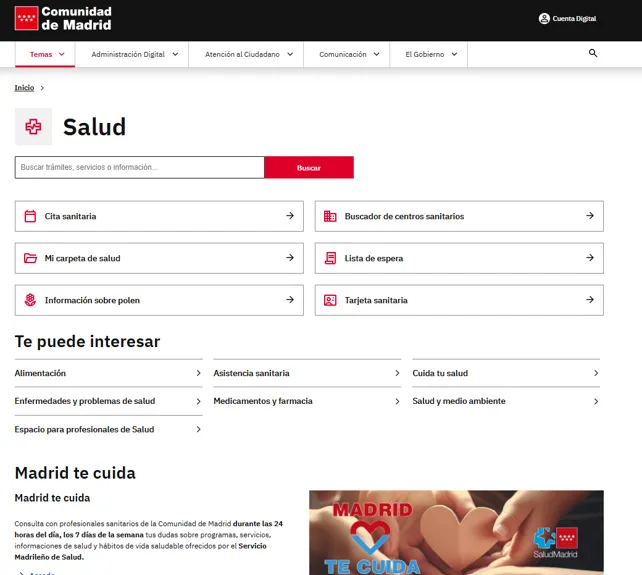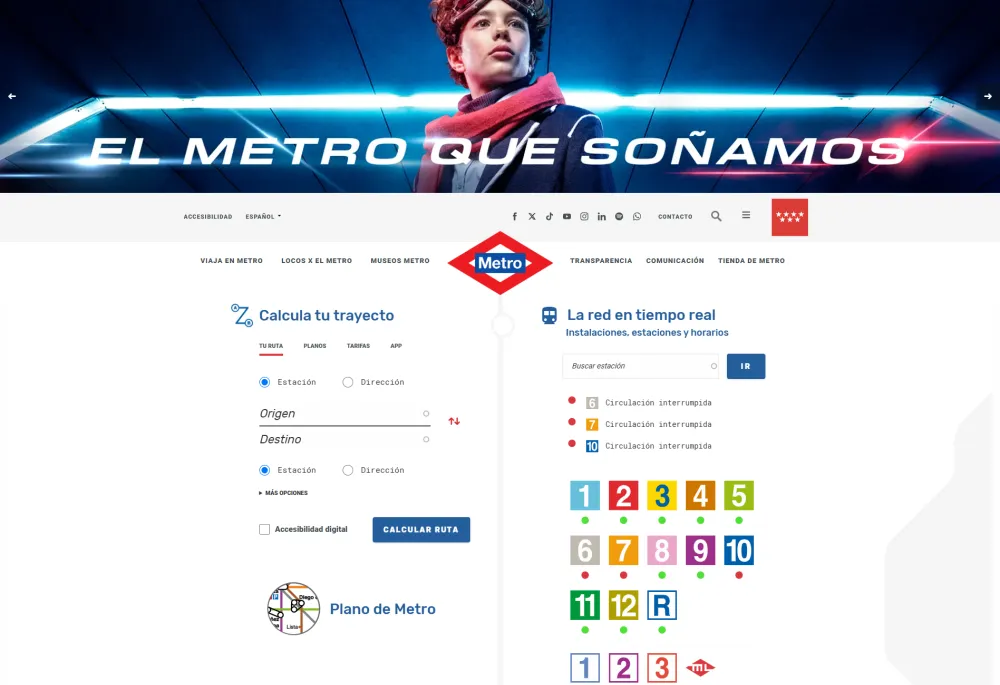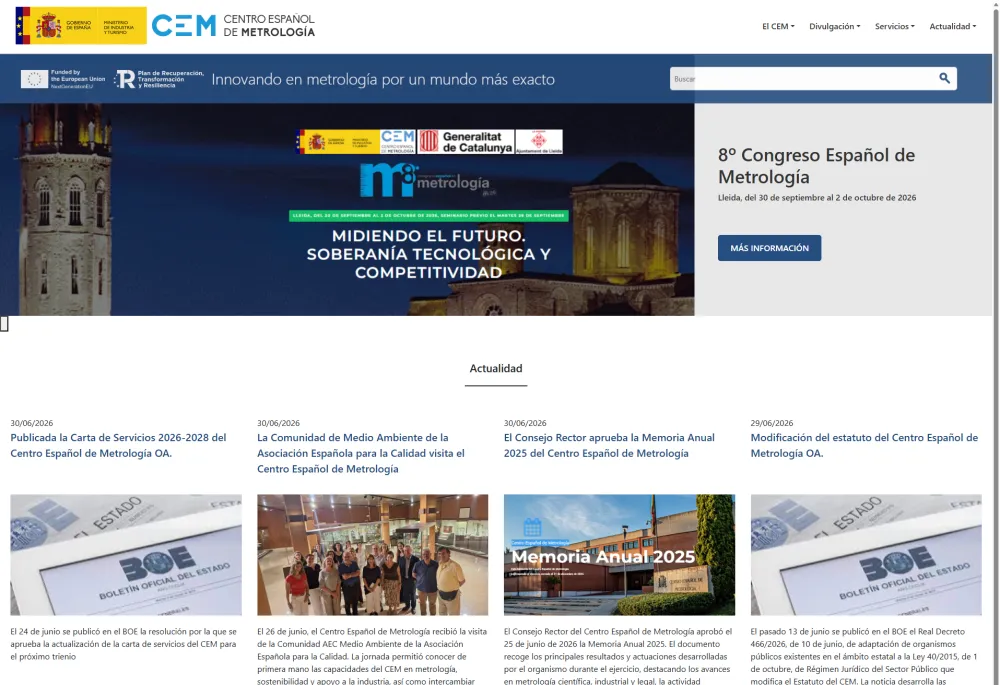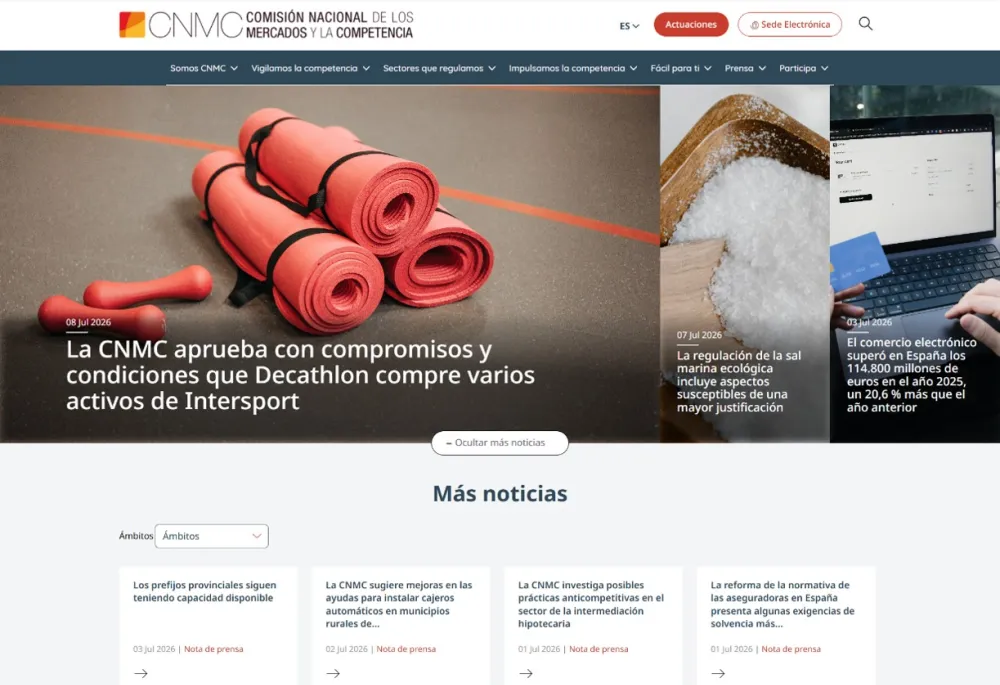
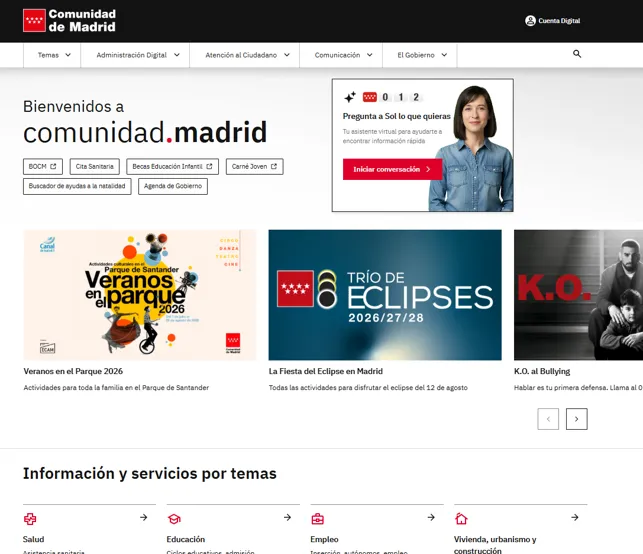
The Comunidad de Madrid (https://www.comunidad.madrid) is the official institutional portal serving more than 6.7 million citizens. It centralizes access to administrative procedures, public services, institutional information and news from multiple regional government departments.
To modernize its digital ecosystem, improve administrative content management and deliver a significantly better user experience, ALTIA carried out a complete transformation of the platform.
The project included migrating the entire portal from Drupal 7 to Drupal 10, redesigning the visual identity following the client's new design system, modernizing the editorial experience and implementing a highly scalable architecture capable of handling the demanding traffic levels of one of Spain's largest public administration websites.
The resulting platform provides citizens with a secure, unified and modern digital entry point while enabling the organization to continue evolving its digital services.
ALTIA has collaborated with Comunidad de Madrid for more than eight years, providing development, maintenance and continuous evolution for this and several other institutional Drupal platforms.
About the project
The modernization programme addressed both technical and organizational challenges, combining a large-scale Drupal migration with a complete redesign of the editorial experience and platform architecture. The following sections describe the project's goals, key challenges, implemented solution and the business outcomes achieved.
Project Goals
- Technology modernization and long-term sustainability: Replace the ageing Drupal 7 platform by migrating the entire digital ecosystem to a modern, long-term supported version of Drupal. The migration had to be carried out while keeping both the legacy and the new platforms running simultaneously, without disrupting the daily work of content editors.
- Complete visual redesign: Redefine the portal's visual identity to align with modern standards of usability, clean design and responsive behaviour, following the client's new design system.
- Editorial experience optimization: Significantly simplify the daily work of public administration content editors by reducing the learning curve and automating complex editorial workflows.
- Maximum performance and availability: Implement an advanced multi-layer caching strategy together with remote storage to deliver fast response times and ensure high availability, even during periods of exceptionally high citizen traffic.
Project Challenges
The modernization of one of Spain's largest government portals involved a number of technical and organizational challenges. Beyond the migration itself, the project had to ensure business continuity, improve the experience for hundreds of content editors and deliver a platform capable of supporting unpredictable peaks in citizen demand without compromising performance or availability.
The main challenges included:
- Critical Drupal 7 migration: The biggest challenge was extracting, cleansing and mapping tens of thousands of legacy content items accumulated over many years in Drupal 7. This included more than fifteen different content types, Views, Blocks and other site structures, all of which had to be migrated while preserving data integrity.
- Editorial experience and diverse user profiles: The platform is used daily by hundreds of public-sector editors with varying levels of digital expertise. The previous Drupal 7 back office had become overly technical, with a slow and unintuitive interface that created bottlenecks when publishing urgent institutional information.
- Unpredictable traffic peaks: As the main institutional portal of the Community of Madrid, the website regularly experiences massive spikes in concurrent traffic during public recruitment campaigns, school enrolment periods, health alerts and official government announcements. The new platform needed to guarantee high performance and availability under these demanding conditions.
Solution
To address the project's technical and functional challenges, ALTIA designed and implemented a modern Drupal 10 architecture focused on scalability, performance, maintainability and editorial usability. The solution combined Drupal's native capabilities with enterprise technologies to deliver a secure, high-performance platform capable of supporting millions of users while simplifying day-to-day content management.
Key elements of the solution included:
- High-performance architecture with Memcached: A multi-layer distributed caching strategy was designed to protect the database and accelerate page delivery. At the application layer, Memcached was implemented to manage Drupal's object cache—including configuration, service containers and entity data—significantly reducing redundant database queries. At the external layer, Drupal 10's native Cache Tags were integrated with a reverse proxy and a Content Delivery Network (CDN), allowing the vast majority of citizen requests to be served directly from memory with extremely fast response times.
- Simplified editorial experience: Drupal's back office was completely redesigned for content creators. Instead of long, complex forms, an intuitive editing experience based on reusable visual components derived from Single Directory Components (SDC) was implemented. Editors can now build complex pages—such as administrative procedures, public campaigns and press releases—using pre-designed components through a visual interface, significantly reducing formatting errors while ensuring design consistency.
- Frontend architecture based on Single Directory Components: The entire frontend was rebuilt using Single Directory Components (SDC). Each component encapsulates its Twig template, CSS, JavaScript and schema definition in a single directory, improving maintainability, ensuring visual consistency and guaranteeing compliance with the client's design system.
- Document management with Amazon S3: To efficiently manage thousands of official documents, PDFs and images migrated from the legacy platform—as well as new media assets created every day—Drupal's Media Library was transparently integrated with Amazon S3, providing scalable and reliable external storage.
- Advanced search powered by Apache Solr: The portal's internal search engine and faceted listings were enhanced through Apache Solr, providing near real-time indexing and allowing newly published content to become searchable almost immediately.
Enterprise Architecture
The platform was designed as an enterprise-grade Drupal solution, integrating modern technologies to ensure scalability, resilience and long-term maintainability.
Key architectural components included:
- Distributed caching: Drupal 10 Cache Tags, Memcached, reverse proxy caching and CDN integration were combined to minimize database load and deliver fast response times, even during periods of exceptionally high traffic.
- Scalable media storage: Drupal's Media Library was integrated with Amazon S3, providing transparent, secure and virtually unlimited storage for thousands of documents, images and other digital assets.
- Advanced search platform: Apache Solr powers full-text search, faceted navigation and near real-time indexing, allowing newly published content to become immediately available to citizens.
- Component-based frontend architecture: The adoption of Single Directory Components (SDC) enabled the creation of reusable frontend components that encapsulate Twig templates, CSS, JavaScript and metadata, improving maintainability, consistency and development efficiency.
- Future-ready platform: The resulting architecture provides a robust technical foundation that supports continuous evolution, simplifies maintenance and enables the Community of Madrid to expand its digital services while maintaining high levels of performance, security and availability.
Results
The modernization of comunidad.madrid has provided the Community of Madrid with a modern, scalable and sustainable digital platform, ready to support both current and future public administration needs.
- Greater stability and performance: Thanks to the multi-layer caching strategy based on Memcached and external cache optimization, the platform delivers excellent performance even during periods of extremely high demand. Database load has been significantly reduced, improving scalability and overall system resilience.
- Improved editorial efficiency and productivity: Simplifying the content management experience removed much of the technical complexity for editors. Publishing public information, citizen guides and official announcements became significantly faster, while reducing dependence on technical support from the development team.
- Consistency, maintainability and innovation: The adoption of Single Directory Components enabled the development team to build and maintain the new design system with greater consistency and without visual regressions. Editors now benefit from a flexible yet controlled authoring experience, while Apache Solr delivers fast, accurate and highly relevant search results for citizens.
Why Drupal was chosen
Drupal was selected because it offered the ideal balance between flexibility, scalability and long-term sustainability required by a large public administration portal.
The Drupal Migrate ecosystem provided a mature and reliable framework for migrating a large volume of legacy content, entities and editorial structures from Drupal 7 while ensuring business continuity throughout the migration process.
Drupal 10 also enabled the adoption of modern frontend development practices through Single Directory Components (SDC), allowing reusable components to encapsulate Twig templates, CSS, JavaScript and component definitions within a single structure, greatly improving maintainability.
From a performance perspective, Drupal's native Cache Tags together with integrations such as Memcached, Apache Solr, Amazon S3 and external cache invalidation through Purge provided the scalability required to support millions of citizens during periods of exceptionally high demand.
Its flexible content architecture, modern editorial tools and enterprise integration capabilities made Drupal the ideal technology to support the long-term digital strategy of Comunidad de Madrid.
Technical Specifications
Drupal version:
Key modules/theme/distribution used:
- Migrate: To migrate all legacy content, entities and editorial structures from Drupal 7 while preserving relationships and data integrity.
- Paragraphs & Layout Builder: To simplify the editorial experience through reusable visual components and flexible page composition.
- Media: To centralize document and multimedia management within Drupal.
- Search API Solr: To provide advanced indexing, faceted navigation and near real-time search capabilities.
- Memcache API and Integration: To optimize Drupal object caching and significantly reduce database load.
- S3 File System: To transparently store thousands of media assets and official documents in Amazon S3.
- Purge: To automatically invalidate reverse proxy and CDN caches using Drupal Cache Tags, ensuring high performance without sacrificing content freshness.