Sector(s)
Project Team
Kate Swayne — Engagement Manager, Business Analyst & QA
Phillipa Martin — Rules as Code Business Analyst
Suchi Garg — Drupal Technical Lead
Mark Calvert — OpenFisca Technical Lead
Awang Setyawan — OpenFisca Developer
Visit the site
Visit the siteOrganizations Involved
Community contributions
This particular sandpit (alcohol excise policy modelling) did not include community contributions, however the broader GovCMS Rules as Code sandpit program included community contributions in the form of changes and enhancements to the Webform OpenFisca module.
We also provided a patch to improve the functionality of the Condition Query module.
As part of the GovCMS Rules as Code sandpit program, this Rules as Code proof of concept focuses on modelling changes in alcohol excise rules for beer production. Policy modelling using OpenFisca helps to see intended and unintended consequences of policy changes before they’re introduced.
About the project
GovCMS’ challenge
With the Rules as Code Sandpit Program coming to an end, GovCMS was keen to explore a proof of concept looking at policy modelling. It was of particular interest given OpenFisca’s simulation capabilities hadn't been explored during the first 14 prototypes.
GovCMS’ transformation
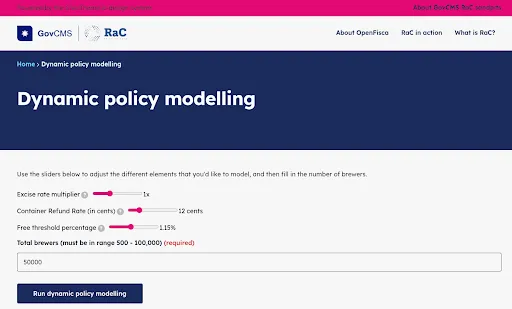
Salsa Digital worked with the GovCMS Rules as Code team to research different use cases before choosing alcohol excise and recycling costs for beer producers. In this prototype, we include the standard Drupal webform approach, this time letting beer producers fill in details to estimate the alcohol excise and recycling costs payable.
We then extended on this, adding:
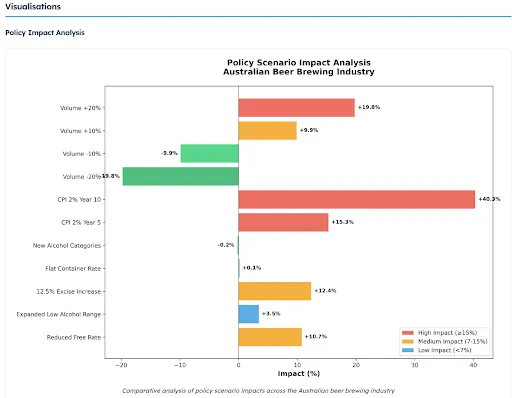
- A comprehensive report outlining 11 policy scenarios to assess their potential impact and support evidence-based decision-making.
- Dynamic policy modelling, with adjustable levers in an interactive Drupal webform linked to the OpenFisca codebase. The levers include:
- Excise rate
- Container refund rate
- Free threshold percentage (for alcohol percentage)
- Number of brewers
Note: This simulation experiment was developed by the GovCMS and Salsa Digital teams using publicly available information, legislation and regulations. It does not reflect, represent or replace ATO policy on alcohol excise.
The outcomes — a policy modelling showcase
This sandpit provides a demonstrator for GovCMS to showcase the power of policy modelling in Rules as Code.
A production rollout of any policy modelling Rules as Code tool would provide the following benefits for government, citizens and businesses:
- Visibility on how policy changes will affect government, citizens and/or businesses
- The ability to experiment with policy changes before implementation
- The ability to make evidence-based decisions around policy changes
- Protection of citizens’ and/or businesses’ best interests through informed decision-making
Why Drupal was chosen
Drupal was chosen as the preferred CMS for Australia’s Federal Government through the creation of the GovCMS platform, which was launched in 2015. GovCMS is designed to make it easier for government agencies to create modern, affordable, responsive websites. Importantly, GovCMS provides a whole-of-government platform to help consolidation across government departments. The fact that Drupal is open source means there are no expensive lock-in contracts, and GovCMS can build a Drupal/GovCMS community.
For this sandpit, the Drupal component was hosted on Salsa Hosting (not GovCMS), however as a proof of concept it needed to use the same technology as the GovCMS platform.
Technical Specifications
Drupal version:
Key modules/theme/distribution used:
-
WebformOpenFisca module was chosen so the Drupal webform could be integrated with the open source rules engine, OpenFisca. Drupal takes the inputs and sends these to OpenFisca, which then sends the results back to Drupal for display.
-
The Token Filter module provides a simple WYSIWYG integration, allowing content editors to use Drupal Tokens directly in their WYSIWYG content. This helps with customised content and the explainability aspect of RaC.
-
The Condition Query module was used to control the visibility of blocks, based on the response from OpenFisca. This allows custom content to be displayed to users based on their inputs, which helps deliver on the important explainability aspect of RaC. Note: Version 1.1.3 of the WebformOpenFisca module removes this dependency.
-
The CivicTheme Design System was chosen to build the prototype quickly and with reduced costs.