Sector(s)
Project Team
- SparkFabrik: Information Architecture, UX/UI Design, Drupal Development
- Agenzia delle Entrate (FiscoOggi editorial staff): product ownership, editorial workflow
FiscoOggi is the most authoritative and long-lived Italian online publication about taxation, edited directly by Agenzia delle Entrate. It publishes updates on the Agency's activity, commentary on legislation and tax case law, and analysis of international tax systems for taxpayers and professionals.
The publication runs at real scale: over 10 million users, 22 million sessions and 40 million page views across three years, with roughly 28,000 newsletter subscribers. An editorial staff of 12 officials coordinates almost 600 authors who publish more than 5,000 articles a year, with mobile use rising sharply.
SparkFabrik led the information architecture, UX/UI design, and Drupal development.
About the project
Goals
Replace an obsolete Drupal 6 (Pressflow) platform with a solid, flexible CMS that improves the day-to-day experience of a very active editorial team, presents content clearly on mobile, and preserves the full historical archive of a magazine that has published for years.
Challenge
Two hard problems ran in parallel. First, a large, live newsroom needed a faster, clearer authoring experience without disrupting its high publishing cadence. Second, a decade of structured content had to move intact from Drupal 6 to the new platform: 42,000+ articles, 35,000 images, and 2,700 audio and video items, with data structures optimised rather than copied verbatim. Mobile usage was climbing (+24% year on year), and as a public-administration site it had to meet strict accessibility standards.
Solution
SparkFabrik rebuilt FiscoOggi on Drupal and reworked both the editor and reader experience:
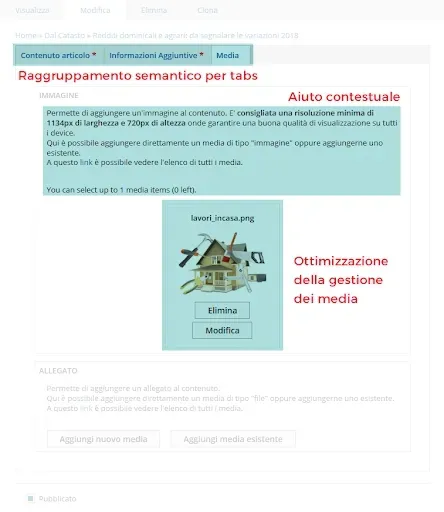
- Editor-first authoring: content forms were reorganised into semantic tabs (field groups) with inline help and notes, replacing a cumbersome legacy workflow
- Large-scale migration: content, images, and multimedia were migrated directly from Drupal 6 using custom destination and process plugins, remapping files, images, video and audio onto media entities and rationalising content types
- Centralised media repository: images became reusable media entities managed through a shared browse-and-embed pattern
- Ranking feature preserved: the most-read ranking, previously provided by a contrib module not yet available on the new Drupal version, was ported forward and its historical ranking values migrated
- Modern streaming: audio and video moved from legacy Flash streaming to HTML5 with MPEG-DASH and HLS support
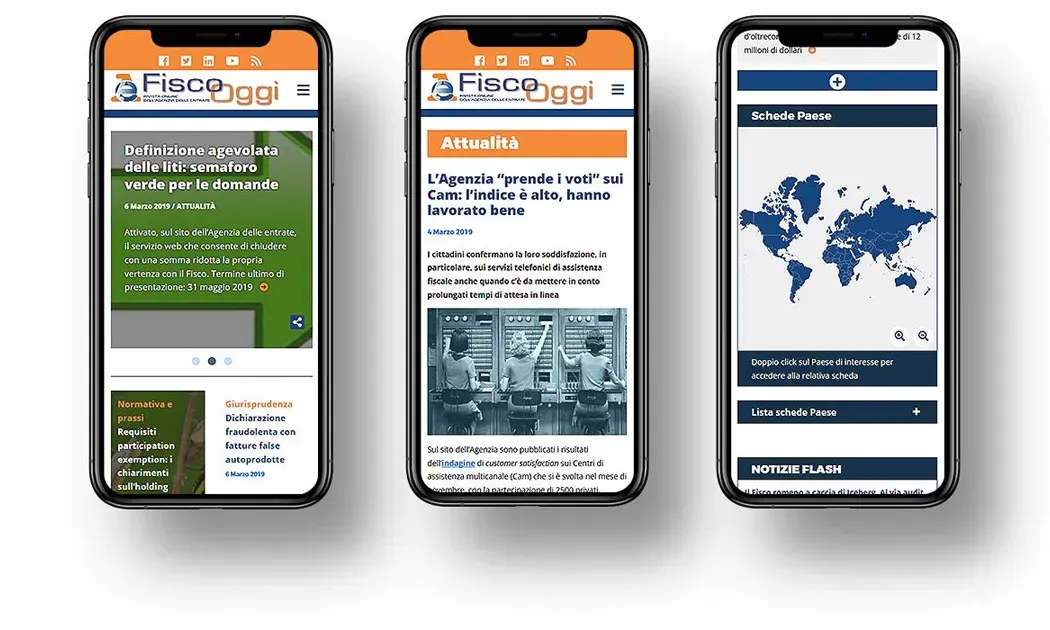
- Mobile-first accessible front end: a Twig theme integrating a responsive framework, with resolution-aware images and stronger typographic hierarchy
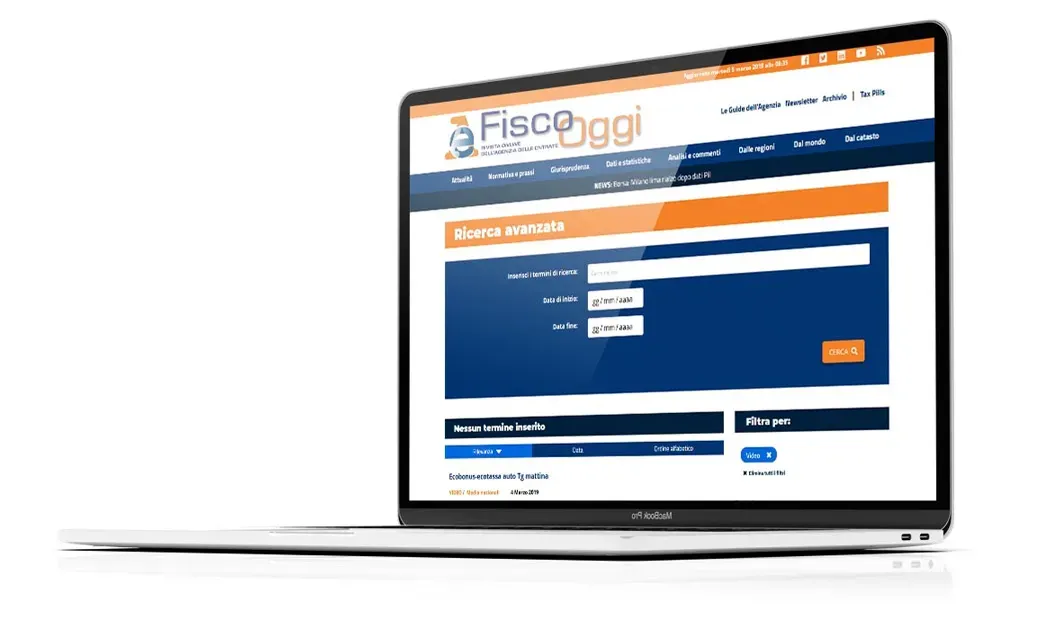
- Faceted search: the existing Apache Solr search was kept and extended, with a recency boost and faceted filtering across all media content
Outcome
- Shorter, clearer paths to content: search centralised, multimedia unified into one coherent interface, country-tax files and the tax-deadline schedule redesigned for quicker access
- The complete legacy archive migrated and re-presented in a modern, future-proof structure
- A faster, WCAG-aligned, mobile-first reading experience, and a modern authoring environment a large distributed newsroom finds easier to use
42,000+ content items migrated, 35,000 images, 2,700 audio and video items, 40 million page views over three years.
The product turns out to be extremely performing, rich in user experience, with captivating client-side components such as dynamic maps for accessing country files, cutting-edge compared to other similar products.
Alessandro Bonelli, ICT Project Monitoring, Agenzia delle Entrate
Why Drupal was chosen
The rebuild continued on Drupal, moving from the legacy Drupal 6 (Pressflow) platform to the current major version rather than switching to a proprietary or lighter-weight CMS. Drupal won on:
- Enterprise-class editorial workflow: customisable content-authoring flows that a large newsroom (12 editors, around 600 authors) can operate daily
- A structured migration path: a mature migration framework to move 42,000+ items from Drupal 6 while rationalising the data model
- Media as first-class entities: native media handling for a centralised, reusable image and multimedia repository
- Standards-based front end: a Twig theme layer for a responsive, mobile-first design meeting public-administration accessibility (WCAG) requirements
- Extensibility and contrib: an ecosystem where existing functionality such as article ranking could be ported and extended, not rebuilt
- Open source, no per-seat licensing: fitting for a public-sector body, with a large community behind it

Technical Specifications
Key modules/theme/distribution used:
The migration framework moved a decade of structured content out of Drupal 6 with custom destination and process plugins, optimising the data model rather than copying it. Treating files, images, video, and audio as media entities created a single reusable repository with a shared browse-and-embed pattern. The newsroom's article-ranking feature was preserved by porting an existing contrib module to the new Drupal version instead of rebuilding it. A Twig theme layer enabled the responsive, accessible front end, and the existing Solr-backed search was extended with recency boosting and faceted filtering.