Sector(s)
Project Team
Julie Erben — Engagement Manager
Phillipa Martin — Rules Analyst, Content Strategist, QA
Suchi Garg — Drupal Technical Lead
Mark Calvert — OpenFisca Technical Lead
Awang Setyawan —Drupal Developer
Amey Mudras — Drupal Developer
Bayer partnered with Salsa Digital to develop a Rules as Code (RaC) proof of concept that digitised and automated parts of the pesticide assessment process for agricultural regulators. The new system enables online submissions, provides instant compliance feedback, and automatically classifies submissions for further evaluation. This significantly reduces manual effort and approval times for regulators, without compromising the quality of decisions.
About the project
Bayer’s challenge
Bayer wanted to explore how the pesticide approval process could be streamlined without compromising the quality of decisions. Bayer was particularly interested in a simple use case like the regulatory application to add or change a manufacturer of a product. While these assessments are usually not complex, they often take a significant amount of time at the regulator level due to application backlog. As a result, approval processes can take up to 2 years or sometimes even longer. Currently, submissions are often handled via email, with producers sending completed forms and supporting attachments directly to the regulator.
Bayer’s transformation
Salsa Digital started this Rules as Code engagement with a series of discovery sessions. These sessions focused on our standard RaC deliverables:
- Rules statements
- Visual diagram of the logic
- Spreadsheet with test cases, ready for our development team
In addition to the standard RaC approach, Bayer wanted to demonstrate broader digitisation. The final solution combines an automated compliance review with an online submission process.
The Rules as Code element establishes equivalence. The digitisation component lets pesticide producers submit their application online and includes a regulator review process.
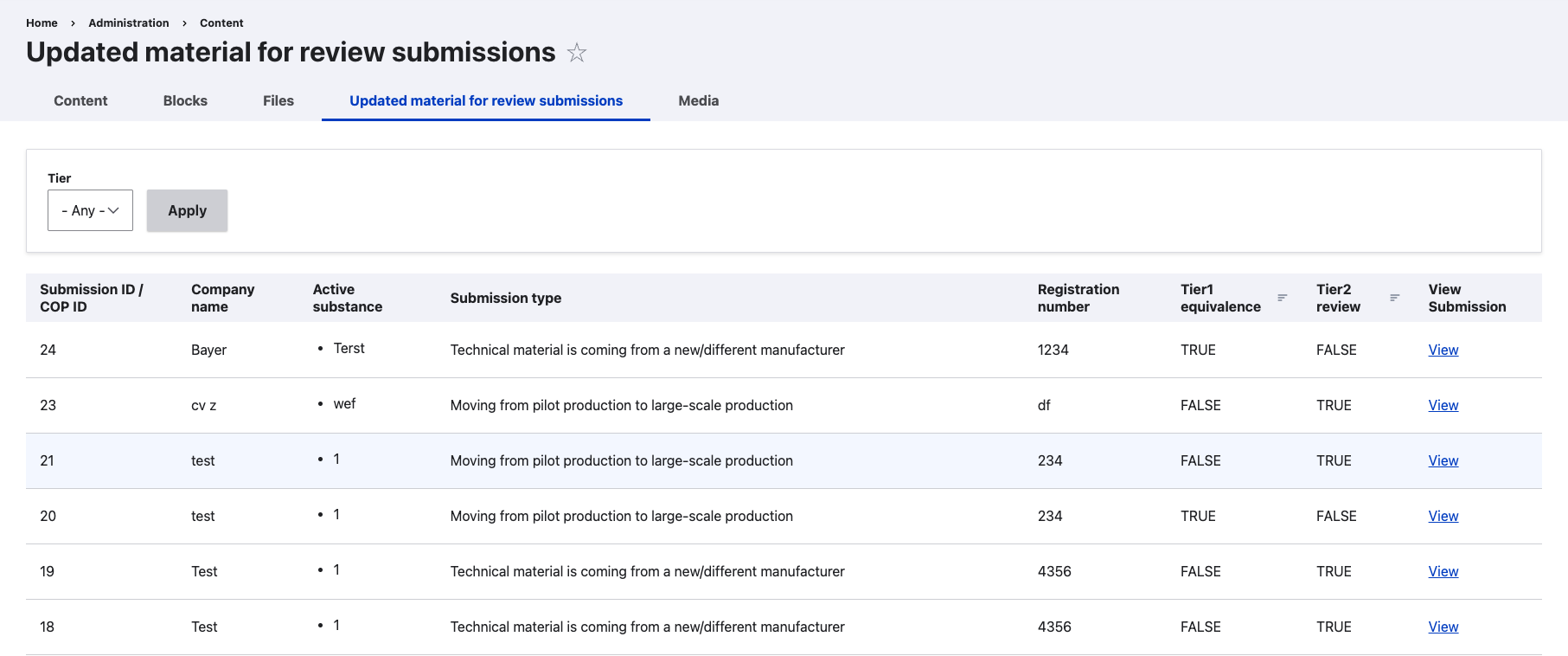
Regulators login to the backend of the website, see submissions sorted as Tier 1 or Tier 2, and then review the submissions. The idea is that Tier 1 submissions could be reviewed and approved by the administrative regulatory staff, while the in-demand experts (e.g. chemists) only need to review the more scientific, complex Tier 2 cases.
From the backend, regulators see all the submissions (as per the screenshot below). They can see the company name, active substance name, submission type, registration number, and if the submission was marked as Tier 1 equivalent or for Tier 2 review.
Regulators can then review the full submission.
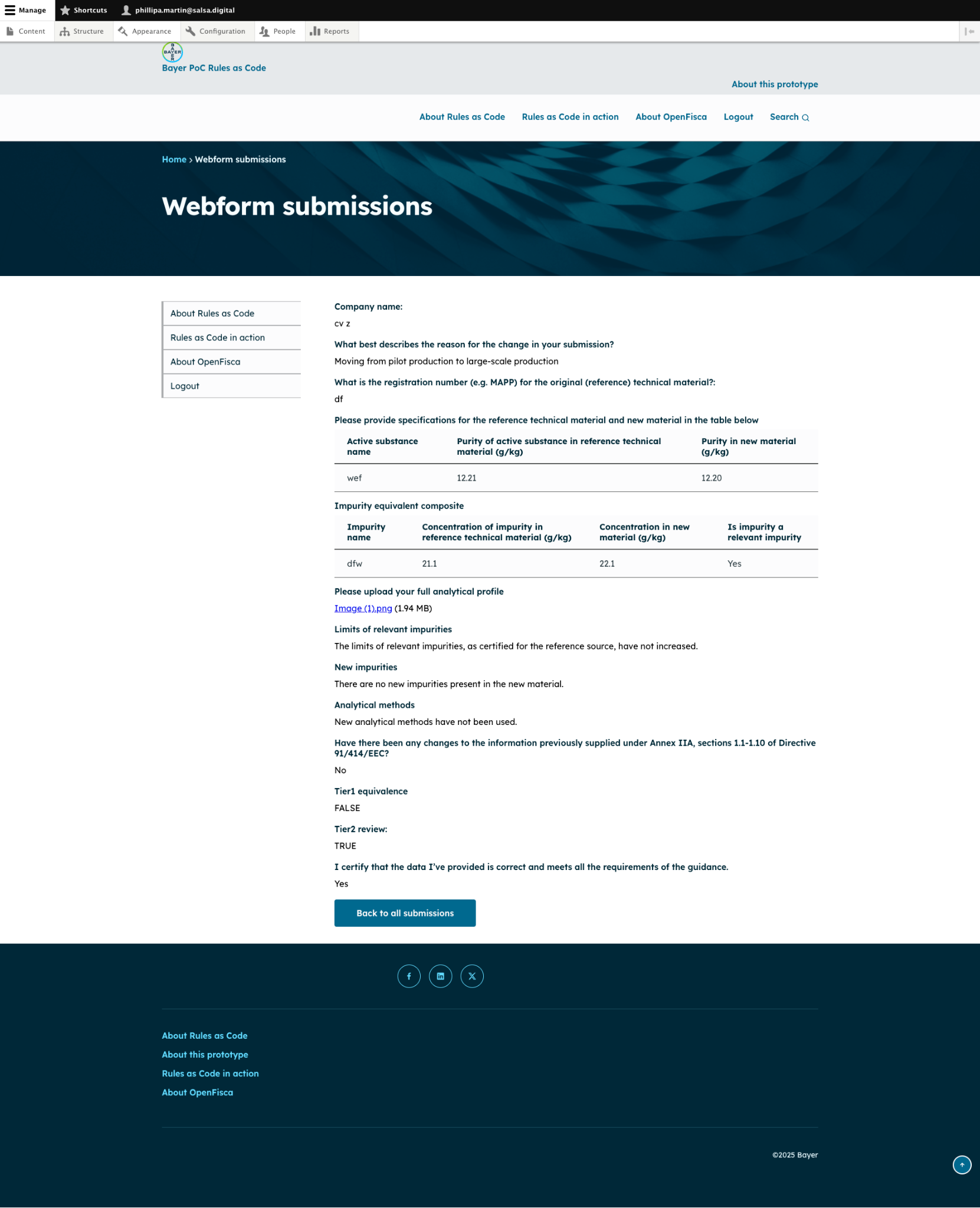
In a production situation (or expanded prototype) a workflow would be included so submissions could be assigned to different regulator staff members and eventually approved or declined all through the one backend system.
Another next step would be to build a database of active substances and impurities, so some of the chemical information could be auto-populated.
OpenFisca and Drupal
This engagement combined OpenFisca with a Drupal content management system to showcase a modern approach to regulatory compliance.
The rules are programmed into OpenFisca for a deterministic Tier 1 equivalence=True or False (where False = Tier 2 review required).
In this prototype, Drupal is actually doing some of the calculation logic, while also drawing on its content management and workflow system to provide a digitised version of the regulatory process.
“We had the pleasure of working with Salsa on this project, and I can confidently say that the experience was great. From the beginning, they took the time to listen to our needs and fully understand our vision. Their ability to adapt to our requirements was impressive, ensuring that every request was addressed with care. Thanks to Salsa, the project went smoothly with a great result.”
Dr Tom Ruts
Regulatory Innovation Lead
The outcomes
- A demonstrator for Bayer to show European and United Kingdom regulators, which was also shared with regulators in North and South America
- A modernised, digital interface so pesticide producers can submit their substances for review and approval online
- Instant feedback for pesticide producers, confirming at submission whether their material meets the criteria for Tier 1 equivalence
- Automated compliance review using Rules as Code (OpenFisca) to see if the substance meets Tier 1 requirements (saving significant time and resources for regulators) without compromising the quality of decisions
- A backend submission interface so regulators can see submissions sorted into ‘Tier 1 equivalent’ or ‘Tier 2 review’
Bayer was so satisfied with the outcomes of the prototype, that they asked Salsa to deliver a similar proof of concept based on the Canadian regulations.
Why Drupal was chosen
Drupal was chosen as the frontend for the Bayer proof of concept because it’s an established part of our Rules as Code technology stack. Salsa integrated Drupal with the open source rules engine OpenFisca via the purpose-built Webform OpenFisca Drupal module.
Technical Specifications
Drupal version:
Key modules/theme/distribution used:
- Webform OpenFisca: For easy integration from OpenFisca API to Drupal via a webform and integrated API handler.
- Condition Query module: Used to control the visibility of blocks, based on the response from OpenFisca. This allows custom content to be displayed to users based on their inputs, which helps deliver on the important explainability aspect of RaC. Note: Version 1.1.3 of the WebformOpenFisca module removes this dependency.
- Custom module was created to save the responses of the OpenFisca API. And thes special dashboards were created to display the results, filtered by Tier equivalence.