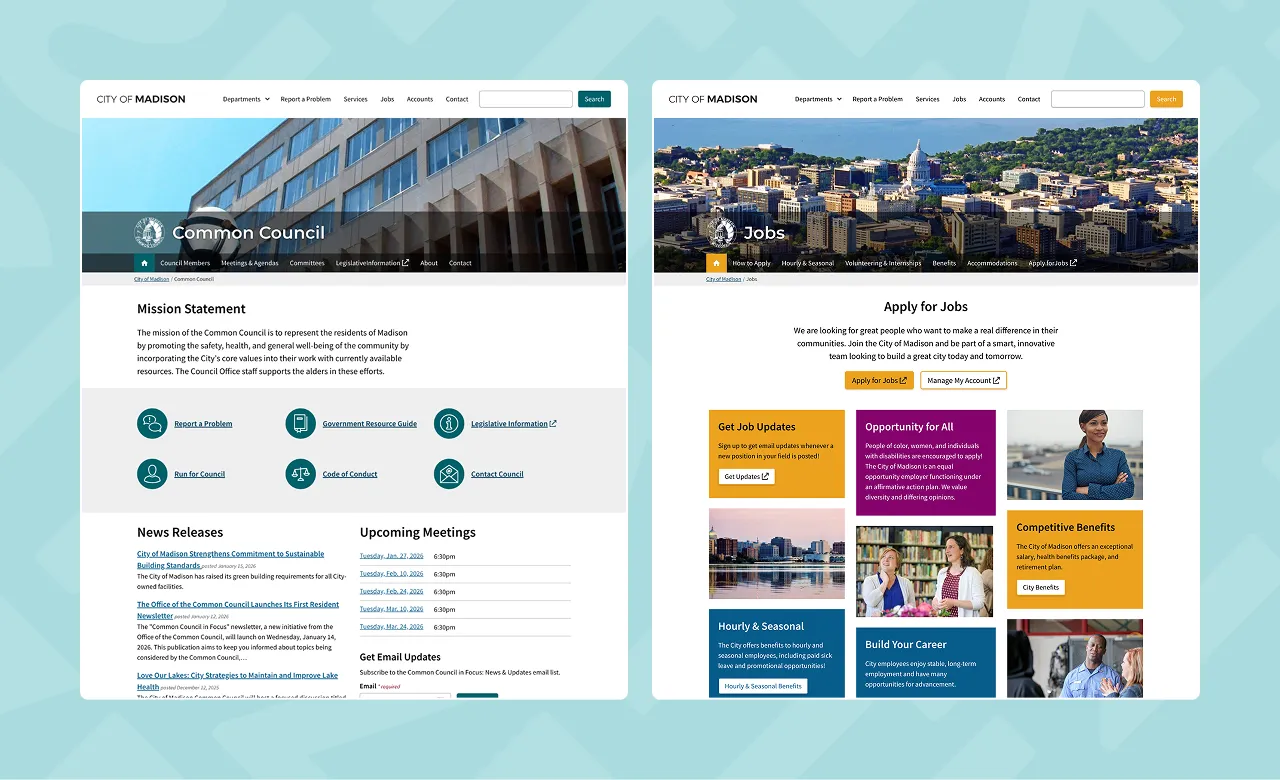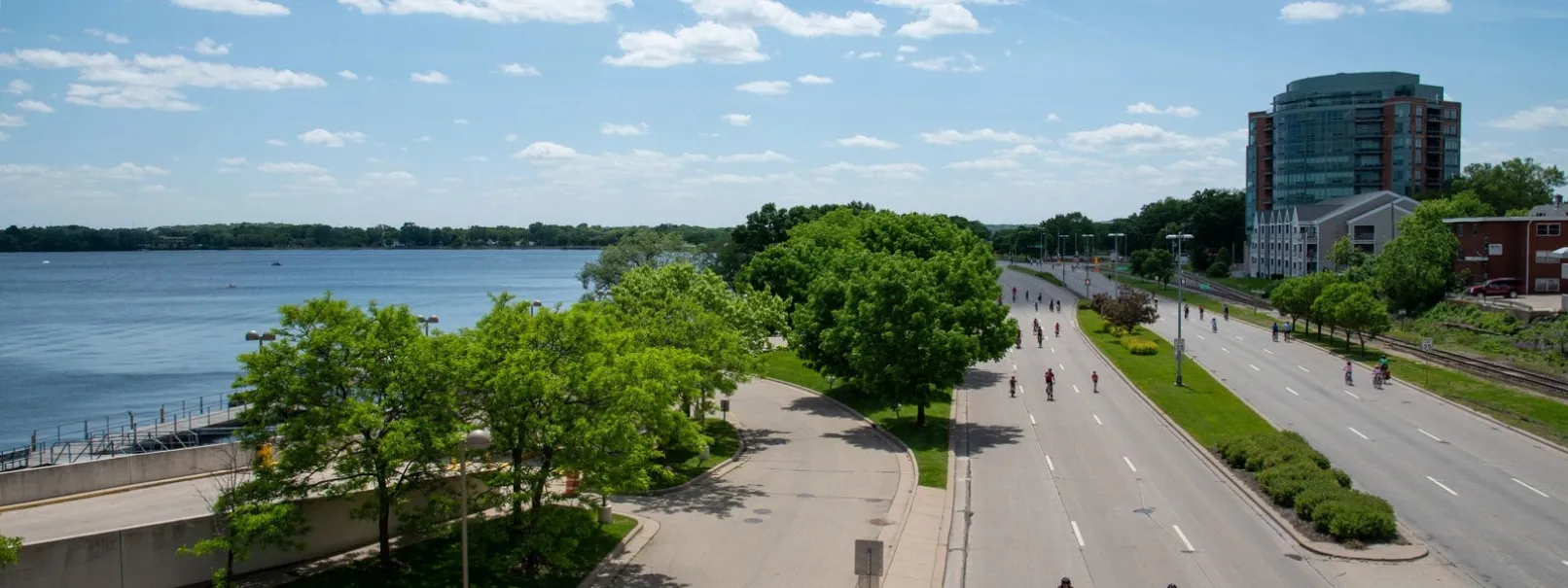
The City of Madison is the capital of Wisconsin and home to the flagship campus of the University of Wisconsin. Madison is the state’s second-largest and fastest-growing city, with a population of roughly 270,000 residents. Its municipal website serves residents, businesses, visitors, and City staff across the full range of services a capital city delivers — from public safety and utilities to parks, planning, and civic engagement.
Madison had long relied on its own developers to build and manage the website. Over time, that self-directed build had grown overly complex and difficult to sustain. The City engaged Electric Citizen to lead a Drupal 7 upgrade, simplify the site’s architecture, and — critically — pair with Madison’s internal development team so the City could take full ownership after launch.
About the project
Challenge
Madison had long relied on its own developers to manage the website. That approach had served the City for years, but over time the site had become overly complex and difficult to sustain — with accumulated content, custom code, and configuration that made it hard to maintain, upgrade, or evolve. Compounding the challenge, the site was still on Drupal 7 and needed to be upgraded to remain supported. The City needed an experienced partner in web development, accessibility, and Drupal best practices — not to take over the site, but to lead a comprehensive rebuild alongside Madison’s own developers so the team could take full ownership after launch.
Solutions
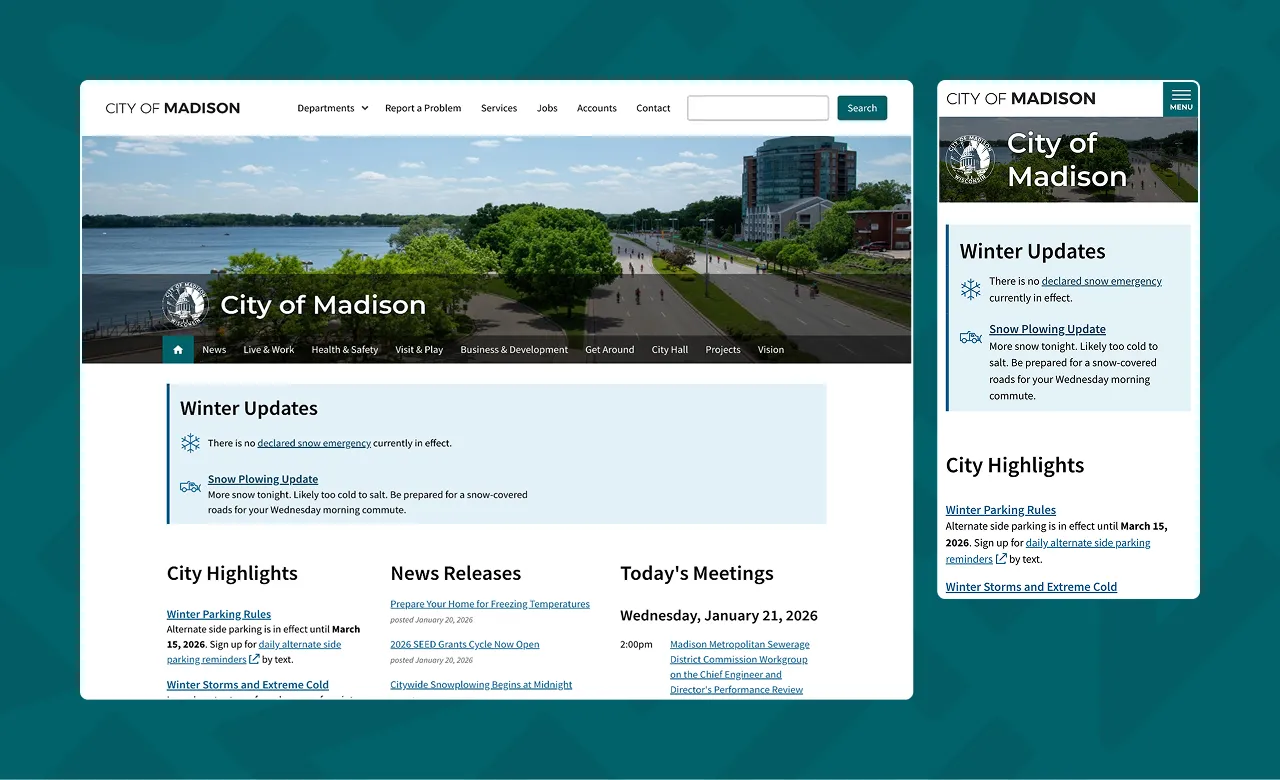
Drawing on years of experience supporting government clients, Electric Citizen worked closely with Madison to design a more sustainable website. We began with a full audit of the existing build, then created a plan to simplify the architecture, remove unnecessary elements, and prioritize essential functionality. The Migrate suite handled the bulk of the content transfer from Drupal 7, with some content re-entered manually where cleanup and consolidation made sense as part of the move. The City’s existing brand carried forward into the new site, with EC leading front-end theming updates to modernize the look and feel and improve accessibility.
A defining aspect of this project was our partnership with Madison’s internal development team. The City wanted its developers directly involved — both to learn from our process and to take full ownership after launch. We guided the team through best practices in build planning, migration strategy, layout and theming, and CMS configuration.
Pairing with a client’s team required clear coordination. We established a joint Jira board, a dedicated Slack channel, and weekly project check-ins to keep both sides aligned and the project moving smoothly.
Mostmadison.org
Post-launch, Madison asked EC to take on an additional city website in need of upgrade: mostmadison.org, the site for the City’s Madison Out-of-School Time (MOST) after-school program. Applying the same Drupal architecture and theme as the main City site, we managed the entire content migration and rebuild of MOST Madison ourselves — including targeted accessibility improvements as part of the rebuild.
Outcomes
This project was considered a success when our services were no longer needed. The Madison team was trained on the new build and took over ongoing maintenance after launch — exactly the outcome the City had set out to achieve. Having earned the City’s trust, EC was then invited back to rebuild mostmadison.org — demonstrating the durability of the partnership even after the primary handoff.
Why Drupal was chosen
The City of Madison was already running on Drupal 7 when Electric Citizen joined the engagement. The decision point wasn’t Drupal vs. another CMS — it was how to move off Drupal 7 while addressing the sustainability concerns that had built up in the existing build. Drupal continued to be the right choice for several reasons:
- Content scale and structure — A municipal government site spans departments, services, permits, meetings, news, and events — with content owned by many different teams across the City. Drupal’s mature content modeling, taxonomy, and entity reference capabilities handle this kind of multi-owner, multi-audience content ecosystem cleanly.
- In-house maintainability — Madison’s in-house developers were going to own the site after launch. Drupal’s open documentation, large contributor community, and role-based permissions support a team building and maintaining a site of this scale without vendor lock-in — exactly the kind of platform a self-directed municipal team can grow with.
- Continuity and familiarity — Staff were already comfortable with Drupal after years on the platform. Moving to the current version of Drupal preserved that institutional knowledge while giving the team a modern editorial and front-end experience.
- Accessibility — As a public-facing government site, accessibility was essential. Drupal’s accessibility-focused core and admin experience support sustained WCAG compliance.
- Sector fit — Drupal is broadly adopted across U.S. state and local government, which means proven patterns for multi-department municipal sites and a deep pool of expertise and contributed modules to draw from.
- Open source and sustainability — No licensing costs, a large contributor community, and a clear long-term roadmap make Drupal a sustainable choice for a city government with a multi-decade horizon.
Technical Specifications
Drupal version:
Key modules/theme/distribution used:
The heart of this project was a Drupal 7 upgrade that also gave us the opportunity to simplify the architecture and rebuild the site on modern best practices. The Migrate suite — Migrate Plus and Migrate Tools alongside core — handled the bulk of the content transfer from Drupal 7, with some content re-entered manually where cleanup and consolidation made sense. Pathauto and Redirect protected SEO equity and inbound links through the migration — critical for a municipal site with years of accumulated inbound traffic across dozens of departments.
The most involved piece of the migration was moving off the Organic Groups module. The D7 site had used OG heavily for section-level access control and content organization, but OG doesn’t have a clean equivalent in modern Drupal — a common obstacle for D7-to-current-Drupal upgrades. Rather than force-fit an ill-suited replacement, we wrote custom migration code to translate Organic Groups relationships and access rules into a modern Drupal architecture, preserving the functionality Madison depended on while leaving the legacy module behind.
Madison’s site is maintained by editors and developers across many City departments, so editorial flexibility and workflow controls were central to the build. Paragraphs and Layout Builder give the City’s editors a flexible, component-based authoring model with higher-level layout control where it’s needed. Media Library centralizes image and asset management across departments. Content Moderation and Workflows provide publishing states and editorial oversight, and Workbench organizes the authoring experience around each department’s own section of the site — giving each team a focused editorial workspace within the shared platform.
As a public government site whose residents rely on it for services and information, discoverability was also a first-class concern. Metatag and Schema.org Metatag support SEO and structured data at scale. Site search is handled by an embedded Google search, keeping ongoing search infrastructure lightweight. On the editorial side, the Gin admin theme gives Madison’s staff a cleaner, more accessible day-to-day authoring experience than Drupal’s stock admin.