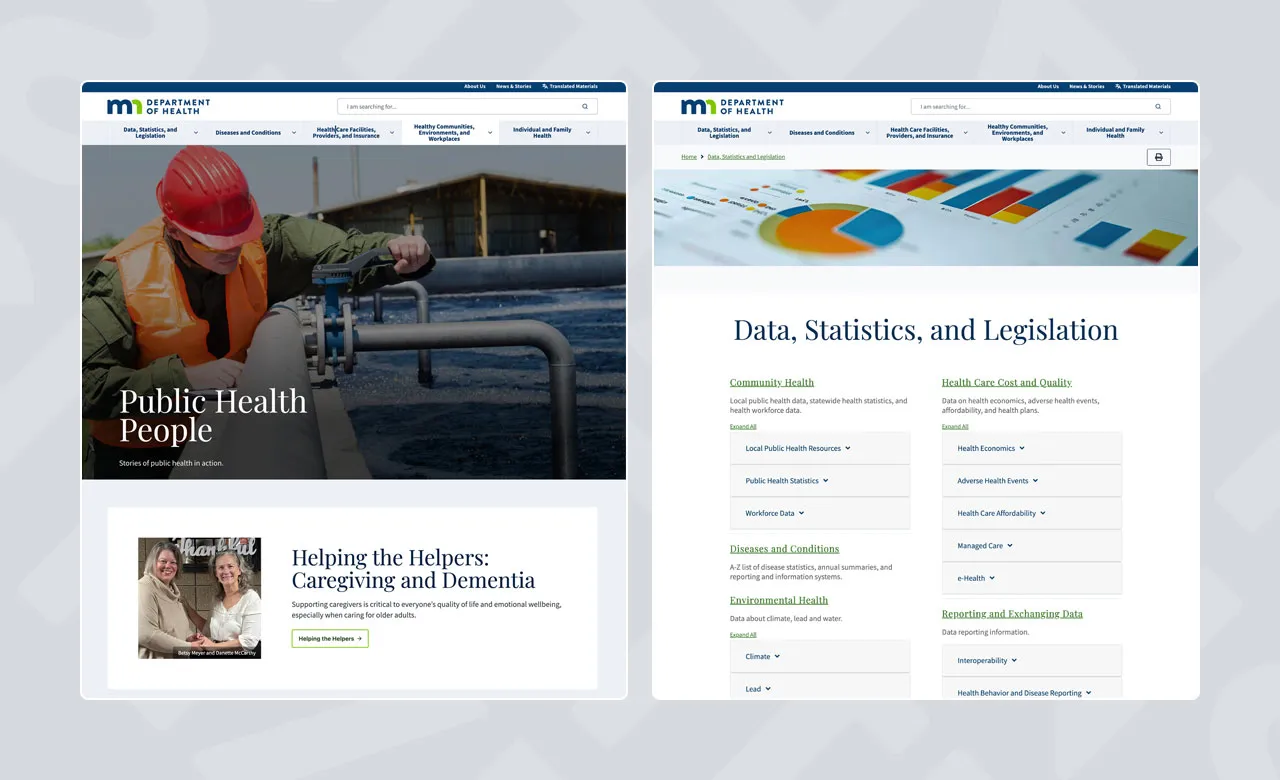
The Minnesota Department of Health (MDH) is Minnesota’s principal public health agency. Its public-facing website is one of the state’s most consequential digital properties, serving Minnesota residents, healthcare providers, local public health agencies, and policymakers — reaching audiences with everything from disease surveillance data and licensing information to guidance during public health emergencies.
MDH’s website is built and managed internally on Drupal. The department first came to Electric Citizen (EC) after beginning a new site design with another vendor, looking for targeted design refinements to improve legibility, consistency, and accessibility. What began as focused design help has evolved over several years into a long-term Drupal partnership: technical audits, editorial workflow refinements, ongoing support, a homepage and navigation redesign, and a new architecture that positions MDH to launch dedicated microsites for high-visibility public health initiatives.
About the project
Challenge
MDH came to Electric Citizen partway through a site redesign begun with another vendor. The visual direction had been established, but the department was looking for improvements that would make the site more legible, more consistent, and better suited to the web — particularly given the scale and complexity of its content. The site itself was built and managed internally on Drupal, and as usage grew, MDH’s needs expanded: clearer navigation patterns and improved information hierarchy, greater design consistency and accessibility, a structured evaluation of the existing Drupal build, recommendations for configuration and content architecture, and ongoing technical support to ensure stability and maintainability. Rather than pursuing another full redesign, MDH chose a measured, incremental approach focused on improving what already existed.
Solutions
Electric Citizen’s engagement with MDH has unfolded in phases, deepening over time.
We began with targeted design and UX refinements — refining typography, improving contrast and accessibility, clarifying navigation behavior, and standardizing layout patterns. These adjustments improved legibility and consistency while respecting the broader visual direction already in place.
As the partnership deepened, we conducted a structured audit of the Drupal build, design implementation, and accessibility posture — reviewing modules, configuration, content types, Views, taxonomies, permissions, and workflows; analyzing navigation structure and template consistency; and evaluating the site against WCAG 2.1 AA. From this audit we implemented configuration improvements, accessibility updates, editorial workflow refinements, and enhancements to key components — strengthening the technical foundation of the site.
Following that audit and improvement work, MDH engaged EC as an ongoing Drupal support partner. This structured engagement covers advanced Drupal development support, contributed module updates and security patches, QA and accessibility testing, feature and configuration improvements, and ongoing consulting and best-practice guidance. The model lets MDH continuously improve the site without large, disruptive overhauls.
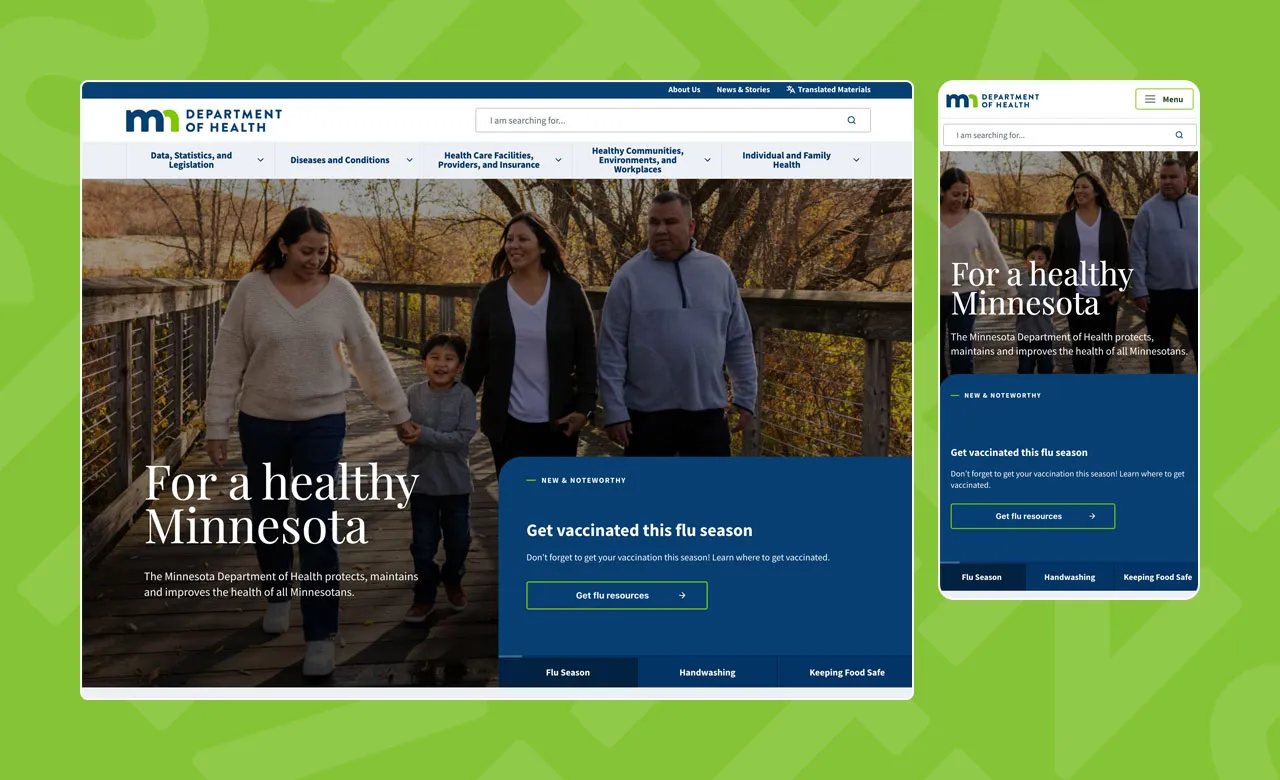
Building on the insight gathered over years of working with the site, MDH later asked EC to revisit the homepage and primary navigation. We developed a revised sitemap to clarify audience pathways and improve information hierarchy, followed by updated homepage wireframes and visual mockups aligned with MDH branding and accessibility standards. The approved design introduced a refreshed homepage experience and refined global navigation — modernizing the user experience while preserving platform stability.
Current initiatives (in progress)
Two significant initiatives are underway as of early 2026:
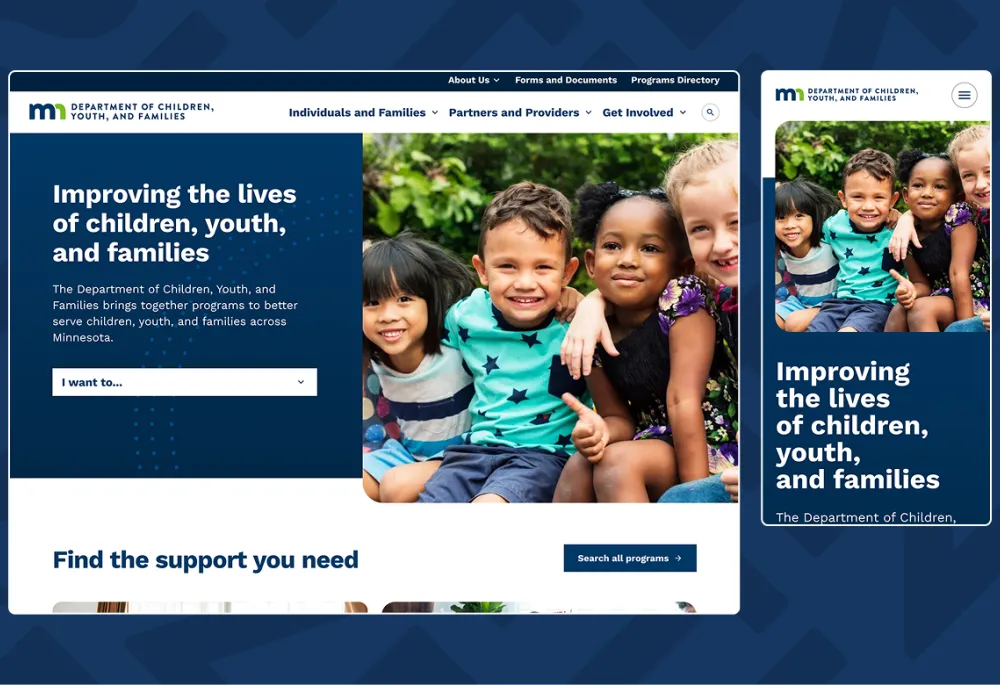
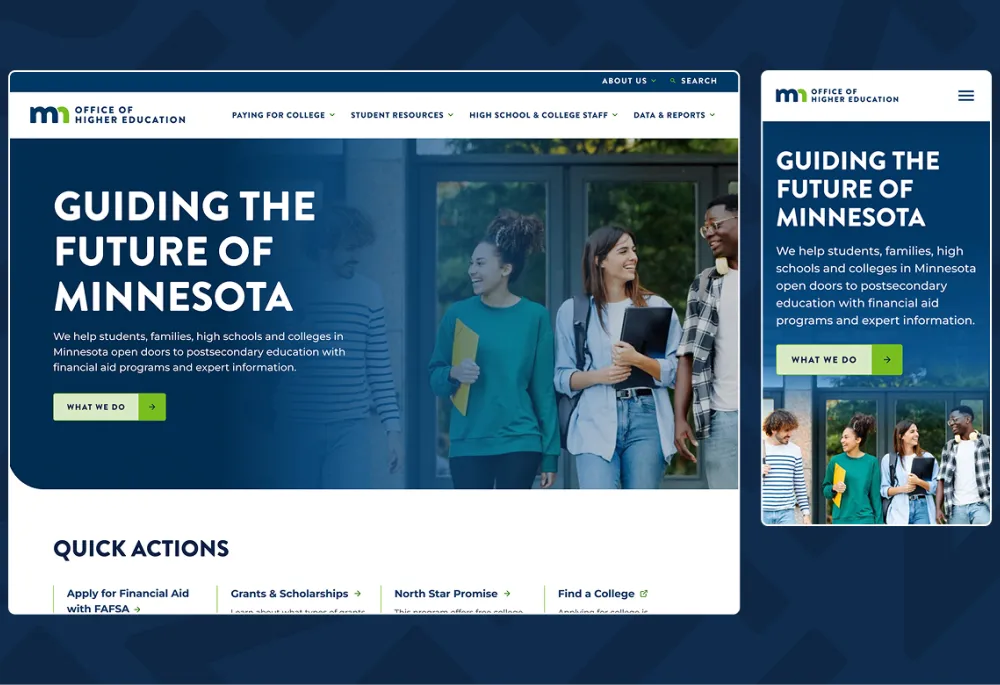
- A new base build for cloneable microsites — EC has developed a Drupal “base build” that MDH can clone to quickly spin up focused microsites for specific public health initiatives. The final deployment approach — multi-site, subsites within a single install, or independent installs — is being finalized based on MDH’s operational needs. What’s built is a repeatable foundation that gives new microsites design and technical consistency without duplicating the underlying build work.
- A dedicated site for Minnesota’s 988 mental health crisis hotline — EC is serving as lead development team on a new Drupal site for the 988 hotline, applying MDH’s evolving Drupal architecture and accessibility standards to a site specifically designed to serve people in mental health crisis and the people supporting them.
Outcomes
Through a phased and collaborative modernization strategy, MDH has strengthened both the usability and technical resilience of its public health website. The site benefits from improved design consistency and legibility, clearer navigation and information hierarchy, stronger accessibility alignment, a more maintainable Drupal architecture, ongoing security and stability, and a scalable foundation for new public health initiatives. What began as targeted design refinements has grown into a durable, strategic partnership — supporting one of Minnesota’s most critical public-facing digital platforms and positioning the department to respond to emerging public health needs with its own dedicated digital resources.
Why Drupal was chosen
MDH was already running on Drupal when Electric Citizen joined the engagement. The question wasn’t whether to stay on Drupal — it was how to strengthen and evolve the existing Drupal foundation while continuing to support the department’s growing digital needs. Drupal has continued to be the right platform for several reasons:
- Content scale and structure — MDH’s site spans disease surveillance data, licensing and regulatory content, public health emergency response, program pages, and news across dozens of practice areas. Drupal’s mature content modeling, taxonomy, and entity reference capabilities handle this kind of large, structured content ecosystem cleanly.
- In-house maintainability — MDH manages the site content with an internal team. Drupal’s role-based permissions, reusable components, and open documentation support a team building and maintaining a site of this scale without vendor lock-in.
- Accessibility — As a public agency serving residents with varied abilities, devices, and access needs, accessibility is essential — especially during public health emergencies. Drupal’s accessibility-focused core and admin experience support sustained WCAG 2.1 AA compliance.
- A base for repeatable spin-off sites — Drupal’s architecture supports the kind of “base build” MDH now uses to spin up dedicated sites for specific public health initiatives, giving the department a consistent foundation without duplicative build work.
- Sector fit — Drupal is broadly adopted across U.S. state and local government, which means proven patterns for multi-audience public agency sites and a large community of developers, agencies, and contributed modules who understand the space.
- Open source and sustainability — No licensing costs, a large contributor community, and a clear long-term roadmap make Drupal a sustainable choice for a public agency with a multi-decade horizon.
Technical Specifications
Drupal version:
Key modules/theme/distribution used:
MDH’s site is large, complex, and internally managed — spanning public health data, licensing, program information, news, and emergency response content across many practice areas. Getting the editorial experience right is central to a site of this scale. Paragraphs and Layout Builder give editors a flexible, component-based authoring model with higher-level layout control where it’s needed. Media Library centralizes image and asset management across the site’s distributed editorial teams. Content Moderation and Workflows support publishing states and editorial oversight across the many staff members contributing to the site.
For a site the size and public-visibility of MDH’s, URL management and discoverability are also first-class concerns. Pathauto keeps URLs consistent and human-readable across large content sets, while Redirect manages inbound links as content evolves. Metatag and Schema.org Metatag support SEO and structured data for a public agency site where residents may arrive through search engines during moments of urgent need — particularly during public health emergencies. Site search itself is delivered by an embedded Google Programmable Search Engine, keeping ongoing search infrastructure lightweight.
The Gin admin theme rounds things out with a cleaner, more accessible editing experience for MDH staff managing the site day to day.