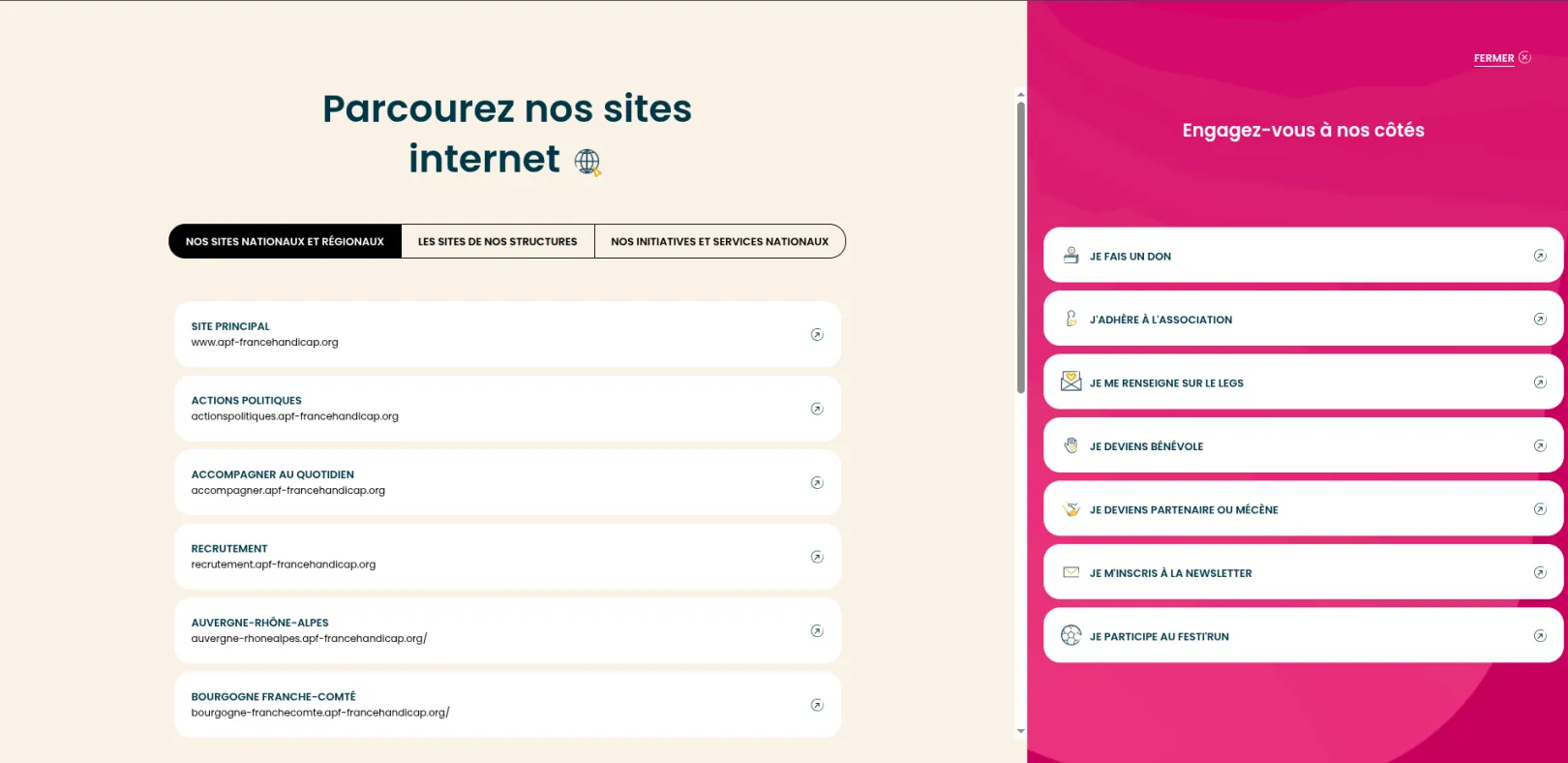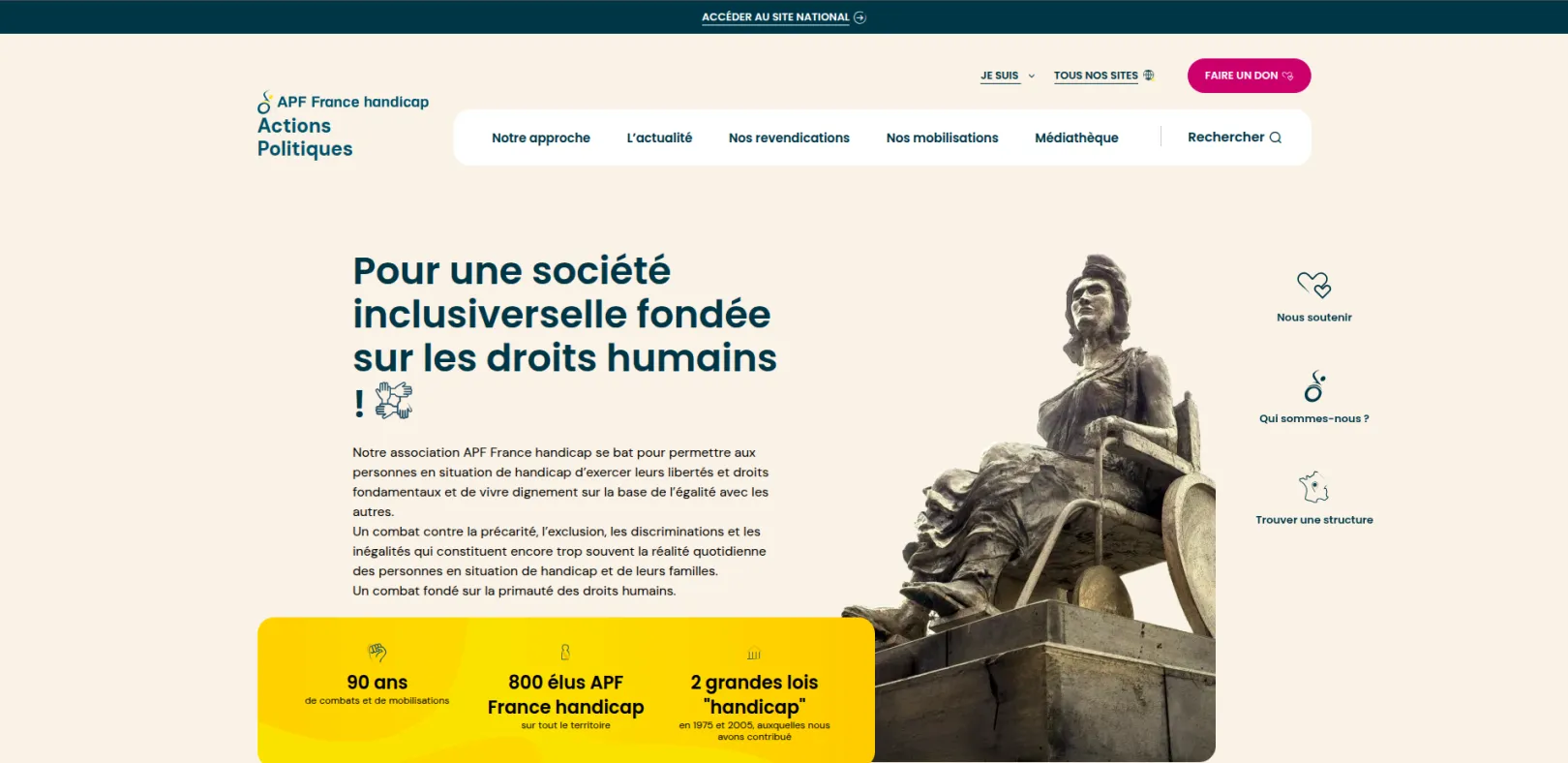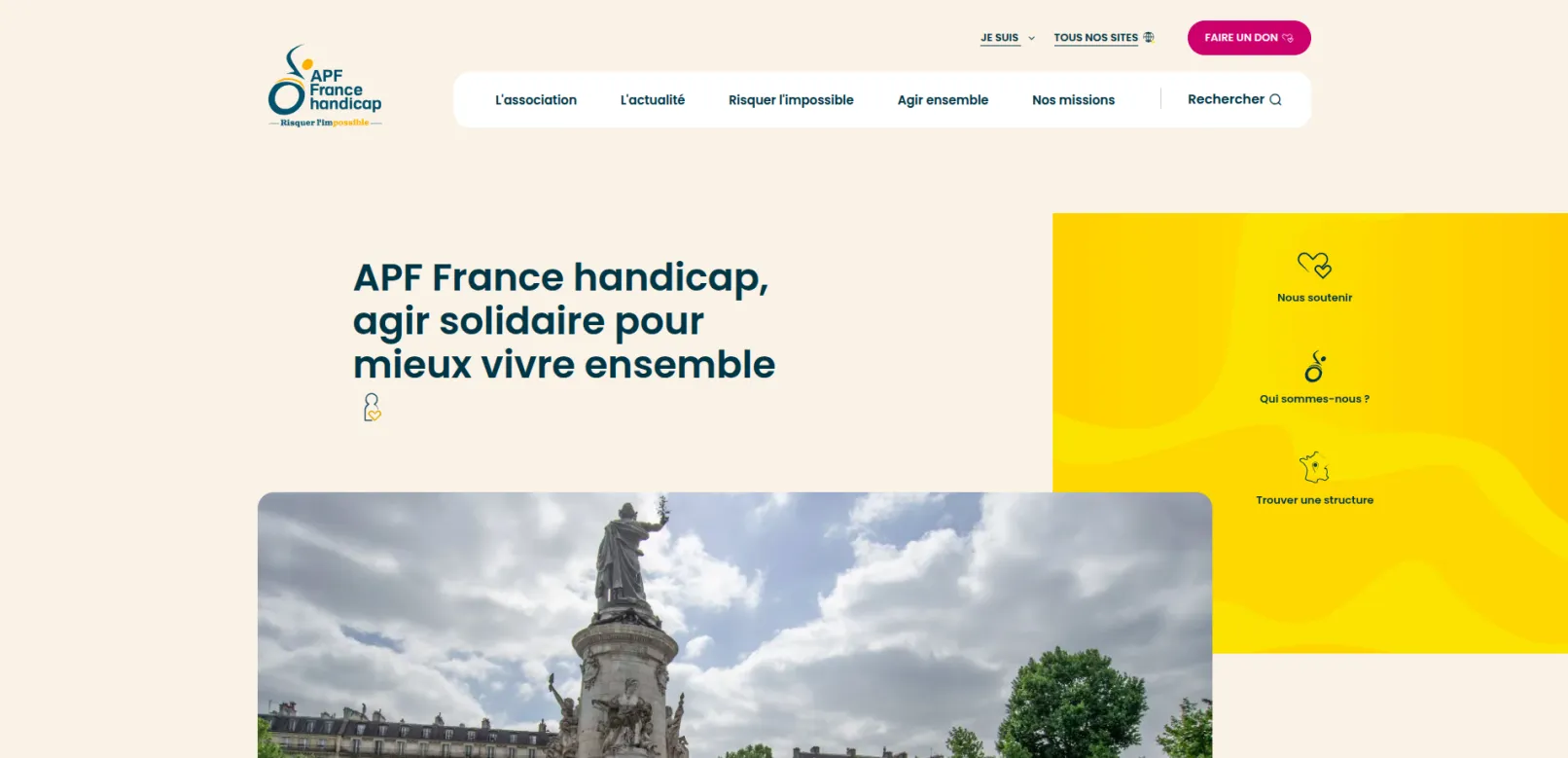
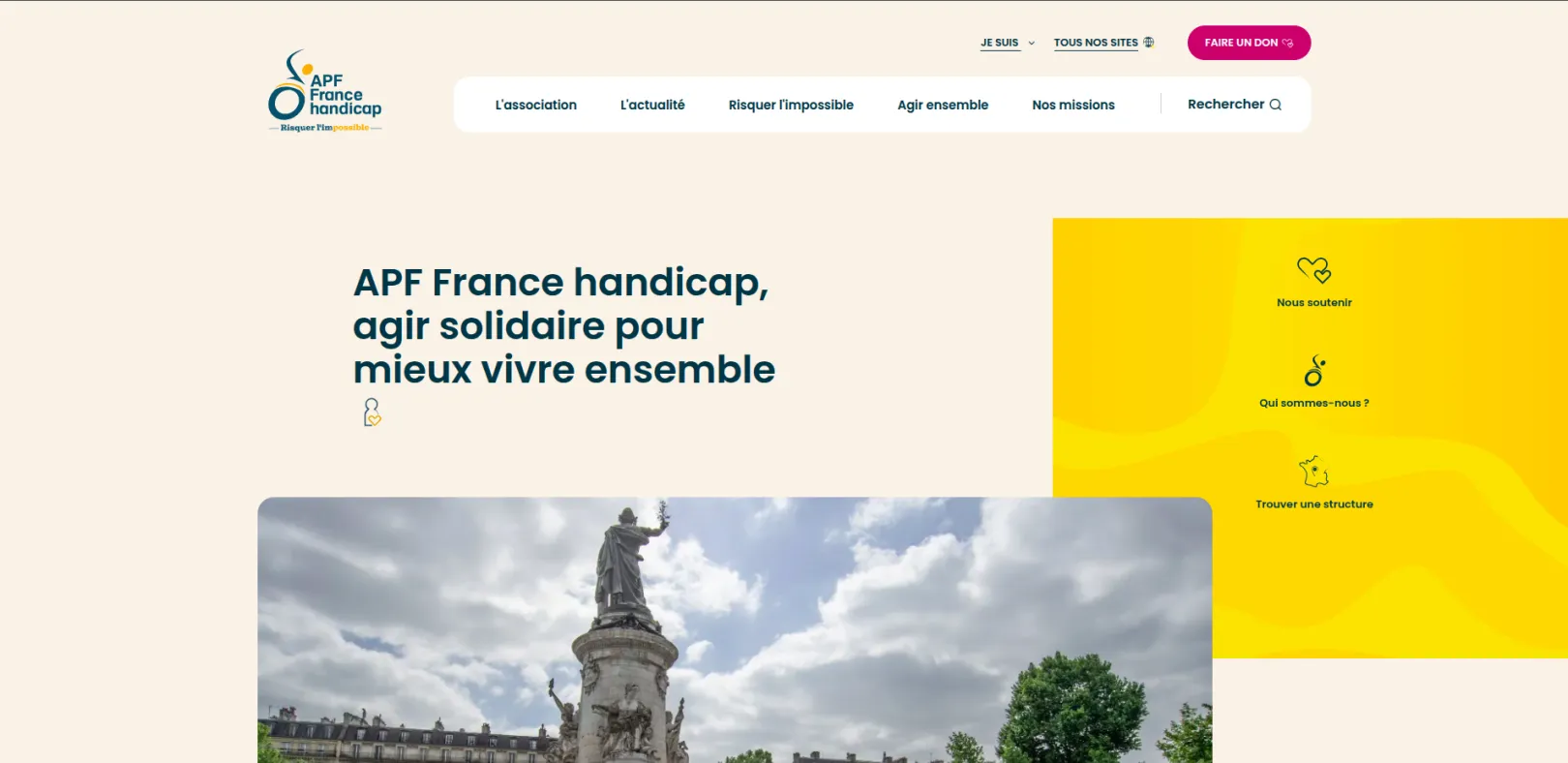
APF France Handicap is a government-recognised public interest organisation advocating for the rights, inclusion and participation of people with disabilities in France. Its network spans the entire French territory through four structure types: national sites (institutional website, recruitment, policy initiatives), regional sites, delegations and establishments, totalling more than 400 structures.
With a fragmented web estate spread across multiple platforms and a legacy CMS, the organisation needed a unified digital platform capable of delivering a consistent experience at scale while preserving the editorial autonomy of each local structure.
ecedi, a digital agency specialising in open source solutions and part of the Ctrl-a group, led the redesign using Drupal. The project delivered a site factory managing 400+ sites from a single shared codebase, with an accessibility score of 87% measured across the entire estate following a third-party audit.
About the project
Goals and requirements
The project aimed to replace a fragmented web estate with a unified site factory capable of hosting 400+ structures across four types: national (institutional site, recruitment, policy initiatives), regional, delegation and establishment. Each structure required its own subdomain, independent content management and personalised appearance, while sharing common templates, components and layout rules.
Key requirements included:
- Consistency per structure type, with tailored templates for each of the four network levels;
- Visitor navigation between structure types, from national sites down to individual establishments;
- An administration interface accessible to non-technical webmasters, often volunteers;
- Centralised maintenance with updates applied across all sites simultaneously;
- Accessibility built into the design, not added as an afterthought.
What makes this project special
APF France Handicap's mission is the inclusion of people with disabilities. Delivering a digitally accessible platform for an organisation of this nature carries particular significance. Accessibility was integrated from the design phase across page architecture, components and editorial tooling, then validated through an independent third-party audit whose recommendations were fully addressed.
The domain-based multisite approach also solves a specific challenge: shared content across domains with per-domain filtering. Job listings, for example, are managed once at the network level and automatically scoped to each site's context, reducing editorial overhead without sacrificing relevance.
Outcomes and results
Accessibility score of 87% across all sites, measured following a third-party audit.
Technical creation of a new site in 5 to 10 minutes, excluding menu customisation and content completion.
- 400+ sites managed from a single codebase, replacing a heterogeneous estate of independently hosted sites;
- Updates deployed simultaneously across all sites from a single central point;
- Maintenance costs reduced through infrastructure and codebase consolidation;
- Accessibility improvements applied network-wide in a single intervention, rather than site by site;
- Local webmasters empowered to manage their sites independently, with reduced training and support requirements;
- Consistent visitor navigation across all four structure types.
Why Drupal was chosen
The existing setup consisted of a legacy Drupal site alongside a fragmented landscape of local sites running on various platforms. Consolidating 400+ structures onto a single, manageable platform required a solution with proven multisite capabilities, a flexible content architecture, and a robust permissions model.
Drupal was selected for the following reasons:
- Native multisite architecture : Drupal's domain-based multisite approach allows all 400 sites to share a single codebase, configuration and module set. Any update deployed centrally propagates immediately across the entire network, with no per-site intervention required.
- Shared content across domains : Certain content types, such as job listings, are administered once and displayed across all sites with automatic domain-based filtering. This eliminates editorial duplication while keeping content contextually relevant for each visitor.
- Structured editorial framework : Drupal's reusable components, content types and page templates provide a consistent structure for local webmasters (often volunteers with no technical background) without restricting their editorial freedom.
- Granular roles and permissions : Access rights are defined per profile: contributor, site manager, national administrator. Each user sees only what is relevant to their role, reducing errors and lightening the central support workload.
- Open source alignment : Both APF France Handicap and ecedi share a strong commitment to open source and sustainable digital practices. Drupal, widely adopted by public and non-profit organisations, aligns naturally with these values.
Technical Specifications
Drupal version: