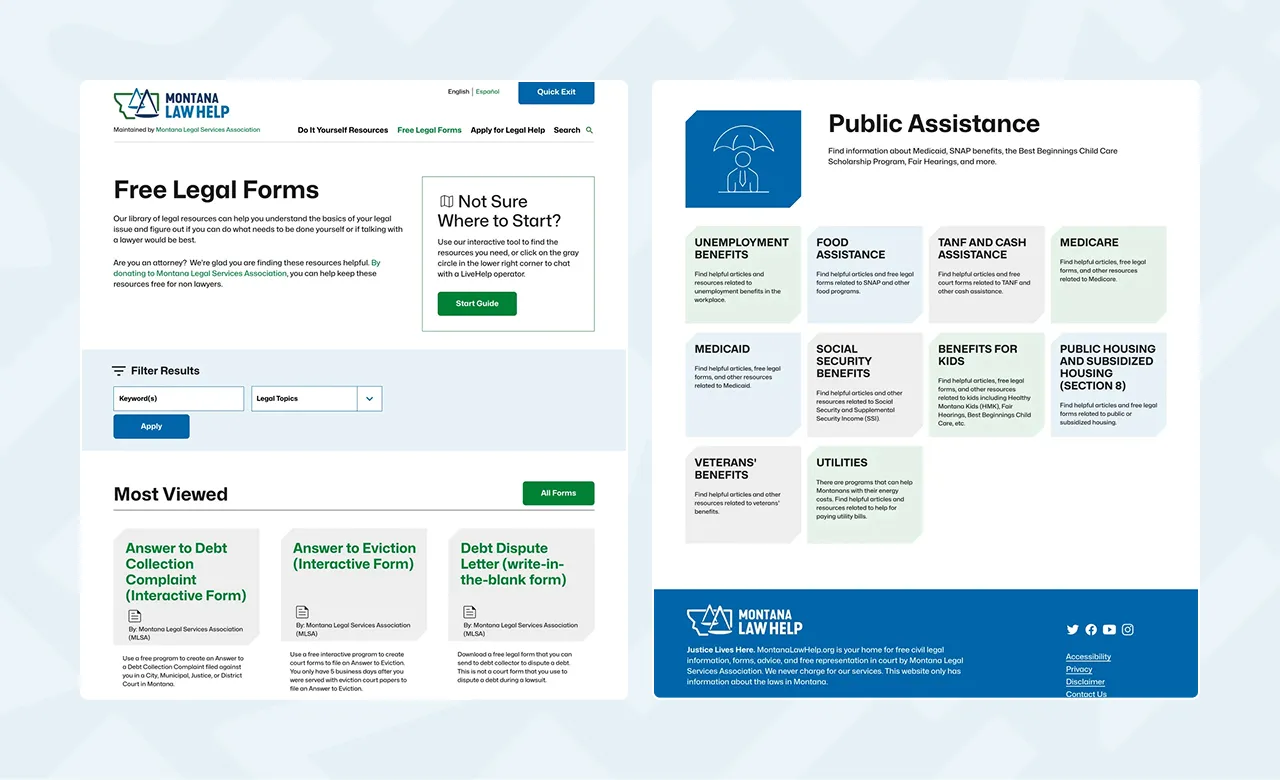
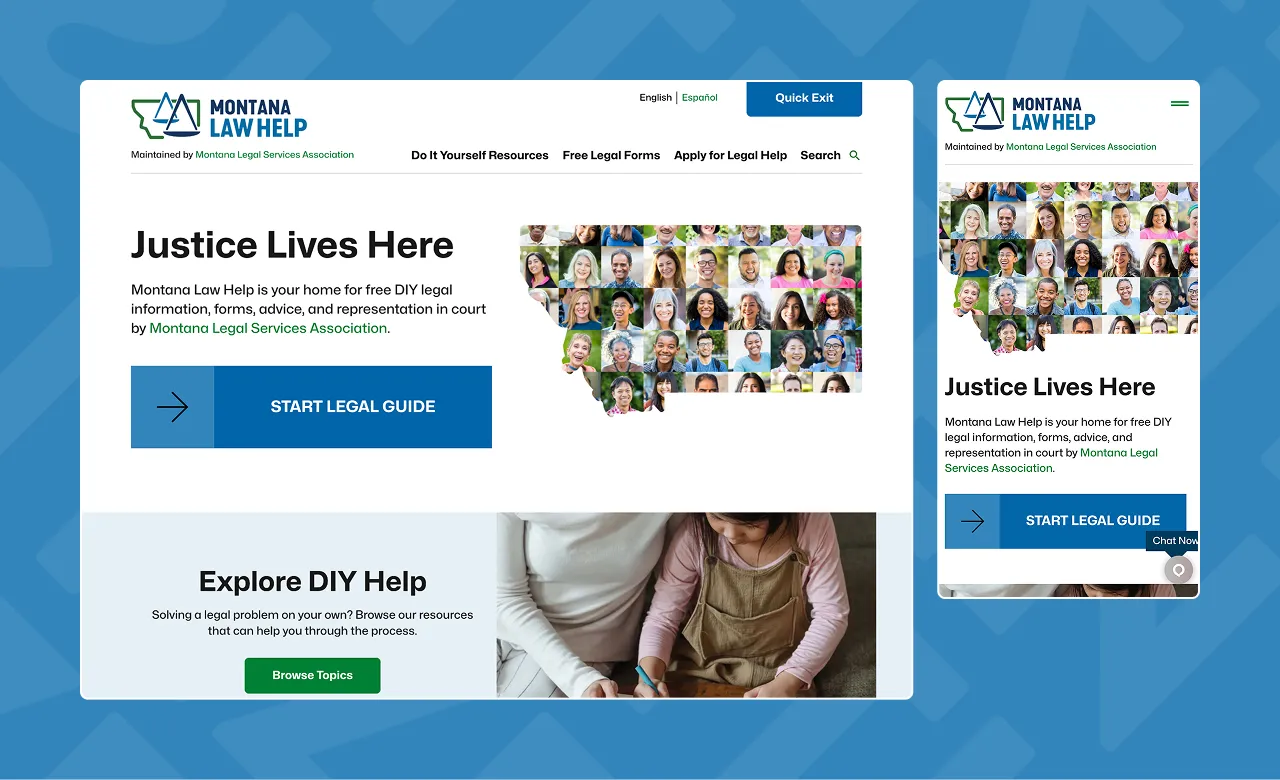
Montana Legal Services Association (MLSA) is a nonprofit legal aid organization that provides civil legal services to low-income, disadvantaged, and vulnerable Montanans across the state. Montana Law Help is its primary public-facing website — the front door for Montana residents seeking legal information, self-help resources, and pathways to legal aid on issues ranging from housing and family law to consumer protection and access to benefits.
The existing site had grown dated and no longer served its audience well. Navigation was hard to work through, the design felt tired, resources were difficult to browse, and the CMS lacked the editorial tools MLSA’s team needed to keep the content current. MLSA engaged Electric Citizen for a full redesign and rebuild on Drupal — with new information architecture, multilingual support, an interactive legal triage tool, and a modern editorial experience.
About the project
Challenge
MLSA’s team was looking for a change. They wanted a site that could offer a better user experience for site visitors — from a fresh design and improved navigation to multilingual content and an interactive tool that could guide people through their legal situations. On the technical side, they were looking to upgrade their CMS to one with better editorial tools for managing a large library of legal resources on an ongoing basis. And because the audience is low-income and often first-time users of legal aid, none of it would work unless it was designed and tested for the people who actually need it.
Solutions
Electric Citizen partnered with MLSA on a full site redesign and rebuild organized around discovery, design and content strategy, technical build, and user testing.
We began with discovery — stakeholder interviews and strategic workshops covering goals and audience needs, followed by user testing to inform a new site navigation before it was finalized. From there, we planned the technical build, including a “legal triage” tool that would let users interactively work through their legal situations to find relevant resources, and mapped out a plan to migrate existing site content over to Drupal.
A new visual design was developed, building on MLSA’s existing brand and leaning into more human-centered imagery, while emphasizing clear pathways for users to take action. Through content strategy and information architecture, we took a large volume of existing legal resources and re-categorized them into a new set of taxonomy terms that visitors could browse on their own — replacing an unclear structure with clear ways to find help.
On the technical side, we built the site on Drupal with full English and Spanish multilingual support using Drupal core’s Content Translation and related modules. Site search is powered by Search API and Search API Solr, letting visitors find resources quickly across a large content base. The legal triage tool is a hybrid Drupal + Vue.js implementation: MLSA editors manage the tool’s content in Drupal, while the tool’s interactive logic and output are delivered by a Vue.js front end that reads from Drupal. For content migration, we used the Migrate suite to move structured content programmatically, with a portion of the content reviewed and re-entered manually so the team could clean it up as part of the move.
Before launch, our team conducted user testing with Montana residents in the site’s target audience, adjusting the tools and content based on their feedback to improve understanding — a small-but-important step that shaped how the finished site actually works for the people who need it.
In the client’s words:
“EC is great to work with… they take the time to learn the language of the project… and try to speak in a way that people not in web development can understand.” — Mel Fisher, MLSA
Outcomes
The new Montana Law Help launched to positive feedback from MLSA staff and Montana residents alike, and was recognized with multiple web design awards in 2024. The site now delivers a large library of legal resources through clear taxonomy-driven navigation, provides English and Spanish content from a single unified site, and includes a modern interactive tool that meets users where they are — while giving MLSA’s editorial team the modern authoring experience they were missing on the previous platform. Electric Citizen continues to support the site today.
Why Drupal was chosen
MLSA came into the engagement looking to move off Pro Bono Net’s CMS — a legal-aid-sector-specific platform that many statewide legal aid organizations have historically used — to a more flexible, general-purpose platform better suited to a modern, multilingual, resource-heavy site. Drupal was the right fit for several reasons:
- Content scale and structure — Montana Law Help serves as a large, structured library of legal resources organized by topic, situation, and audience. Drupal’s mature content modeling, taxonomy, and entity reference capabilities are well suited to a resource site of this shape.
- Multilingual out of the box — With English and Spanish support required, Drupal’s core multilingual system — Content Translation, Configuration Translation, Interface Translation, and Language — provided the foundation for delivering both languages from a single site with a single editorial workflow.
- Editorial flexibility — MLSA’s editorial team needed a CMS that let them create, update, and translate content without custom development for every change. Drupal’s component-based authoring model supports that.
- Interactive tools without a rewrite — Drupal is well suited to sites that combine editorially-managed content with modern JavaScript front ends. The legal triage tool’s content lives in Drupal while its logic and output are delivered by a Vue.js front end — a hybrid pattern Drupal supports cleanly.
- Accessibility — As a legal aid site serving disadvantaged residents on the devices they actually have, accessibility was essential. Drupal’s accessibility-focused core and admin experience support sustained WCAG compliance.
- Sector fit — Drupal is widely adopted across nonprofits and legal aid organizations (including the LawHelp network of statewide legal aid sites), which meant proven patterns for resource libraries, multilingual content, and self-help tools.
- Open source and sustainability — No licensing costs, a large contributor community, and a clear long-term roadmap make Drupal a sustainable choice for a nonprofit with a long-term mission.
Technical Specifications
Drupal version:
Key modules/theme/distribution used:
Montana Law Help is a large resource library in two languages, so multilingual support and content organization were central to the build. Drupal core’s Content Translation, Configuration Translation, Interface Translation, and Language modules provide the foundation for delivering English and Spanish content from a single site and a single editorial workflow — rather than fragmenting into parallel sites per language. Pathauto keeps URLs consistent across languages and taxonomies, while Redirect protected SEO equity and inbound links through the migration from Pro Bono Net.
Editorial flexibility is the other half of the story. Paragraphs and Layout Builder give MLSA’s editorial team a flexible, component-based authoring model with higher-level layout control where it’s needed, and Media Library centralizes image and asset management. The Gin admin theme provides a cleaner, more accessible authoring experience for MLSA staff than Drupal’s stock admin.
For content migration, the Migrate suite — Migrate Plus and Migrate Tools alongside core — provided the scaffolding to move structured content into Drupal programmatically from Pro Bono Net’s CMS, with a portion of the content re-entered manually so it could be reviewed and cleaned up as part of the move.
The site’s two most distinctive features are its search and its interactive triage tool. Search API and Search API Solr power fast, filterable search across a large legal resource library, so visitors can find what they need across topics, situations, and audiences. And the legal triage tool is a hybrid implementation: content is managed by editors in Drupal, while the tool’s interactive logic and output are delivered by a Vue.js front end that reads Drupal content via JSON:API — giving MLSA the best of both worlds, a modern interactive experience for visitors and a familiar, structured content model for the people maintaining the tool over time.
Metatag and Schema.org Metatag round things out with SEO and structured data for a public legal aid site whose audience often arrives through search engines during moments of urgent need.